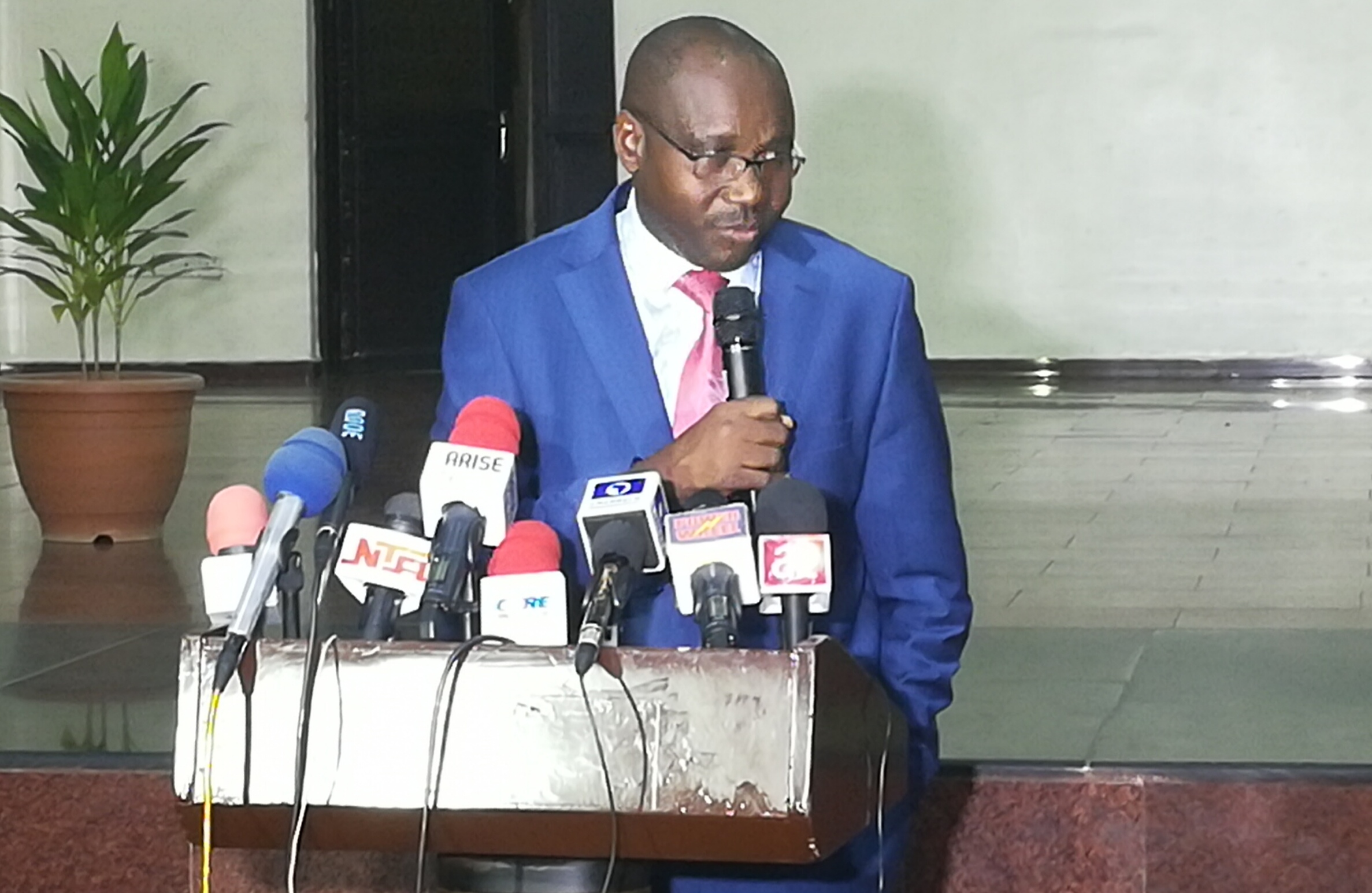
The Managing Director of the Transmission Company of Nigeria (TCN), Usman Gur Mohammed, has disclosed the installation and commissioning of at least 68 power transformers across the country in 2019 just ended.
He said that the company which used its in-house engineers to execute the projects, saved the Federal government colossal sum of money which would been expended on contractors who would even delay the project if not adequately monitored.
Mr. Mohammed who doubles as the Chairman of the West Africa Power Pool (WAPP), further explained his rational for consistent advocate for the recapitalization of the power Distribution Companies (DisCos), saying that it was to upgrade DisCos facilities to make the efficient to deliver transmitted energy to the end users.
He spoke in an interview during which, he commented on wide range of issues in power transmission and distribution.
On power transformers, he said that most of them installed and commissioned are 60MVA capacity and above
According to him, “I can tell you from 2017 to October this year, we have installed and commissioned 68 power transformers across the country and the least among them is the 30MVA transformer installed in Gombe. The rest of them are 60MVA and above. It’s no longer business as usual, any contractor that refuses to do what he is supposed to do, we cancel the contract and take over the job by ourselves and complete it.
” When we did the last simulation of the grid which was in December 2018, the grid moved from 5,500 to 8,100. Our intention is to reconductor and build more transmission lines. There are some areas where we have high transformer capacity but the line that will give them power is not adequate. We are going to reconductor such lines.
“We used in-house capacity to install and commission over 68 power transformers nationwide, recovered 790 out of over 800 containers that were stranded in the Ports, some of them for over 10years.”
On need for recapitalization of the DisCos, he said it is meant to enhance their ability to provide PrePaid meters and efficiency in delivering power transmitted to ultimate users.
According to the TCN Managing Director, “We are connected to the DisCos and so protection is very important. Out of the 738 interface connections we have with the DisCos, only 421 have protection on their side. The remaining 317 have no protection.
“This means that fault in people’s house can easily hit TCN transformers and spoil it. The problem is how do you enforce mandatory building of injection substations when the DisCos don’t have money?
“So we need to re-capitalise the DisCos so that they will have funds to fix their network and provide meters that would reduce their aggregate commercial loss.”
The full text of the interview subject by subject reads as below:
Implementation of the 20-year Least Cost Transmission Master Plan In 2018 and the four year Transmission Rehabilitation And Expansion Programme (TREP).
When we came in 2017, transmission was the weakest in the power value chain, we needed to do something to remove TCN from that position. We quickly ensured that the 20year Least Cost Transmission Expansion Plan was completed and delivered in December 2017 by Messers Fitchner. We then came up with a 4 year plan out of the 20year plan which is the Transmission Rehabilitation and Expansion Programme (TREP).
TREP has the objective; to expand the grid to 20,000MW by 2023 and has a four point strategy: Frequency Control, establishing a functional Supervisory Control and Data Acquisition (SCADA), achieving Spinning Reserve, which is a key requirement for stability of the Grid and ensuring critical investments in Lines and Substations consistent with N-1 reliability criteria across the country.
On SCADA, we have done a lot of work and are gradually putting in place strategies that will enable us have a functional SCADA.
On the spinning reserve, we have procured 260MW, which is awaiting approval from the Nigerian Electricity Regulatory Commission (NERC). Presently, NERC is looking into funding it because spinning reserve is supposed to be financed by the Electricity Market.
On Critical investment in lines and substations, we used in-house capacity to install and commission over 68 power transformers nationwide, recovered 790 out of over 800 containers that were stranded in the Ports, some of them for over 10years.
For underperforming contractors, we took over some contracts and completed them using TCN staff. We also approached international donors and have so far raised $1.661b for investment in TCN, the projects are at various stages of implementation. Although we have worked very hard, we won’t say we have solved all the problems of transmission, but transmission is really not the problem of the power sector anymore, we have reversed that trend.
Evaluation of the Abuja Ring Project.
Abuja wheeling scheme project comprises five new substations in Abuja and a new 330kV transmission line supply route from Lafia to Abuja. TCN staff completed all the studies before the contract was awarded. Before now, contracts are awarded without completing all the studies but this time, we completed all the studies, paid the compensations for the Right of Way (RoW), before we launched the process. So the implementation of that project is on track. We are working to deliver the substations and a new transmission line supply route to Abuja which would make Abuja consistent with N-2 criteria in terms of 330kV transmission line.
Sustaining Frequency Control And The SCADA Implementation Process in 2019
We have achieved a significant level of stability as at today, all generators connected to the grid are now on free governor control mechanism. This is significant, but we still have the problem of matching demand and supply especially when it rains there is usually sudden drop in load because of the poor network of the DisCos.
On SCADA/EMS, we have also launched the procurement of Critical Optical Ground Wire (OPGW) for the few areas not covered under TREP. All our lines are going to have OPGW after which we will close all communication backbone to make it possible for us to have a functional SCADA. We have selected 15 staff of TCN and commenced training them extensively. We have sent them to Ghana, and sent a team to Brazil to learn how automation is done and have equally commenced the procurement of a Supervisory Consultant.
We have also finished the design for the control room; adapted the PJM model of one National Control Center with two Work Centers in Osogbo and Shiroro and they are going to work real time in synchronism. All these are in readiness for the launching of SCADA. We have also procured a contractor for the AMR (Automatic Meter Reading) which is also a component of SCADA. The implementation of the project is going on smoothly.
Transformers And Substations TCN Commissioned in 2019
I can tell you from 2017 to October this year, we have installed and commissioned 68 power transformers across the country and the least among them is the 30MVA transformer installed in Gombe. The rest of them are 60MVA and above. It’s no longer business as usual, any contractor that refuses to do what he is supposed to do, we cancel the contract and take over the job by ourselves and complete it. When we did the last simulation of the grid which was in December 2018, the grid moved from 5,500 to 8,100. Our intention is to reconductor and build more transmission lines.
There are some areas where we have high transformer capacity but the line that will give them power is not adequate. We are going to reconductor such lines.
Some of such lines include the recently launched Ikeja West – Alimosho – Ogba to Ota transmission line and we also want to do the Birnin-Kebbi to Sokoto and Ituaba to Itu line; the Onitsha – Awka, Awka – Oji River and the Kaduna-Zaria- Funtua lines among others. Once we reconductor these lines, we will recover significant capacity that had been limited.
Afterwards, we will simulate the Grid capacity again and this will clearly move our capacity well above 10,000MW. If you look at the recent study carried out by Ikeja and Eko DisCos, it vindicated our position that the transmission capacity is more than 8,100MW because according to the report, the operational capacity of the two business units is almost about 4,000MW, so we are looking at almost 25% of the capacity we have in Nigeria in Lagos, that means that what they have reported showed that we are far well ahead of what we projected.
The Need For Capitalisation Of Distribution Companies Of course, if you look at the current situation, transmission will continue to expand and will not wait for the DisCos because transmission infrastructure is more difficult and expensive to build and takes longer time than DisCos infrastructure. Many of the equipment used by Distribution are manufactured in Nigeria, but most transmission equipment are manufactured outside Nigeria and transmission infrastructures require bigger Right of Way (RoW) and that is very expensive.
We look at transmission as an enabler, and so anytime government takes a decision or distribution investors become serious, they can fix the DisCos. Nigerians will not get the benefit of transmission grid expansion if the DisCos are not fixed.
Secondly, we are connected to the DisCos and so protection is very important. Out of the 738 interface connections we have with the DisCos, only 421 have protection on their side. The remaining 317 have no protection. This means that fault in people’s house can easily hit TCN transformers and spoil it. The the problem is how do you enforce mandatory building of injection substations when the DisCos don’t have money?
So we need to re-capitalise the DisCos so that they will have funds to fix their network and provide meters that would reduce their aggregate commercial loss. The industry can only work well when all the players are working. Capitalization will lead to a situation where we have stronger companies with better management.
Increase In Capacity Of In-house Engineers and Better Service delivery
Engineering is about confidence. What we do is to give TCN engineers confidence to do their job and that is why they are doing things they haven’t done before. A few weeks to the election, we lost a 150MVA in Kano and mandated TCN engineers to fix the transformer before election. They successfully repaired and energized it two weeks before the election. In Ilashe, TCN engineers built a 132kV substation on an island on their own. We challenge our engineers, because that is the only way they can improve and become proficient. We had a 150MVA transformer that got spoilt in Asaba, before, we pay contractors to fix it but now, TCN engineers have almost completed the project. An Engineer that is not empowered cannot be innovative and be at his best, we are training them. We collaborated with APUA, and trained 306 engineers with National Power Training Institute (NAPTIN), we have conducted several hands-on in-house training and have equally had them trained in specialized areas. We plan to bring other experts to also train them. We are working very hard to ensure that we position the organization to deliver on its mandate in the power sector.
In 2020, we will continue to push our engineers to steadfastly implement TREP and emphasize massive training to enable us fix our challenges with limited recourse to third parties. We will build transformer repair workshops and the recently recruited 200 new engineers would start their pupilage programme where they will be mentored by other qualified engineers. We are working to see that all the projects that we have under TREP are implemented in a sustainable manner and we will keep pushing for the recapitalization of the DisCos. Recapitalization would move the power sector to sustainable growth and development. The power sector has to attract investment and the only way we can have investment is to ensure that it is sustainable, meaning every party is working with the regulator providing cost reflective tariff that is consistent with the position of ECOWAS. Presently, TCN is the only agency in the power sector that has adapted the investment regulation of NERC which requires all licenses to procure their equipment, supply and install them in a competitive selection process. We advertise all our procurement needs.
Update on TREP Implementation Of course, TREP is still on target, we are still on course because the implementation of TREP has not derailed, we are pushing ahead to ensure that we continue to stay on track. But we have the challenges of Right of Way and some of them require huge amount as compensation. The state governments are however giving us all the necessary support.
Chairmanship of WAPP and successes
WAPP is an Agency of ECOWAS that is financed by power utilities within member states. It’s the only agency that is not dependent on ECOWAS for financing and Nigeria has always played a critical role in the formation and management of WAPP. Under my leadership as a chairman of WAPP, we have done a lot of things that I can tell you.
Under my leadership, NAPTIN became Center of Excellence; we resolved the problem of the North Core Project that will build a 330kV double circuit line connecting Nigeria, Niger, Burkina Faso and Benin and we also established the implementation structure which is housed here in Nigeria. We successfully delivered the West Africa Power Market, which we launched in June 2018, with the ECOWAS Regional Electricity Regulatory Authority (ERERA) Chairman in Cotonu. We started the first stage, we are looking forward to the second stage.
We have also concluded the Generation and Transmission Master Plan for ECOWAS which was approved by the ECOWAS Heads of States in their meeting held in December 22nd 2018 and that master plan looks at expansion of Generation and Transmission infrastructure from 2019 to 2033. One of the priority programmes in that masterplan is the Eastern Backbone, which is the 330kV line that will start from Calabar – Ikom – Ogoja – Kashimbilla – Mambilla – Yola – Hong – Biu – Damaturu – Potiskum – Azare – Dutse and to Kano. That line will solve the problem of critical infrastructure to the North East because the area currently receives supply from one single circuit line from Jos to Gombe. In Cross River State, from Calabar to Ogoja is about 10hours, yet from Calabar to Ikom to Ogoja, there is no single transmission infrastructure.
This project will build 330kV Substation in Ikom and Ogoja. It is critical to enabling areas that are most neglected in terms of electricity in Nigeria. We are happy that this is part of WAPP priority project and are working tirelessly to ensure that it becomes a reality. We are equally working towards a situation where we can actually have a proper trading in electricity, where electricity can move from areas that have excess to places that do not have enough.
Nigeria can benefit from electricity trade because we can establish generation plants here and sell electricity to other countries. This will generate foreign exchange and employment. Under the new generation and transmission master plan of ECOWAS, a 330kV line will run from Nigeria to Senegal where the cost of Energy is very expensive and to other parts of West Africa.
Today, WAPP has achieved success in connecting 9 out of the 14 countries in West Africa. The remaining five will be connected when the new line between Coted’ivoire – Sierra-Leone – Liberia and Guinea is completed. Another line would be built from Senegal – Gambia – Guinea Bissau and to Mali. These lines will be completed next year, that means all the 14 countries will be connected. The new master plan will establish a 330kV line from Nigeria to Senegal which is also another significant achievement.
The Expectations From The Regional Market in 2020
The only way Nigerians can benefit from WAPP is for us to implement the ERERA Regulation. First of all, we have to allow, at this stage, bilateral contract to continue; allow people that generate electricity in Nigeria to sell to energy users in other countries in West Africa. That is the only way we can benefit from the market. If we allow government to operate the market, they will continue to subsidize electricity. From the position of WAPP, we are going to be pushing for the implementation of sustainable electricity market for WAPP, we are also going to push for the next stage of WAPP Electricity Market, which is a full liberalization of the electricity market in West Africa.















 Business News1 week ago
 News6 days ago
 News1 week ago