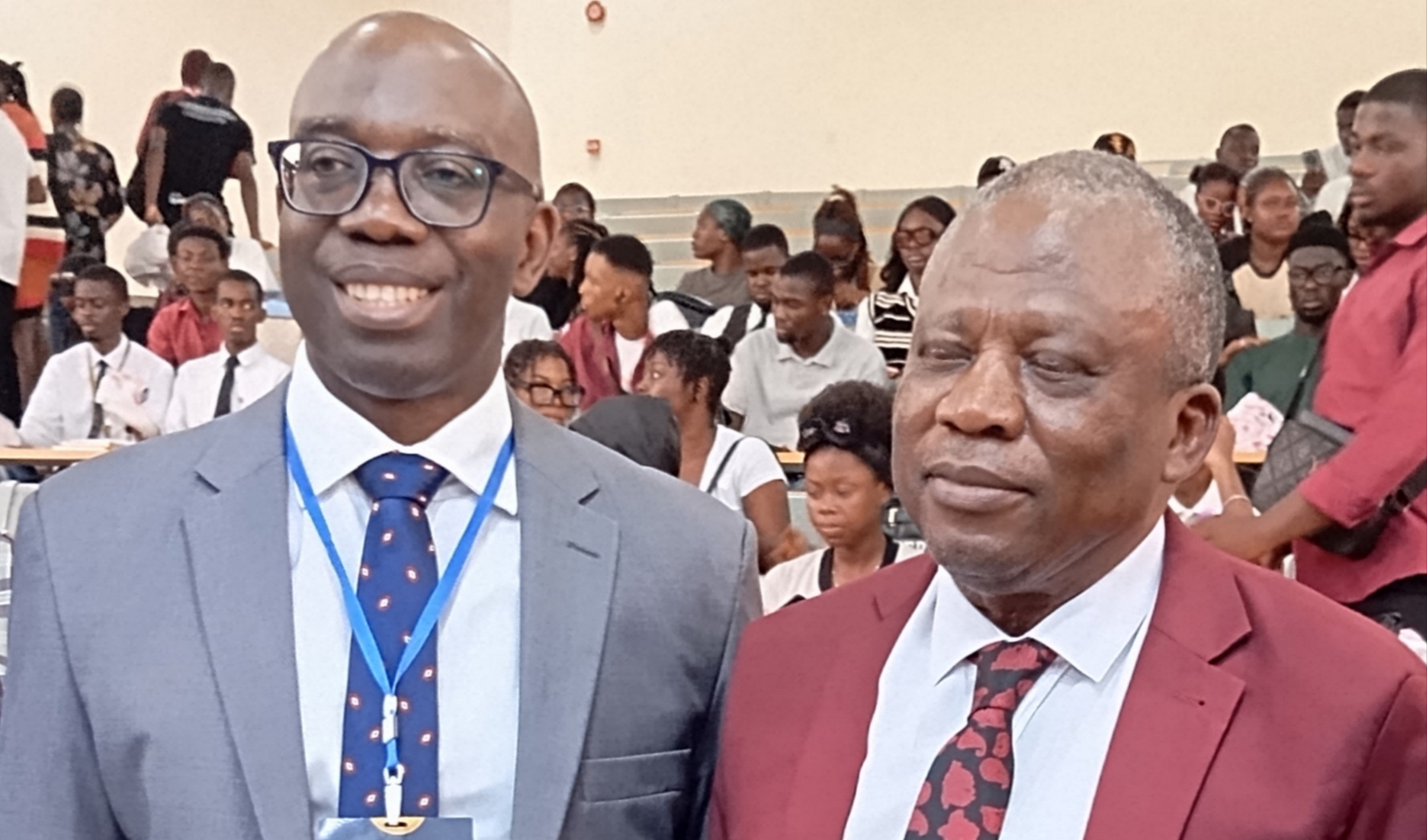
From left-Right: The Keynote speaker, the Nigerian Communications Commission (NCC) Secretary, Gwa Tobbie Mohammed, who representated the Chairman of the Commission and Professor Isaiah U. Ilo is a Professor, Department of Theatre Arts, University of Abuja, Director of Thesisprofs Academic Writing Consultancy, and creator of Thesis-Speedwrite.ai — a digital academic methodology ecosystem, during the launch on Thursday, 4th June, 2026. Photo credit: Optimum Times.
…As UniAbuja VC Advocates Framework To Support Students, Scholars On Responsible Use Of AI
The Nigerian Communications Commission (NCC), the University of Abuja and other scholars have officially launched the Thesis SpeedWrite, described as solution to the academic challenges associated with writing research works such as Projects, Dissertations, Thesis, Research Papers and Proposals.
Speaking at the launch at the University of Abuja as Keynote speaker Thursday, the Nigerian Communications Commission (NCC) Secretary, Gwa Tobbie Mohammed, who representated the Chairman of the Commission, applauded ThesisProfs team for the innovation.
He observed that the significance of Thesis-Speedwrite.ai lies in the problem it seeks to address.
Tobbie Mohammed, particularly noted that at a period when Artificial Intelligence is reshaping almost every sector of human endeavour, “it is encouraging to see Nigerian scholars not standing at the margins as passive consumers of imported technologies, but actively designing solutions that speak to our own academic realities.”
According to him, “This is not merely the unveiling of another digital platform. It is, in a deeper sense, a statement about the future of education, research, and technological innovation in Nigeria and across the African continent.
He said: “Across our universities, many students do not fail in research because they lack intelligence. More often, they struggle because they lack structure, direction, methodological clarity, and sustained academic support. Research writing has become, for many, a source of anxiety, delay, and frustration.
“This affects not only students, but also supervisors, departments, institutions, and the overall quality of knowledge production.
“This is why an innovation of this nature deserves attention. From what this platform represents, its strength is not in replacing the scholar, but in guiding the scholar. It seeks to support the research process from topic development, conceptual clarification, literature organization, methodological alignment, and academic drafting, to revision and scholarly refinement. That distinction is very important.”
He cautioned against the current abuse of Artificial Intelligence by most lazy individuals, saying “Artificial Intelligence must never become a shortcut around knowledge. It must not weaken originality, critical thinking, ethical judgement, or intellectual discipline. Rather, it should help scholars work with greater order, confidence, and productivity.
“The future of education will not belong to those who reject technology entirely, nor to those who surrender thinking to machines. It will belong to those who can use technology responsibly while preserving the dignity of human intelligence.”
NCC further urged policymakers, university leaders, and regulators, to begin to find solution to the current challenge.
“We must begin to think more seriously about responsible frameworks for AI-assisted learning and research. The question is no longer whether Artificial Intelligence will influence higher education. It already does. The real question is whether we will guide that influence with wisdom, ethics, and institutional responsibility.
Nigeria cannot afford to be left behind in this transition. Our universities must move from merely adapting to global technological change to participating actively in shaping it.
“We need home-grown academic technologies that understand our students, our supervision systems, our research challenges, our infrastructural limitations, and our aspirations for global competitiveness.”
Earlier on his part, the Vice Chancellor, University of Abuja, Professor Hakeem Babatunde Fawehinmi, said the launch of the Thesis SpeedWrite.ai represents
a contribution to one of the most urgent conversations in contemporary higher education: how can technology assist scholarship without weakening the discipline, originality, and responsibility that true scholarship requires?
According to the Vice Chancellor who was represented by Professor Kasim Musa Waziri, Dean, School of Postgraduate Studies, “This is where Thesis-Speedwrite.ai becomes particularly noteworthy.
“From what we have seen, the platform does not merely seek to generate academic text. Its deeper value lies in its attempt to guide students and researchers through a structured academic process. It emphasizes planning, logical development, literature engagement, methodological alignment, critical synthesis, and responsible academic writing. These are matters that remain central to credible research, whether technology is involved or not.
“As a university committed to research excellence, innovation, and national development, we recognize the importance of tools that can help reduce the confusion many students experience in research writing.
“Anyone familiar with postgraduate supervision knows that many students do not struggle because they lack intelligence. Often, they struggle because they lack structure. They are unsure how to move from topic selection to problem statement, from literature review to methodology, and from data to defensible argument. A system that helps to clarify this process, if used ethically and intelligently, can become a meaningful support to academic development.
“It is therefore important to commend Professor Isaiah U. Ilo and the Thesisprofs team for this initiative. Their work reflects vision, courage, and a serious awareness of the direction in which higher education is moving. It is also encouraging that this innovation is emerging from within our own academic environment.”
The Vice Chancellor however cautioned that “No digital platform, no matter how advanced, can replace deep reading, intellectual honesty, critical thinking, methodological discipline, and the patient labour of scholarship.”
He stressed that: “AI can assist the researcher, but it must not become the researcher. It can provide structure, but it cannot replace judgement. It can support writing, but it cannot substitute for originality of thought.
“This is why institutional guidance is very important. The future of scholarship will not belong simply to those who use technology, but to those who use it responsibly, ethically, intelligently, and creatively.
“Universities must therefore move beyond fear or blind excitement. We must build frameworks that help students and scholars understand how to use AI as a support system while preserving the integrity of academic inquiry.
“I believe that Thesis-Speedwrite.ai has the potential to stimulate important conversations around research methods instruction, postgraduate supervision, academic writing support, scholarly publishing, and digital capacity-building across African universities. Its value will be strongest when it is used not as a shortcut, but as a structured companion to serious academic work.”
Prof. Isaiah Ilo who is the Team Lead of the innovation, made an elaborate explanation on the use of Thesis SpeedWrite.ai .























 News1 week ago