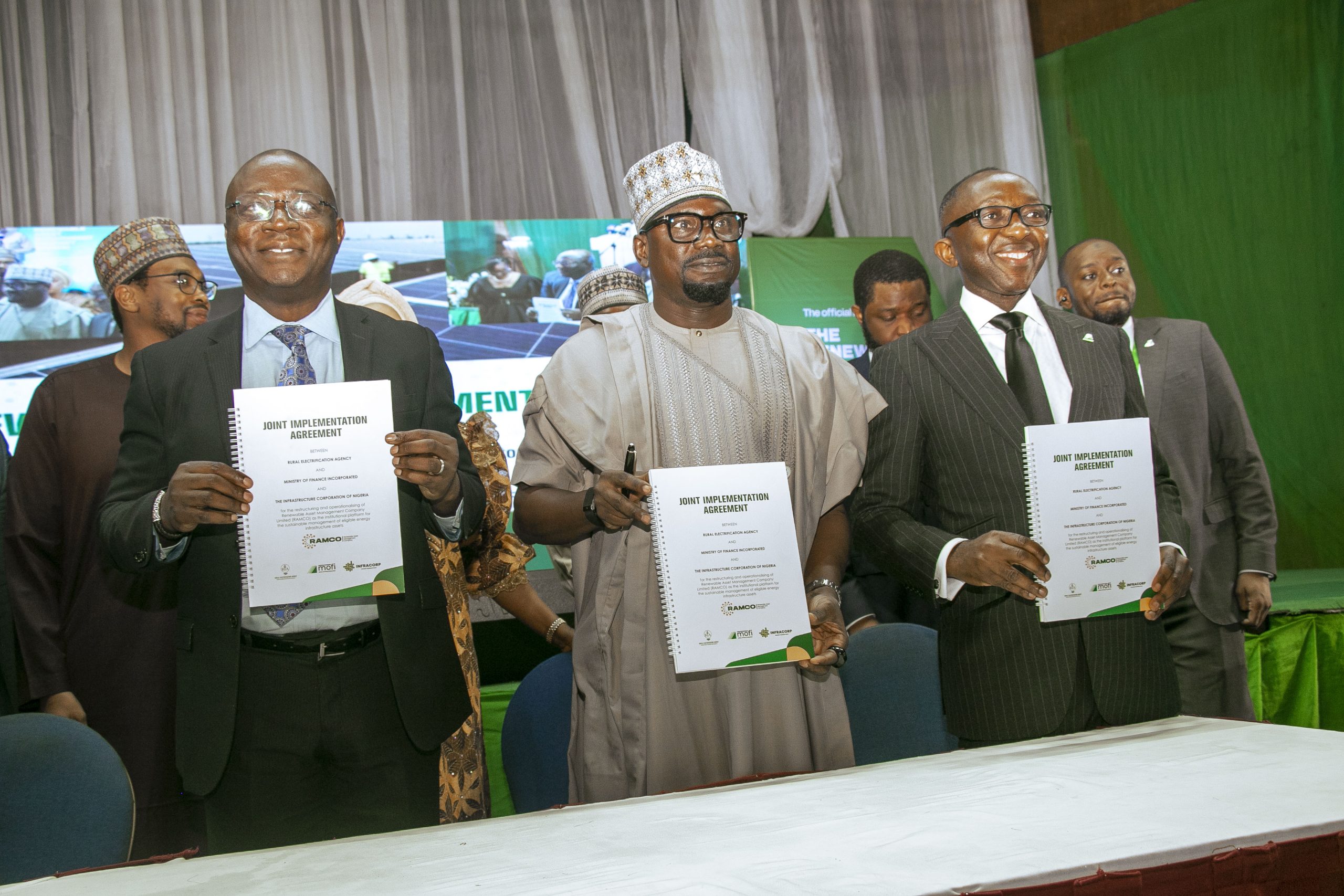
*L-R: MD/CEO InfraCorp, Dr Lazarus Angbazo; MD/CEO REA, Dr Abba A. Aliyu; and MD/CEO MOFI, Dr Armstrong Takang at the launch of RAMCO on Wednesday, August 26, 2026 at the TransCorp Hotel, Abuja.
…As REA, Others Launch RAMCO to Maintain, Sustain Assets
By Clement Nwoji
The Federal Government, World Bank and African Development Bank have within the past 9years (2017-2026), cumulatively deployed investments worth over N263 billion under Energizing Education Programme.
The Managing Director/Chief Executive Officer of the Rural Electrification Agency (REA), Dr. Abba Abubakar Aliyu, disclosed this while speaking at the official launch of the Renewable Asset Management Company (RAMCO) on Wednesday. The theme was Powering Sustainability -launching Nigeria’s Renewable Asset Management Company.
Providing further statistics, Dr. Aliyu explained that through the programme, REA deployed 82 Megawatts of solar-hybrid generation assets across 22 federal universities and three teaching hospitals equivalent to the amount.
In addition, he said: “more than 150 megawatts is either under construction or in the pipeline through TETFund, DARES, the National Public Sector Solarisation Initiative, subsequent phases of the Energising Education Programme, Desert to Power and other publicly financed programmes.
“Within the next three years, another 70 to 80 public institutions could be powered through assets implemented by REA. But there is another side to this story that we must be willing to say out loud.”
Regrettably, the REA Managing Director, said “We went back to assess the seven sites delivered under the first phase of the Energising Education Programme (EEP).
Of those seven, only three were in good or usable condition. At one institution, the required special-purpose vehicle had been established, but no revenue was being collected to maintain the plant Nigeria built world-class energy infrastructure and then watched part of it deteriorate-not because of engineering failure, but because we had not adequately institutionalised what happens after the ribbon is cut.
“There was no sustainable maintenance regime, no dependable revenue mechanism and, critically, no institution whose primary responsibility was to preserve those assets throughout their economic lives.”
He explained that this sad discovery of deteriorating renewable energy assets gave rise to the establishment of RAMCO as the institutional platform for managing Nigeria’s renewable energy infrastructure assets.
He noted that his predecessor developed the sustainability framework and secured the support of the Federal Ministry of Power for an asset-management vehicle (RAMCO).
“We have taken that good idea forward and are giving it the governance, partnerships and capital structure required to succeed.
“I say this deliberately because one reason public institutions struggle with sustainability is that we do not always finish what those before us began”, he declared.
Dr. Aliyu explained that from Nigeria’s pioneering mini-grids, to the Nigeria Electrification Project, to the Energising Education Programme, DARES and now RAMCO, REA is intentionally building an institution that learns, improves and continues-regardless of who occupies the leadership position.
According to him, RAMCO’s mandate include to manage publicly financed renewable-energy assets professionally; contract competent operators; meter, bill and collect; maintain sustainability reserves for major equipment replacement; and report transparently on asset performance.
“If a battery or inverter requires replacement in year eight, we should not return to the Treasury in year eight looking for emergency funding. The money should already be there.
“RAMCO is also not designed to extract profit from public institutions. Where government has fully funded the capital asset, that capital is already sunk. The tariff should therefore reflect what is required to operate, maintain and renew the system over its economic life.
“And RAMCO is certainly not another request for Treasury funding. Its purpose is precisely the opposite: to move the long-term sustainability burden away from repeated public appropriation and onto a commercially sustainable platform capable, over time, of attracting private capital”, he added.
He revealed that between 2012 and 2024, REA also invested approximately N135 billion in grid-extension infrastructure, 3,766 transformers and about 9,556 kilometres of network, stressing that infrastructure on this scale equally requires a sustainability culture if it is to continue delivering value.
On his part, the Chairman of REA Board and a former Governor of Ekiti State, Ayo Fayose, canvassed for attitudinal change by all in order to leave an enduring legacy to the next generation.
He called for involvement of youths in governance and administrative structures so that they will learn and pass on to other younger generations.


















 Business News6 days ago
 News1 week ago
 Business News1 week ago