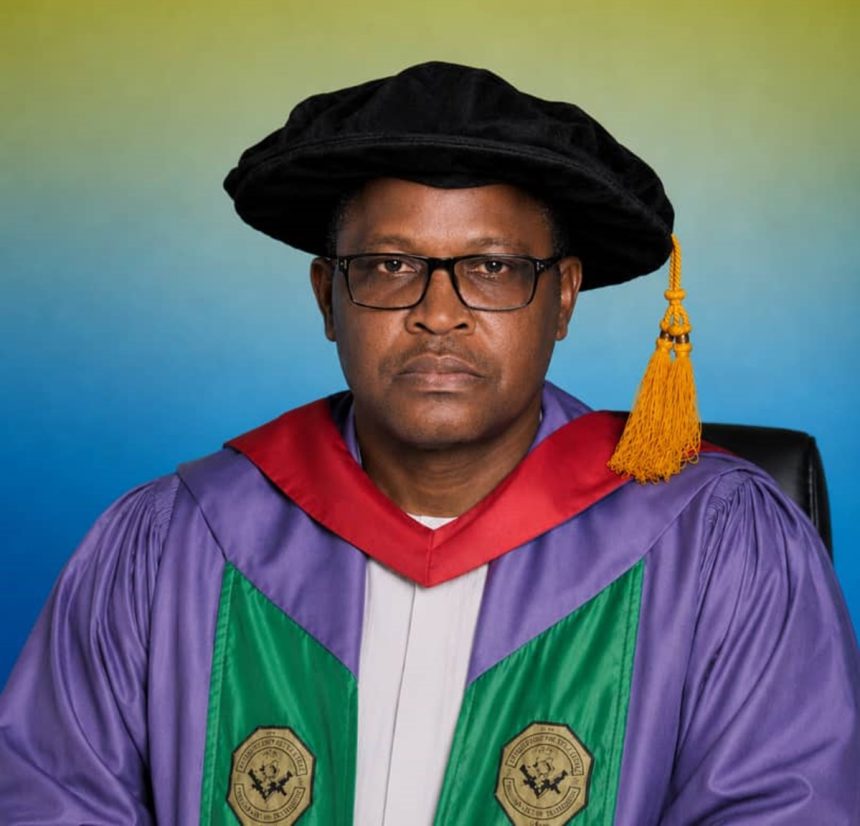
*Prof. Abdullahi Ahmed
By Joe Bitrus Ali
Can people demand access to Nigeria’s national opportunities for their own sons and daughters, but in active collusion with their political and traditional leaders, insist that federal establishments located in their territory should be reserved, in practice, for them alone?
The answer must be no. There is everything wrong with creating the impression that a federal institution belongs to the ethnic community in whose neighbourhood it happens to be located.
This is why it is imperative for voices of reason to speak out against the ongoing protests against the appointment of Prof. Abdullahi Ahmed, a native of Gombe State as Provost of the Federal College of Animal Health and Production Technology, located in Vom, Plateau State.
Over time, Plateau citizens have benefited enormously from Nigeria’s federal structure. They have been appointed to some of the country’s most important political, educational, technological, administrative and professional positions, many of them in institutions located far outside Plateau State.
And Nigerians elsewhere have, by and large, accepted these appointments because they understand the basic principle that federal institutions belong to the federation, not to the host community.
Consider Chief Ayuba Burki Gufwan, a prominent Plateau native, who serves as Executive Secretary of the National Commission for Persons with Disabilities. The commission is a federal institution serving Nigerians across the country, not a Plateau establishment.
The Digital Bridge Institute, meanwhile, is headed by another Plateau technocrat, David Daser, who was appointed its President/CEO in 2024. The two institutions have even collaborated on programmes for persons with disabilities.
There are thousands of qualified Nigerians who could have occupied these positions. They were not necessarily denied because anybody hated them. One person simply had to be chosen. That is the nature of appointments.
The same principle applies to Barrister Festus Fuanter, a native of Plateau State and current Chairman, National Teachers Institute (NTI) with headquarters in Kaduna.
Would Kaduna people be justified in arguing that a federal institution located in Kaduna must be headed by a Kaduna indigene?
And what about Rufus Bature, another Plateau citizen, who was appointed Chairman of the Nigerian Coal Corporation (NCC), an institution headquartered in Enugu State? Where was the agitation that an Enugu indigene must head it?
Where were the protesters insisting that Plateau had no business producing the chairman of a federal establishment located in the South-East?
There was none, and rightly so. That is precisely how a federation works.
Section 14(3-4) and Section 15(2) of the 1999 Constitution as amended deal with the composition of government of the federation and issues of national integration. The first directs the federal government and its agencies to mirror Nigeria’s diverse makeup in order to build national loyalty and avoid sectional or ethnic dominance.
Section 15(2) prohibits discrimination based on place of origin, sex, religion, status, ethnic or linguistic ties.
This is probably why the examples of Plateau people heading federal institutions outside of their home state become even more compelling in the university system. The late Professor Umaru D. Gomwalk, a distinguished son of Plateau, was the pioneer Vice-Chancellor of the Federal University of Technology, Owerri, Imo State. He subsequently became Sole Administrator of the University of Nigeria (UNN), Nsukka, Enugu State. Historical records from the University of Nigeria confirm his appointment as Sole Administrator following the removal of Vice-Chancellor Professor Oleka Udeala. Imagine if Imo or Enugu people had said: “This is our institution. A Plateau man cannot head it.” They would have been wrong.
Professor Angela Freeman Miri provides another powerful example. A Plateau-born academic, she became the second Vice-Chancellor of the Federal University Lokoja, Kogi State, serving from 2016 to 2021. The university itself records that she succeeded its pioneer Vice-Chancellor.
Did Kogi people demand that an indigene must be the Vice-Chancellor because the institution is located in their state? No. And they should not.
Professor Patricia Manko Lar is another example. A Plateau citizen, she was appointed Acting Vice-Chancellor of the University of Abuja, now Yakubu Gowon University in February 2025 and served for six months. When her tenure ended, another person took over. Contemporary reports praised her leadership during the transition. Again, Abuja did not become Plateau. The Gbagyi did not insist that it must be one of their own and not Prof. Lar that should have acted. This is how things work in a federation.
The list is much longer. Professor Danladi Slim Matawal, born in Bokkos, Plateau State, served as Director-General/Chief Executive of the Nigerian Building and Road Research Institute.
Rev. Dr Yakubu Pam, a Plateau son, served as Executive Secretary of the Nigerian Christian Pilgrims Commission. Sir Joseph Ari, another Plateau citizen, headed the Industrial Training Fund (ITF), whose headquarters is in Jos.
Dr. Amos Bulus Cirfat, from Langtang North, served as Provost of the Federal College of Education, Pankshin, for several years before his retirement.
And Plateau citizens continue to occupy important positions in federal institutions located within the state itself.
Engr. Dr Bongfa Binfa is Rector of the Federal Polytechnic, Nyak-Shendam. Dr Pokop Wushipba Bupwatda is Chief Medical Director of Jos University Teaching Hospital (JUTH).
These appointments are not wrong because the appointees are Plateau people. But neither would they have been wrong if qualified Nigerians from other states had been appointed.
That is the entire argument. What should matter is competence, integrity, due process and the ability to deliver, not ethnicity. Federal character is not ethnic ownership.
Perhaps some of the confusion comes from the misuse of the idea of federal character. It was never designed to give every host community proprietary rights over federal institutions located in its territory as I stated above. Plateau people cannot legitimately argue that because an institution is located in Plateau, its leadership must automatically belong to a Plateau indigene.
Plateau was once celebrated for its hospitality and cosmopolitan character. Jos was once a city where Nigerians from different parts of the country felt at home. Politicians, businessmen, military officers, expatriates, academics and professionals maintained homes and looked forward to permanent retirement there. Regrettably, this is no more! Available records show that most have sold their properties and moved on to other much more peaceful parts of Nigeria. This should worry leaders from Plateau.
A few decades ago, Plateau’s climate, relative tranquillity and commercial importance made it a natural destination for conferences, seminars and business.
It was also an important commercial meeting point, attracting traders from especially the North-East, and also from neighbouring countries. Much of that advantage are now being lost to what some people see as ethnic and religious bigotry.
The destruction of the old Jos Main Market and the prolonged crises that followed were not merely economic setbacks. They weakened the city’s reputation as a place where people from different backgrounds could live and do business with confidence. That should concern Plateau people more than the nationality or state of origin of a person appointed Provost of a federal college.
A society that scares away outsiders eventually scares away investment, talent and opportunity.
Lagos did not become Nigeria’s commercial nerve centre by telling Nigerians from other states to stay away. Kano’s historic commercial importance similarly rested on its ability to attract merchants from different parts of the country and beyond. No modern economy can be built on the premise that only indigenous people have the right to participate. No great city can become globally competitive by turning inward.
Plateau people should also be careful about the precedent they are establishing. Every Plateau citizen who accepts a national appointment outside the state benefits from the same principle of national mobility. The door cannot be open when a Plateau citizen is walking out and suddenly become locked when another Nigerian is walking in. That is the double standard Nigerians should reject.
Plateau cannot demand national inclusion for its citizens and simultaneously demand local exclusion for citizens of other states. It cannot celebrate its sons and daughters when they occupy national offices outside the state and then object when other Nigerians occupy federal offices inside the state.
It cannot invoke federal character when Plateau is seeking an appointment and abandon the principle when another state gets one. It cannot have both ways. The people of Plateau deserve better than ethnic politics masquerading as justice.
*Ali sent this piece from Abuja.


















 News1 week ago
 News6 days ago