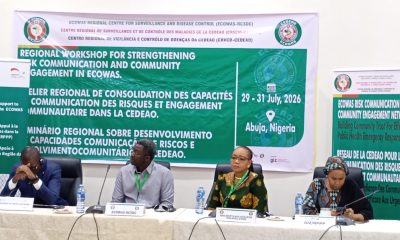
The Minister of state for Health and Social Services, Dr. Iziaq Adekunle Salako, represented by Dr. John A. Ovuoraye, Director of Health Planning and Statistics, Federal Ministry of Heath (center), flanked by top officials of the ECOWAS Regional Centre for Disease Surveillance and Control (RCSDC) at the ordinary annual meeting of the Technical Advisory Council (TAC) on Wednesday 6th May, 2026 in Abuja. Photo credit: Optimum Times
The Minister of state for Health and Social Services, Dr. Iziaq Adekunle Salako has pledged Nigeria’s commitment to support
broader ECOWAS health security agenda.
He expressed the commitment Wednesday while declaring open the ordinary annual meeting of the Technical Advisory Council (TAC) of the ECOWAS Regional Centre for Disease Surveillance and Control (RCSDC) taking place in Abuja.
According to the Minister, “Nigeria remains fully committed to the objectives of the RCSDC and to the broader ECOWAS health security agenda.
“We will continue to support initiatives aimed at strengthening disease surveillance systems, enhancing early warning and alert mechanisms, and improving preparedness and emergency response capacities across the sub-region.
Nigeria’s commitment coincided with a call by the Executive Director of ECOWAS Regional Center for Surveillance and Disease Control (RCSDC), Dr. Mamadou Diarrassouba, for a strong regional health governance, enhanced surveillance, early detection, and a coordinated, evidence-based response by the region.
Dr. Diarrassouba noted that the region remains complex with climate change, rapid urbanization, population movements related to humanitarian crises, and the frequent emergence or re-emergence of infectious diseases.
The Minister who was represented by Dr. John A. Ovuoraye, Director of Health Planning and Statistics, Federal Ministry of Heath, underscored the importance of the meeting.
According to him, “This meeting is both timely and strategic. Our region continues to confront complex and evolving health challenges, including emerging and re-emerging infectious diseases.
“These threats underscore the urgent need for stronger surveillance systems, improved data sharing mechanisms, and more coordinated cross-border responses. Indeed, no Member State can effectively address these challenges in Isolation; they require sustained collaboration, solidarity, and collective action.”
The Minister further commended the West African Health Organization (WAHO) and the Economic Community of West African States (ECOWAS) for their unwavering commitment to strengthening regional health security and enhancing the collective capacity to prevent, detect, and respond to public health threats.
On his part, the Executive Director of the ECOWAS Regional Center for Surveillance and Disease Control (RCSDC), Dr. Mamadou Diarrassouba, charged the participants at the three-day meeting to work with scientific rigour, a spirit of consultation and a sense of practicality.
He expressed confidence that their commitment, independent analytical capacity and collaborative spirit would ensure the operational relevance of recommendations, which will be contextualized based on solid evidence.
Also speaking, the Director of early warning of the ECOWAS Commission, Dr. Onyinye Onwuka, noted that the lessons of recent outbreaks have reinforced a critical truth that health crises are not isolated events.
She said, “they are regional threats with far-reaching socio-economic and security implications”, adding that the role of early warning systems is pivotal.
“The ECOWAS Early Warning Directorate continues to monitor and analyze emerging risks across the region, including health-related threats.
” Increasingly, we observe that disease outbreaks are not only humanitarian concerns but also catalysts for instability, affecting livelihoods, governance, and social cohesion.
“This underscores the urgent need for stronger integration between early warning and public health surveillance systems”, she emphasized.




















 News4 days ago