
Business News
43 Insurers Meet NAICOM Capital Requirement, Eight Await Final Verification

By LOVETH-AZODO CHIJIOKE, Lagos
The National Insurance Commission (NAICOM) has formally concluded Nigeria’s insurance sector recapitalisation exercise, announcing that 43 insurance and reinsurance companies have successfully met the new minimum capital requirements prescribed under the Nigerian Insurance Industry Reform Act (NIIRA) 2025.
The announcement marks the completion of the 12-month recapitalisation programme and represents the most significant regulatory reform in the Nigerian insurance industry in decades.
In a statement issued Sunday, the Commission said the exercise signals “the beginning of a new era” for the industry, describing it as a major milestone towards building a stronger, more resilient, professionally governed and policyholder-focused insurance market.
However, the Commission disclosed that eight insurance companies which submitted evidence of compliance shortly before the July 31 statutory deadline are still undergoing final verification and regulatory review, a process expected to be concluded within 14 days.
NAICOM also published the names of the companies that have been verified as compliant with the new capital regime.
The list includes major operators such as Zenith General Insurance Company Limited, Leadway Assurance Company Limited, Custodian Life Assurance Limited, NEM Insurance Plc, AIICO Insurance Plc, Heirs General Insurance Limited, Consolidated Hallmark Insurance Limited, Stanbic IBTC Insurance Limited, AXA Mansard Insurance Plc, LASACO Assurance Plc, Coronation Insurance Plc, Prestige Assurance Plc and Great Nigeria Insurance Plc.
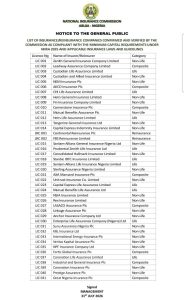
The two licensed reinsurers confirmed to have met the new capital threshold are Continental Reinsurance Plc and FBS Reinsurance Limited.
According to the Commission, the recapitalisation was undertaken pursuant to Section 15 and other relevant provisions of the Nigerian Insurance Industry Reform Act (NIIRA) 2025, which was signed into law on July 31, 2025.
To ensure transparency and credibility throughout the exercise, NAICOM said it developed comprehensive implementation guidelines detailing the new minimum capital requirements, admissible capital instruments, verification procedures, regulatory timelines, reporting obligations and supervisory expectations.
The Commission stated that following an extensive process of review, verification and validation, the exercise has strengthened the financial resilience of insurance operators, attracted significant domestic and foreign investment and boosted investor confidence in the sector.
It noted that the higher capital base would enhance insurers’ capacity to underwrite larger and more complex risks, meet policyholder obligations promptly, support infrastructure financing and other long-term investments, while improving their competitiveness within regional and global insurance markets.
NAICOM further stated that the recapitalisation provides a stronger foundation for the implementation of risk-based supervision, ensuring that regulatory capital remains aligned with the nature, scale and complexity of each licensed operator’s business.
Reaffirming its commitment to policyholder protection, the Commission said it would continue to strengthen consumer protection, promote sound market conduct and deepen insurance penetration as implementation of NIIRA 2025 progresses alongside ongoing reforms in innovation, technology and digitalisation.
It added that stakeholders would continue to receive updates on post-recapitalisation supervisory actions, companies undergoing final verification, industry restructuring developments and the implementation of the Risk-Based Capital Framework.
Describing the exercise as a historic achievement, NAICOM expressed appreciation to the Federal Government, shareholders, investors, operators, professional bodies, development partners and other stakeholders for their support throughout the implementation process.
“The successful completion of this recapitalisation exercise is not the destination but the foundation. It marks the beginning of a new era in which stronger institutions, stronger governance and stronger public confidence will make insurance work better for every Nigerian,” the Commission stated.




Click to read full text









Just In: DSS, NIA To Probe NFF Over Alleged Sabotage Of National Interests

Ojukwu Confered With 2026 UTA International Humanitarian Awar

Electricity For Underserved Communities: REA, Alpha Morgan Bank Collaborate On ₦50 Billion Financing Facility To Accelerate Access

MPC Meeting: Nigeria’s Economy Remains Resilient To External Shocks, Cardoso Assures As Members Commit To Sustain Financial Stability

NERC Gives PHED 60-Days To Incorporate PHED SubCo To Oversee Interstate Power Supply As AKSERC Assumes Electricity Oversight

Asset Integrity, Life Extension, Fixing Obsolescence Key To Sustaining Value For Independents – Seplat CEO


-
 News5 days ago
NERC Gives PHED 60-Days To Incorporate PHED SubCo To Oversee Interstate Power Supply As AKSERC Assumes Electricity Oversight
-
 Business News1 week ago
President Tinubu’s New Deep Offshore Investment Framework, Game Changer For Nigeria’s Oil Sector – TDF
-

 Business News1 week ago
FGN Power Company Supports Visiola Foundation’s 2026 STEM Summer Camp, Inspires Next Generation Of Energy Innovators