…As Adelabu Aligns, Assures Improvement If…
The Transmission Company of Nigeria (TCN) has advanced reasons why system collapses have become intractable in the country just as it said however, that this can be redeemed if given adequate funding to tackle the causes.
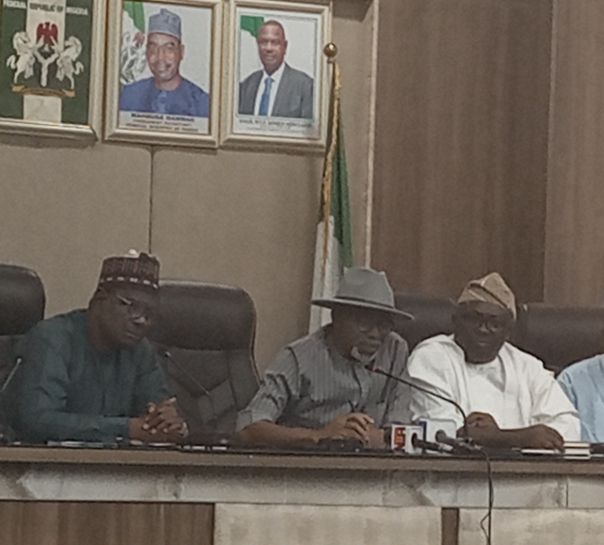
TCN made the presentation on the causes and the way forward to alleviate the system collapses on Monday while the Senate Committee on Power led by Sen. Enyinnaya Abaribe were at the Corporate Headquarters of the company on oversight and familiarization visit.
Sen. Abaribe has earlier laid a background that prompted the Committee’s visit, noting that in the recent past, the nation had witnessed frequent collapses of the national grid resulting to back outs adding that this doesn’t tell good about a nation that prides itself as the giant of Africa. He recalled that the distribution and generation aspects of the power sector had since been privatised while that of the transmission sector still remains government owned entity for security reasons.
Senator Abaribe noted that though, the generation companies are said to have about 13,000 MW installed capacity but observed that often times, whenever transmission is about reaching 5,000 MW, the system would trip down to about 2,000 MW despite the TCN claims of having about 8,000 MW installed capacity. He wondered why it is so in the past over 20 years and insisted that this would not be allowed to continue.
According to him, “We are here to hear directly hear from the TCN what is really the problem. And are there anything we can do using the law to help you to make Nigeria one of the countries that do not have to depend on their own installed power.”
The Managing Director of TCN, Engr. Sule Abdulaziz in an explanatory address, pointed out that the major work of the TCN is to expand the grid, manage it and reconduct the lines, adding that the power system is dynamic, always increasing just as the people that use the power are also increasing in number.
He recalled that presently over 100 critical projects are ongoing and when completed, would add great value to the national grid. However, he appealed to the Senate Committee on power to assist TCN for more funds allocation to enable it to complete the projects.
He said: “These projects are hanging for over 20 years, there are some that started in 2001; some 2007, 2008, 2010 up to 2023. The major problem we have with these projects is funding.
“There are some of them which have problems with right of ways which we are making efforts to contact out state governors to help us to resolve these issues.
“Secondly, there is grid visibility. As everyone knows, the TCN does not have a full SCADA ( Supervisory Control And Data Acquisition) system even though the world bank has helped TCN in given contract for the SCADA but this will take at least two years to be completed. Presently, we applying in house innovation to see most of the stations, generations and transmission stations.
“Another issue we are facing is vandalisation. We have reported so many times the extent of damages we are having in this country, especially in the north east. A lot of transmission lines and towers were vandalized and some substations are uncompleted especially in the south east which because of lack of transmission lines, we are not able to energize the stations, people went there and vandalized them.”
Engr. Abdulaziz reminded the Senate that the 2024 budgetary allocation was only N2 billion and wondered how the nation could achieve efficient power transmission with such amount which said was not even enough for the TCN to pay compensation.
He appealed to the Senate for more funds to complete ongoing projects, construction of super grid, enact laws to mandatorily give TCN right of ways, and to devise means of ensuring security to curb vandalisation of its infrastructure nationwide.
On his part, the minister of power, Adebayo Adelabu, canvassed that the states should play active involvement in power generation, transmission and distribution.
He noted that some of the handicaps of the TCN include lack of evacuation capacity of generated power to distribution companies, aging infrastructure such as transformers, transmission lines, substations among others.
According to him, “The state of the infrastructure is the major problem. A number of the substations and lines are over 50 years old without reconducting it. Secondly is uncompleted projects. It is true that government has spent so much money to improve transmission infrastructure in the last 20-25 years, millions of dollars. But the issue is that this spending have not really transmitted into major impacts on transmission and national grid”.




















 News1 week ago
 News3 days ago
 Politics1 week ago