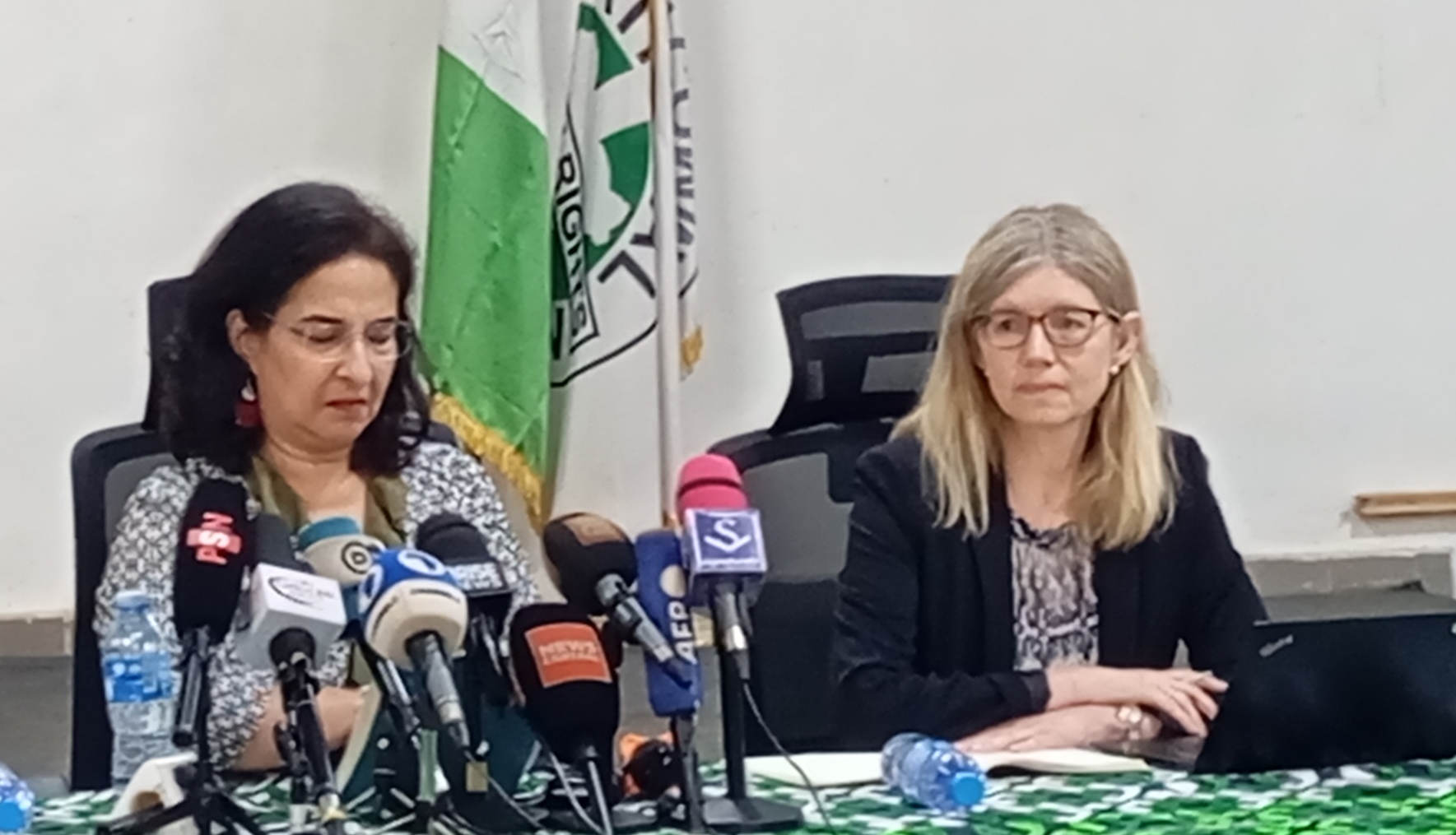
The UN Special Rapporteur, Prof. Nazila Ghanea (left) and her colleague at the NHRC headquarters Abuja while presenting preliminary report on their 11-day visit to Nigeria. Photo credit: Optimum Times, 19/6/2026
…Urge FG To Operationalize Constitutional Provisions
By Clement Nwoji
The United Nations Special Rapporteur on Freedom of Religion or Beliefs (FoRB), Professor Nazila Ghanea, has tasked the Federal Government of Nigeria to, as a matter of urgency, consider domesticating the International Criminal Court (ICC) statues so that international crimes can be tried effectively in Nigerian courts in addition to giving the nation’s constitutional provisions practical meaning.
This forms the key recommendation made by Prof. Ghanea, after 11-day (8-19 June) visit in Nigeria on a fact-finding mission on FoRB. During the visit timeframe, the Rapporteur visited Plateau and Kano states, and interacted with over 200 interlocutors.
This official country visit focused on exploring how freedom of thought, conscience and religion (freedom of religion or belief) interacts with human rights realities on the ground throughout this vast land.
Further, she specifically mentioned meeting with the National Security Adviser to the President, the Solicitor-General/Permanent Secretary of the Ministry of Justice, the Permanent Secretary of the Ministry of Foreign Affairs, and with representatives of various departments of the Ministry of Justice, the Ministry of Women’s Affairs and Social Development, the Nigeria Police Force, Nigeria Immigration Service, Supreme Court Justices and the Nigerian Human Rights Commission (NHRC).
“I had asked for a number of other official meetings at the Federal level and regret that these could not be facilitated”, Prof. Ghanea added at a press conference in Abuja on the preliminary report of findings.
The visit is against the background of heightened insecurity in Nigeria and widespread reports of persecutions and attacks based on religious affiliations.
On findings, She said: “Pockets of horrendous mass atrocities and international crimes were observed, but investigators found no evidence of a nationwide, intentional government policy to destroy a religious community. Inadequate security responses and repeated violence are major drivers of harm. Freedom of religion/conscience is being constrained by labels, silos, and political instrumentalisation; victims must lead the narrative until proper investigations and justice occur.”
The Special UN Rapporteur who also affirmed that the prevailing insecurity in Nigeria prevented her from extending her investigations to other parts of Nigeria, called for accountability processes and victim‑centred investigations to determine individual and institutional responsibility.
She noted that labels, cultural frames and polarisation prevent many people in Nigeria from freely expressing conscience and religious belief.
She called for the need to break silos and enable plural, conscience‑based expression across communities.
According to the preliminary report, ” Discussion of freedom of religion or belief in Nigeria elicits very acute concerns about insecurity, violence and conflict which has spread throughout the country and has generated huge alarm, albeit to different intensities and for different reasons.
“These include terrorist actions, gang violence and banditry incursions, land grabbing to mass displacement, armed conflict and cattle rustling, hostage taking to arson attacks, destruction of holy places and schools, large scale kidnappings in remote areas and civil unrest around protests and strikes, decimation of irrigated farmlands and whole villages and livelihoods, through endless cycles of threats, fear and death in expanding areas of the country. Impunity and lack of accountability have reportedly entrenched these cycles of fear and violence and encouraged its spread. Previously these cycles were focused in particular regions, for example in the Northwest and North Central.
“They have now spread across many parts of Nigeria, but largely outside urban areas. Federal authorities report a noteworthy stepping up of ongoing court cases in seeking to address this. What remains uncontested is that, at the village and hamlet levels in particular concentrations of the country, scores of innocent people experience killings, mass violence and the total decimation of their livelihoods, time and again, witnessing little or no justice.
“Horrific instances have included mass arson against whole communities with survivors forced to move to camps for the internally displaced with no return in sight, unable to farm, earn a livelihood, and provide for their families.
“In other instances, rural communities are forced to strike ‘peace deals’ with the bandits – reportedly assigning fields to them, granting them the proceeds from the produce of other fields, and ‘taking any woman that they want’ from the hamlet. In the contexts where this was reported, the communities concerned were predominantly Christian.”















 Business News1 week ago

 Business News5 days ago