By Mohammed Abubakar Dutse
Though two years may be so short a time for any development programne to record impactful achievements in a clime like Nigeria, but the success story of the Family Planning Advocacy Group, The Challenge Initiative (TCI) in just two years appears to have put a lie to this assumption.
The TCI programme is an intervention that has the main purpose of supporting the state government to scale up its family planning interventions, while working with the state government in different thematic areas such advocacy teams to stress the need for improved funding of family planning by the state government, improve on the coordination of family planning activities as well as engaging with the media in the areas of advocacy and amplifying family planning messaging amongst others.
With funding supports from the Gates Foundation, (formerly Bill & Melinda Gates Foundation) and Bayer, a pharmaceutical company, the TCI activities have been recorded in 13 out of the 27 LGAs across the state. Each of the 13 LGAs have 52 health facilities where they work with service delivery teams to improve on their capacities to scale family planning services.
So far, the programme has been implemented in 22 states of the federation and actively taking place in the 10 states, including Jigawa which will transit to self sustainability in Monday June 30.
According to Ankale Kongude, the State Programme Manager for TCI, ( SPM-TCI,) in Jigawa, “In all these states we have implemented a life span of three- and a half years in the intervention. A time, Bayer brought up a strategy for states to test run the programme, using the same resources, the same staff strength, the same financial resources, but this time around two years.
“So, Jigawa was selected to test run this, so we came and started engaging the state in June 2023 and we’re in June 2025, so the two years is complete now and Monday June 30, we’d have transited.”
The affected LGAs include Malammadori, Dutse, Birnin Kudu, Babura, Ringim, Buji, Kafin Hausa, Jahun, Gagarawa, Yankwashi, Gwaram, Maigatari, and Kiyawa.
Thus, preparatory to transit, the state government, in partnership TCI convened a high-level transition alignment meeting to discuss the institutionalization and sustainability of family planning interventions initiated under the TCI programme.
The meeting, held at Haitel Guest Inn, Dutse, brought together key stakeholders, including high level government officials, development partners, traditional and religious leaders, and the media.
With the main theme: “Transitioning Towards Jigawa State Self-Reliance in Family Planning”, the meeting aimed to facilitate a structured and seamless transition of programme ownership to the state government, ensuring continuity, scalability, and long-term integration of TCI’s impactful work beyond the programme’s timeline.
Besides, the stakeholders discussed ways to sustain and expand family planning interventions through full government ownership, strategic policy integration, and community engagement.
Another sore point which various speakers spoke about was the inadequate or near non-fatal ability of family planning commodities which they say are reported by many states where currently engaged in family planning.
Kongude, while giving the overview of the programme in the state said the programme has achieved significant milestones in the state, including: 421 neighbourhood campaigns, 889 voluntary mobilization efforts, 82 in-reaches, 36 service delivery outreaches, 120 association meetings, 234 key life event engagements, 27 structured community dialogues, 9,861 postpartum family planning clients recorded across 13 LGAs.
The Executive Secretary of the Jigawa State Primary Healthcare Development Agency (JSPHCDA Dr. Shehu Sambo, who acknowledged the tremendous impact the intervention of TCI on the family planning activities in the state, reaffirmed state’s government commitment to institutionalizing family planning interventions, ensuring the long-term sustainability of the programme.
According to him, the state government plans to build on the achievements of the TCI program, leveraging the momentum to improve the health and well-being of its citizens.
He said meeting marked a significant step towards scaling up family planning efforts in Jigawa State, demonstrating the government’s commitment to improving access to reproductive health services and promoting economic development.
Hajia Aliya Ahmed, the RH Coordinator, who gave the overall assessment of the impact of the TCI programme said the arrival of the interventionist agency had paved the way for general acceptability of the family services, which she said had shot up by almost 85% in the state from the previous low record.
Dr.Taiwo Johnson, the Country Director of TCI, who was on ground during the Jigawa State high-level transition alignment meeting commended the Jigawa state government for its efforts so far noted that more still needed to be done, especially in the area of funding of the family planning activities.
She believed therefore, that said the meeting should serve as an eye opener on state governments impending family planning programme to attach more importance to the issue of availability of family planning commodities, saying a situation whereby people are sufficiently enlightened and they’re embracing family planning and there are no commodities could be counterproductive.
Dr. Johnson, who addressed the inadequate FP commodities challenged the state governments to take up the ownership of the programme by making adequate budgetary allocation to the sub-sector so that more people could benefit from the programme.
She disclosed at the moment, the federal government which is the sole authority to purchase the commodities in the country requires about $45 million (USD), “which means, the states have to seriously come in to ensure that their citizens are not denied the use of these critical commodities.”
” She noted that, “The primary objective of the meeting was to facilitate a structured and seamless transition of programme ownership to the state government, ensuring continuity, scalability, and long-term integration of TCI’s impactful work beyond the programme’s timeline, which runs from October 2023 to May 2025.”
According to her, “This was followed by comprehensive presentations that highlighted critical thematic areas, including family planning indices and TCI coverage, advocacy efforts, demand generation, strategic pillars of TCI, social mobilisation, service delivery, postpartum family planning (PPFP) uptake, coaching and capacity building, research, monitoring and evaluation, key learnings, implementation challenges, voices from the state, and compelling visual stories.”
She explained that the project was conducted in 13 out of the 27 local government areas in the state, where a total of 9,861 postpartum family planning clients were recorded. Additionally, 421 neighbourhood social mobilisation campaigns were carried out, 889 voluntary mobilisation efforts, 82 in-reaches, 36 service delivery outreaches, 120 association meetings, 234 key life event engagements, and 27 structured community dialogues.
However, in response to the TCI ‘s Country Director on the $45 million for the purchase of the commodities, the Jigawa PHCDA boss criticised the FG position saying the country should priopriotze the health of Nigerians over and above other consideration
According to Dr. Sambo $45 million is not a partcularky huge amount of money given the kind of money lamented that the government spends on other sectors that are not relevant and as important as the health sector.
Further Sambo lamented the current processes and procedures for accessing and supplying family planning commodities have been monopolized, which he said is one of the factors contributing to the slow progress in many states.
According to him, “I have a message to the lead team. I was at a national conference on family planning in 2024, and I spoke about the commodities. I challenged and asked the panel: as a surgeon, why can I freely go to the market and buy anaesthetic and other products, but it is difficult to buy family planning commodities freely in the market? Why the monopoly? Why is there only one supplier to feed the entire country? Why are we not allowed to manufacture? Everyone is talking about family planning. When they come to the state, the complaint is always demand and capacity, yet they leave the state with little supply from the national level. Everyone goes, leaving the Executive Secretary with the demands, crowds, and maternal mortality. Something must be done.”
The Executive Secretary added that a budget of $45 million is not enough for the supply of family planning commodities in Nigeria. “What is $45 million for a country like Nigeria? There is a need to do more and provide a tangible amount to meet the needs of Nigerians,” he said.
He also advised states to make adequate provisions for purchasing the commodities in order to supplement the federal government’s efforts, adding, “Here in Jigawa State, the government is trying. Presently, we have a work plan. A memo has already been prepared, and we are optimistic that His Excellency, the Governor, will approve it when it is presented to him.”
Dr Sambo further criticised the “Vision Health Fit 2030” which targets 27 percent family planning coverage in Nigeria, stating that the target is too low given the rate of maternal mortality in the country
The meeting concluded with a commitment to sustaining and expanding family planning interventions, recognizing the importance of family planning in improving access to reproductive health services, reducing maternal and infant mortality, and promoting economic development in Jigawa State.
Highlights of the event included the presentation of championship awards to key figures who have championed the cause of family planning in Jigawa state, recognizing their outstanding advocacy and leadership.
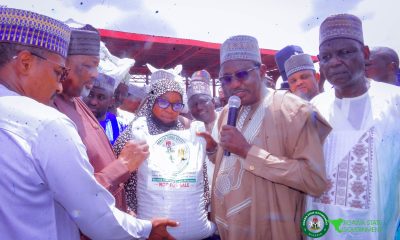
The awardees, who were decorated with the TCI badges of Honour, included the State Commissioner for Health, Dr. Abdullahi Muhammad Kainuwa, the Permanent Secretary in the Ministry Dr. Kabiru Ibrahim Aliyu, the ES PHCDA, Dr. Sambo and a traditional title holder in Dutse Emirate, the Bauren Dutse, Umar Ahmed
Also decorated for their roles were, a prominent and respected Islamic Scholar in the state, Sheik Aminu Baba Waziri, the Chairman of the Christian Association of Nigeria, (CAN) Revd Maurice King Hassan, the State Director of Family Health, Dr. Abubakar Saidu Kanya and the Director of Medical Services in the ministry, Dr. Abdulkadir Yakubu



















 Business News1 week ago
 News6 days ago
 News1 week ago