
Business News
Insurance Recapitalization: Federal Government Warn Operators Against Fighting Policy Directive


By CLEMENT NWOJI, Abuja
The Federal Government on Monday warned insurance operators to desist from fighting against the sector’s recapitalization policy directive enunciated by the National Insurance Commission (NAICOM) in May 20, 2019, but to take advantage of the opportunities provided by it.
It advised the operators to explore available options including mergers and acquisitions as means of achieving their continued existence, instead of resorting to fighting the policy because of inability of raising the required capital.
President Muhammadu Buhari gave the warning while declaring open in Abuja, the on going 2019 National Insurance Conference, which theme is “Disruption, Innovation and Business Growth”.
President Buhari also said that the Federal Ministry of Finance would collaborate with National Insurance Commission (NAICOM) and insurance sector stakeholders to achieve 40 Percent financial inclusion rate by the year, 2020.
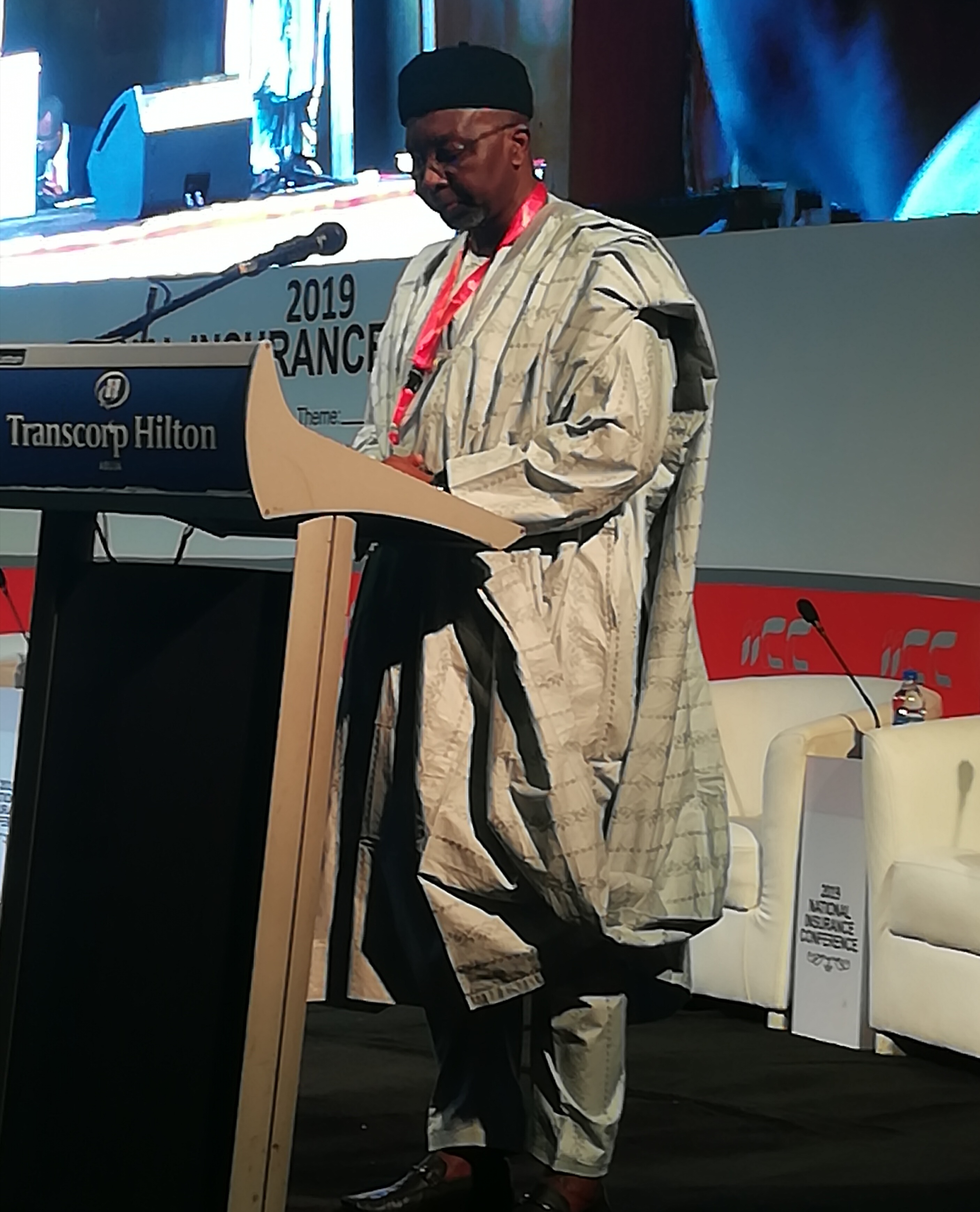
Commissioner For Insurance, Mohammed Kari while delivering address at the Conference
According to the President who was represented by the Permanent Secretary of the Ministry of Finance, Mahmud Isah-Dutse, “The insurance Industry has rules and regulations that all insurance companies must follow and this will cause them to struggle to understand and implement the rules, new technologies and innovations.
“With the recapitalization directive issued recently, we expect operators to be truth to themselves and consider all opportunities available for continued existence. While this could include mergers and acquisitions, it should not include fighting the policy just because you cannot raise the additional capital.”
On financial inclusion, he said “As you are aware, it is a major policy thrust of this administration to ensure poverty reduction and financial inclusion of the majority of Nigerians hitherto excluded from the financial services.
The Financial Sector Development Organization enhancing financial innovation access estimated that in 2018, 36.8 percent of Nigerian adult population remain outside the formal sector.
“The federal ministry of finance will collaborate with the National Insurance Commission and the industry stakeholders to ensure that the target 40 Percent of inclusive rate by the end of 2020 is achieved as contained in the 2018 Reversed National Financial Inclusion Strategy.”
President Buhari noted that the timing of the conference is very auspicious as the Federal government through the National Insurance Commission (NAICOM) is rolling out various initiatives with the objectives of strengthening the institutions and increasing the spread of insurance companies in the country.
He said that the insurance industry has undergone some series of reforms of recent which include introduction of products and services such as the microinsurance, Kakafu insurance and Bancassurance among others.
“Insurance companies are now facing serious challenges in the current competitive environment and these calls for market innovation, creating new services, prompt delivery of services to customers that will lead to growth and development of the industry”, the President stressed.
On his part, the Commissioner for Insurance, Alhaji Mohammed Kari, noted that the theme is very pertinent against the backdrop of the need for the Nigerian insurance industry to remain relevant in an era of dynamism where operating in the same way is an assured route to irrelevance.
According to him, “The need for radical reforms has been accentuated by the disruptive impact on the insurance industry of a series of digital innovations in areas such as online sales technologies, machine learning, the Internet of Things, advanced analytics and virtual reality, among others.
While these new technologies are already making it easier for consumers/policyholders to benefit from superior service and more choice as well as lower prices, there are corresponding challenges.
“For example, cyber risk and crimes, determination of liability in driverless car accident, emergence of inter-sectoral competitors as well as disruptive social and technological changes.
“Therefore, in order to remain relevant and become a critical contributor to the national economy, the industry must consciously be proactive and organized so as to take advantage of the opportunities provided by these disruptive developments while at the same time curbing their corresponding negative impacts.”
Kari maintained that firms will only benefit from digital technology only if they embrace its potentials along the entire insurance value chain, including underwriting and claims management.
This would therefore entail a rethink of the industry’s business strategy and alignment of its operational practices to contemporary economic context such as the Economic Recovery Growth Programme (ERGP) of the Federal Government, sustainable and inclusive insurance as well as exploiting the benefits of the implementation of the 2nd Phase of Market Development and Restructuring Initiative (MDRI), among others.”
He said the need to exploit the opportunities of digitalization and to tame the cumulative consequence of inflation and devaluation of the Naira heightens the necessity for the ongoing reforms of the insurance industry such as, expansion of the insurance distribution channels, financial inclusion, corporate governance enforcement, market discipline, professionalism and the recapitalization exercise aimed at strengthening insurance institutions and increasing the spread of insurance in the country.
Also speaking in a welcome address, the Chairman of the Insurance Industry Consultative Council, Eddie Efekoha pleaded with the NAICOM to give consideration to reasonable suggestions by the Nigeria Insurers Association towards the recapitalization process.
He said, “As we commence this round of recapitalization I plead with the National Insurance Commission to give favorable consideration to the suggestions made by the Nigerian Insurers Association in their on-going engagements so that the necessary guidelines when released will ensure that the objectives of this reform are fully realized.
“This recapitalization exercise, like every past reform, presents both opportunities and new challenges.”









Click to read full text









NAICOM Clears Seven More Insurers, Closes Recapitalisation Exercise At 50 Operators

Kari Opposes Regulatory Concessions For Insurance Recapitalization Defaulters

Vom: Plateau People Cannot Have It Both Ways

FG flags Off Smart Meters Installers Training programme, Targets Installing Seven Million Meters Nationwide

MPC Meeting: Nigeria’s Economy Remains Resilient To External Shocks, Cardoso Assures As Members Commit To Sustain Financial Stability

NHRC Tasks FG, State Govts, People Of Means To Make Practical Interventions Towards Combating Poverty, Inequity


-

 Business News7 days ago
Asset Integrity, Life Extension, Fixing Obsolescence Key To Sustaining Value For Independents – Seplat CEO
-

 News4 days ago
Police Arrest Clergyman, Air Force, Navy Personnel Over Alleged Plot To Kidnap Bishops’ Wives In Plateau
-

 News6 days ago
Gov Abiodun Commends Army, Police, DSS, Others For Intelligence-led Rescue Of Five Kidnapped Poly Students, Two Others