
For Records
How We Achieved Success In 2020, FIRS Explains


By CLEMENT NWOJI, Abuja
The year, 2020 can be described as turbulent and hostile for socioeconomic activities and development, given the unanticipated entry and ravaging effects of the deadly novel virus, Coronavirus (COVID-19) which took the world by storm and surprise. With this, socioeconomic activities were completely distorted, crippled and destroyed by consequent lockdown in virtually all the nations of the world at one time or the other in a bid to contain spread of the COVID-19 pandemic.
Consequently, the sudden advent of COVID-19 presented ready made excuse for non-performance by governments, government owned agencies as well as private enterprises prone to poor outputs. This is not to say that there were no even giant companies which recorded losses due to the devastating effects of the COVID-19.
But in the midst of these, one agency stood out in Nigeria in its drive to save the nation from total collapse in operations in terms of raising/generating funds for funding government activities and development programme such as payment of salaries and provision of infrastructure.
The outstanding agency is the Federal Inland Revenue Service (FIRS) which distinguished itself to make enormous reforms and achievements despite the challenges posed by the COVID-19 pandemic, under the leadership of the Executive Chairman, Muhammad Nami, who assumed office at the most critical moment of the agency.

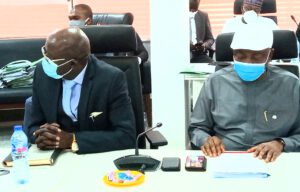
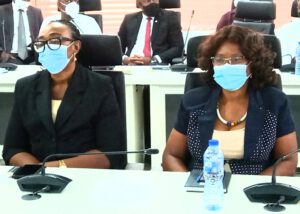
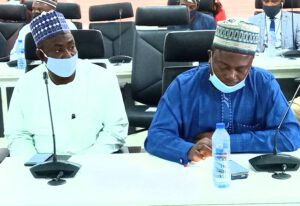
Some Members of FIRS Management Team while giving updates on the 2020 Score Card and the way forward in 2021. Photo credit: OPTIMUM TIMES
It is not in doubt that the FIRS Chairman and the management team operated under a very difficult environment posed by the advent of COVID-19 and other existing problems met on ground within the FIRS in 2020, but yet the agency strived and collected a colossal sum of N4,952,243,711,728.37 in total tax revenue in the year 2020, which represented approximately 98 percent of the national revised tax target of N5.076 Trillion set for it by the Federal Government.
While recalling the harsh conditions under which FIRS operated in 2020, Nami in a score card report said: “You are not unaware of the difficult environment in which I worked since I assumed the chairmanship of this apex tax authority. You will recall that when I assumed office I told Nigerians that I met the Service in complete disarray. In other words, I inherited a disoriented organisation with the majority of the staff on low morale mainly as a result under-utilisation of staff productive capacities, stalled promotion exercises and centralisation of authority, among others. These posed great challenges to me and my team.
“Just when I was trying to get around these issues, the now dreaded Covid-19 pandemic happened and disrupted economic activities globally. It forced the price of crude oil to crash to an all-time low whereby the country sold oil far below production cost. In addition to this, I also had to grapple with the waivers granted in the Finance Act 2019 to small companies with a turnover of N25 million and below. Also, there was the challenge of insecurity in some parts of the country especially the lootings that followed the EndSars protest. And in the wake of this protest we had to also grant tax waivers to taxpayers as a recovery lifeline. All these were against the backdrop of poor tax culture among Nigerians. So you will agree with me that the tax environment in the preceding year was no less chaotic and daunting.
“Yet, we had a mandate to collect a target revenue of initially N8.5 Trillion which was eventually reviewed downward to N5.076 Trillion. In the year under review the Federal Government operated a deficit budget, and as a result resorted to borrowing to augment what we were able to raise as revenue. Without gainsaying the fact, all three tiers of government badly needed money to fund their activities.”
Even as difficult as the above narratives were, Nami and his management team, through determination, commitment and strategic re-engineering, were able to shore up the FIRS revenue generation to a surprising higher level when compared to the previous years and boosted the economy against the backlash of the Covid-19 pandemic most especially.
“For the first time in recent memory non-oil tax revenue accounted for almost 70% of contribution to the Federation Account. In other words, oil which used to contribute over 50% in tax returns through the Petroleum Profits Tax in previous years, accounted for only 30.6% contribution to the tax revenue generated in 2020. Further, the Federal Inland Revenue Service (FIRS) collected N4,952,243,711,728.37 in total tax revenue in the year 2020, which represents approximately 98% of the national revised tax target of N5.076 Trillion set for it by the Federal Government.
“This near 100% collection feat is attributable to a number of reforms initiated by the Board and Management of the Service under my leadership. The reforms include capacity building for members of staff; improved staff welfare package; promotion and proper placement of staff; deployment of appropriate technology for tax operations; segmentation of taxpayers to ease tax compliance; and continuous collaboration with relevant stakeholders, among others”, according to the FIRS Executive Chairman.
Other revelations on how the FIRS weathered the storm of 2020 in the midst of lockdown which lasted greater part of the year and emerged successfully include that the agency deployed automation as the Finance Act 2020 empowered FIRS in respect of automation of its activities.
“You will recall that during the lockdown, companies and businesses were closed down but because of the use of appropriate technology by the service, taxpayers were able to file their returns and then make payments. Due to the observance of the COVID-19 protocols, most of our staff were not in the office but still because of deployment of appropriate technology, we were able to interact with the taxpayers and they were able to meet their obligations.”
Despite all these innovations, the FIRS Executive Chairman, noted that the reforms were able to crystallize into enhanced revenue generation for the government because of the support and cooperation of the Board Members and his tireless Management Team; dedicated members of staff nationwide who supported to made this performance possible and conscientious taxpayers in the country who worked hard and diligently paid their tax obligations
##





Click to read full text









NOUN Bursar Nasiru Marafa Shot Dead — School

Herbal Tea Businessman Behind Cocaine Shipments To Saudi Arabia Arrested In Lagos

Probe ₦78.8 Billion Cash Transfer Scandal, SERAP Tells Tinubu

AECAF Congratulates Abdulrazaq Isa, Bala Wunti, On Respective Emergence As Chairman, CEO World Energy Council Nigeria

Electricity For Underserved Communities: REA, Alpha Morgan Bank Collaborate On ₦50 Billion Financing Facility To Accelerate Access

NERC Gives PHED 60-Days To Incorporate PHED SubCo To Oversee Interstate Power Supply As AKSERC Assumes Electricity Oversight


-
 News1 week ago
Power Minister Decries Yearly Energy Loss Worth N120 Billion Along 132kV Ikorodu–Sagamu corridor, Threatens Stiff Measures Against Culprits
-

 News1 week ago
DSS Directs Counsel To Seek Adjournment In Sowore’s Alleged Cybercrime Case Until After 2027 Presidential Election
-

 Business News1 week ago
TCN Holds Awareness Campaign, Warns Stakeholders To Safeguard Power Installations In Aba To Prevent Outages