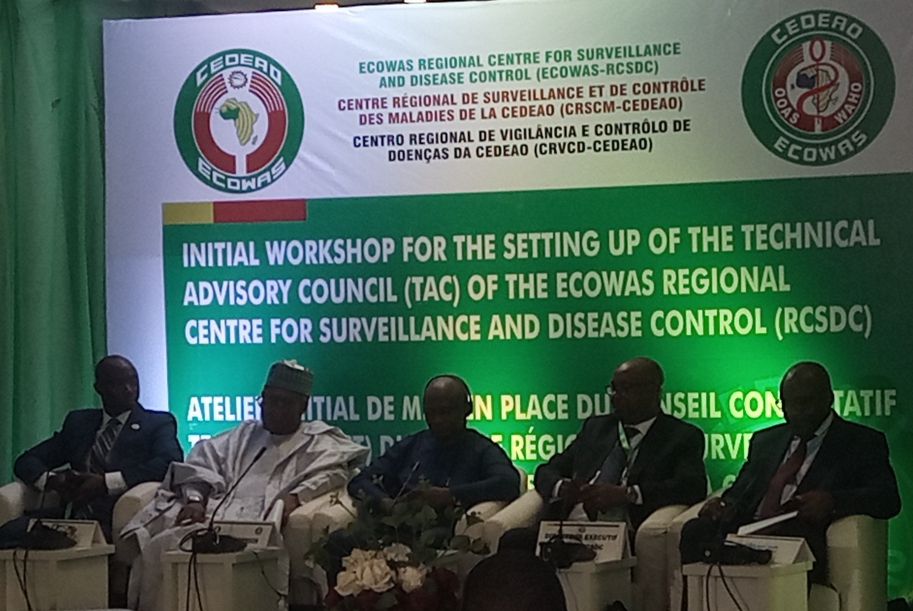
The President of ECOWAS Commission, Dr. Omar Alieu Touray, has charge the Technical Advisory Council (TAC) of the ECOWAS Regional Center for Surveillance and Disease Control (ERCSDC) to provide strategic guidance and expertise to the Regional Center.
He urged TAC them to ensure that its programs and activities are technically sound, evidence-based, and aligned with regional and global health priorities.
He gave the charge at the opening session of a two-day national workshop for the setting up of the Technical Advisory Council (TAC) of the ECOWAS Regional Center for Surveillance and Disease Control (ERCSDC), taking place in Abuja.
ECOWAS Commission President recalled that the outbreak of Ebola in 2014-2016 and the COVID-19 pandemic have highlighted the importance of robust health systems, effective surveillance, and swift disease control measures.
He noted that the ECOWAS Authority created the Regional Centre for Surveillance and Disease Control with a mandate to identify, assess, and report current and emerging threats posed to human health by diseases and prepare appropriate responses.
He observes that the ECOWAS Regional Center for Surveillance and Disease Control (ECSDC) plays a critical role in strengthening regional capacities to prevent, detect, and respond to public health threats.
According to him, “The establishment of the Technical Advisory Council marks a significant step forward in our collective efforts to strengthen health security in West Africa.
“I urge us to embrace the spirit of collaboration, share our expertise, and work together towards a common goal. The Technical Advisory Council should be seen to play a critical role in ensuring that the ECOWAS Regional Center for Surveillance and Disease Control is equipped with the latest technical expertise and knowledge. As we move forward, I encourage Council members to leverage their expertise to inform program design, implementation, and evaluation.
“I urge the Technical Advisory Council to take a regional approach, to consider the specific needs and contexts of ECOWAS member states. As we move forward, it is essential that we ground our decisions in evidence.”
On his part, Nigeria’s Minister of health, Dr. Muhammad Ali Pate while declaring the workshop open, said that the Nigeria Centre for Disease Control and Prevention (NCDC) has set a benchmark in International Health Regulations (IHR) coordination and in building capacity for health emergency preparedness and response.
According him, “Its efforts in fortifying laboratory networks, genomic surveillance architecture and developing rapid response systems are indispensable during outbreaks. Through strategic partnerships with global institutions such as the World Health Organization (WHO) and Africa CDC, the NCDC exemplifies scientific excellence and collaborative innovation.
The Minister maintained that the lessons learned and the capacities built at the national level serve as a clarion call for all ECOWAS Member States to work in concert towards an integrated regional approach to health security.
“The establishment of the Technical Advisory Council is a pivotal step forward in our collective mission. As envisioned under ECOWAS Regulation C/REG/11/12/15, the TAC will be much more than a statutory body-it will be a dynamic forum for the exchange of scientific knowledge and technical expertise. Its membership will comprise distinguished regional and international experts in public health.
“They will play an Instrumental role in ensuring that the Centre’s operations reflect the highest standards of scientific excellence and operational efficiency, and in providing strategic recommendations to the Executive Director and the Governing Board of the RCSDC. Their contributions will be pivotal in pooling critical knowledge, ensuring that our regional strategies are responsive to emerging threats, and fostering a culture of continuous innovation and collaboration across the region.
“This workshop represents a critical milestone in our regional journey-a journey defined by our collective aspiration to build a resilient, integrated health security framework across the ECOWAS region”, he stated.
Also speaking, the World Health Organisation (WHO) Regional Director on emergencies in West Africa, Dr. Abdou Salam Gueye, observed that African region carries the highest burden of public health emergencies globally, with over 100 major events reported each.
However, he said that in any emergency, what is critical is to deliver rapid, predictable, and comprehensive support to member states in terms of prevention, risk reduction, preparedness, surveillance, response and early recovery in case of any threat to human health.




















 Business News1 week ago

 Business News4 days ago