
For Records
Building Brains Before School: New Report Urges Early Investment in Nigerian Children

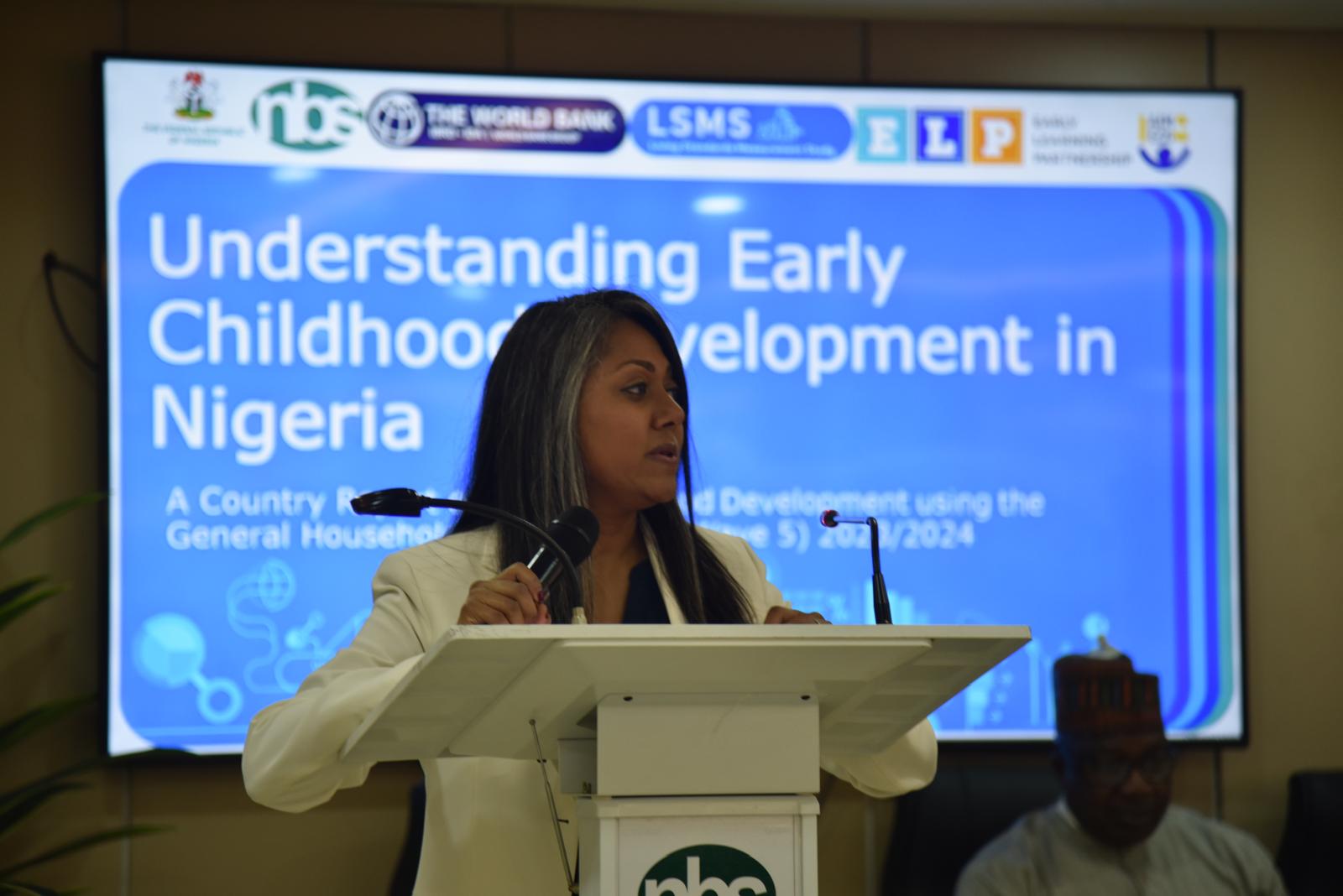
A new report by the National Bureau of Statistics (NBS) and the World Bank has sounded the alarm on the urgent need to invest in Nigerian children long before they set foot in a classroom.
Drawing from the 2023/2024 General Household Survey–Panel (Wave 5), the landmark study paints a clear picture of the challenges young children face in their earliest years, especially in nutrition, caregiving, and early learning.

Group photograph of participants
The report, “Early Childhood Development in Nigeria: A Country Report,” includes, for the first time, national indicators on preschool child development. It reveals powerful links between early life conditions, such as nutrition and caregiving, and a child’s cognitive and emotional growth between ages 0 and 6.
One of the report’s most sobering findings shows that only 4.5% of stunted children aged 4 to 6 could write a simple word, compared to 20.9% of non-stunted children. In northern states like the North East and North West, where stunting affects over 40% of children, the consequences are particularly dire.
“In zones where stunting is highest, fewer than one in ten children can demonstrate basic literacy,” the report notes. “This has serious implications for school readiness and long-term learning.”
Speaking at the event, David Babalola, Supervising Director at the NBS, called the GHS-Panel a “national treasure,” noting how it has grown to capture essential development indicators. “The GHS-Panel is not just a data set; it is a story of where Nigeria’s children are coming from, and where they are headed if we don’t intervene,” he said at the report’s launch in Abuja.
This is the first time Nigeria has used a validated tool to measure early childhood development in a national survey. The assessment covered literacy, numeracy, social-emotional growth, and executive function – the mental skills critical for learning such as memory, attention, and self-control.
The findings expose deep regional and socioeconomic disparities. Children in urban areas or those with more educated mothers consistently outperform their rural counterparts. For instance, while over 65% of children in the South West could write a simple word, fewer than 10% in the North East and North West could do the same. The gap in basic literacy between urban and rural children stands at a staggering 34 percentage points.
In her remarks, Dr. Rifat Hasan, Practice Manager for Health, Nutrition and Population at the World Bank, emphasized the importance of acting early. “The clock starts ticking from the moment a child is conceived,” she said. “The first 1,000 days from pregnancy to age two shape the foundations of life. The next 1,000 days either build on that foundation or break it.”
Dr. Gbemisola Oseni, Manager of the LSMS Program at the World Bank, highlighted the need for cross-sectoral collaboration to tackle the issues raised in the report. “The findings can guide integrated policies in health, education, nutrition, and social welfare,” she noted.
Calling for swift and strategic action, Dr. Ritgak Tilley-Gyado, Senior Health Specialist with the World Bank, warned of the consequences of inaction: “If we don’t act during this critical window, the economic and human costs will be staggering. This data provides clear evidence of how malnutrition undermines brain development and future productivity.”
The report lays out five priority actions: Put nutrition at the heart of Nigeria’s human capital strategy, Integrate early childhood development (ECD) into national development plans, Move from siloed to multisectoral programs, Tailor interventions by region based on specific needs; and Equip frontline workers, such as teachers and caregivers, with the tools to support early learning.
“With this data in hand, Nigeria has what it needs to make smart, targeted investments in the next generation,” the report concludes. “The real question is whether we will act in time.”
Government ministries, international agencies, including the U.K. Foreign, Commonwealth and Development Office (FCDO), Global Financing Facility, and local NGOs were present at the launch, underscoring the broad support for accelerating progress in early childhood development across Nigeria.







Click to read full text









NAICOM Clears Seven More Insurers, Closes Recapitalisation Exercise At 50 Operators

Kari Opposes Regulatory Concessions For Insurance Recapitalization Defaulters

Vom: Plateau People Cannot Have It Both Ways

FG flags Off Smart Meters Installers Training programme, Targets Installing Seven Million Meters Nationwide

MPC Meeting: Nigeria’s Economy Remains Resilient To External Shocks, Cardoso Assures As Members Commit To Sustain Financial Stability

NHRC Tasks FG, State Govts, People Of Means To Make Practical Interventions Towards Combating Poverty, Inequity


-
 Business News6 days ago
Asset Integrity, Life Extension, Fixing Obsolescence Key To Sustaining Value For Independents – Seplat CEO
-

 News3 days ago
Police Arrest Clergyman, Air Force, Navy Personnel Over Alleged Plot To Kidnap Bishops’ Wives In Plateau
-

 News6 days ago
Gov Abiodun Commends Army, Police, DSS, Others For Intelligence-led Rescue Of Five Kidnapped Poly Students, Two Others