
For Records
TCN Confronting Insecurity, Other Challenges In Power Transmission

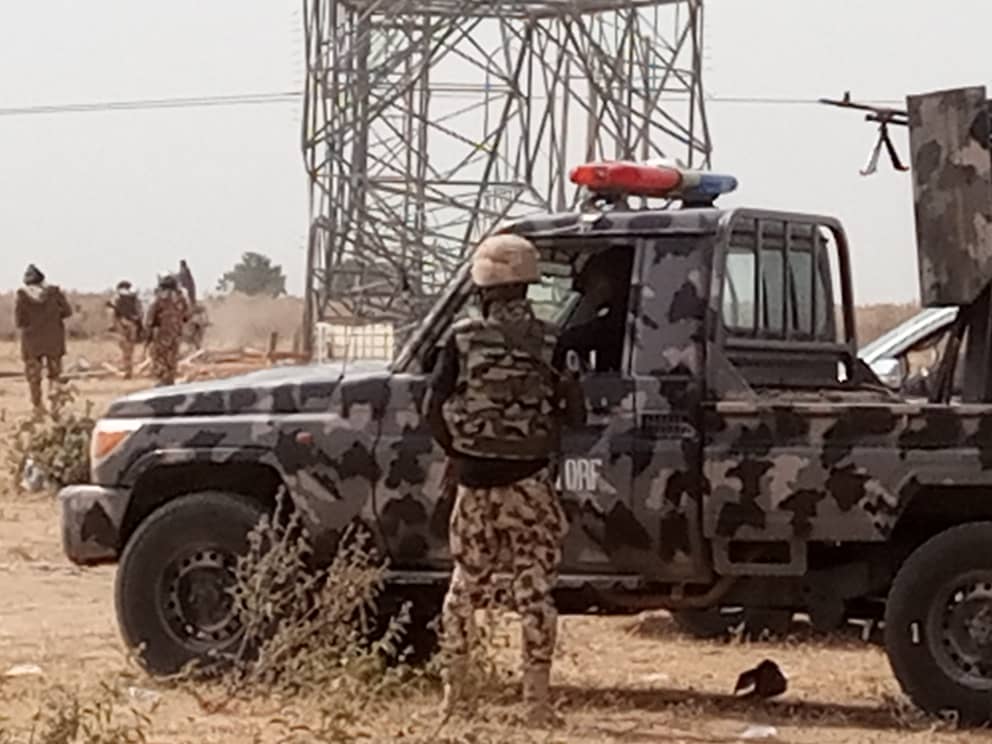
Before the recent past, the Transmission Company of Nigeria (TCN), have had to contend with numerous challenges in power transmission network which in collaboration with other players in Nigeria electricity supply chain are managed and minimised.
However, the increasing security challenges such as Boko Haram attacks/bombing of transmission infrastructure, kidnapping, vandalisation of power transmission lines among others have taken a threatening dimension to the extent of frustrating the well intentions of the TCN and setting the hands of progression backwards in its operations.
Examining the challenging issues TCN is daily confronting in its operations in Nigeria Electricity Supply Industry, as a middle player between the Generation companies (GenCos) and the Distribution Companies (DisCos), it always find itself in a dilemma position. Beginning with power generation, it is what’s generated that is taken off by the TCN. In other words, if for any reason the GenCos fail short of expected generation capacity, the failure will reflect in the inability of the TCN to off take and transmit power even if it has the capacity to transmit. It cannot transmit what was not generated.
For instance, statistics obtained from the Power Advisory Team under the Presidency showed that on 31st March, 2021, the peak generation attained was 4,618 MW which was less than peak generation attained ever 5, 801.6 MW recorded on March 1, 2021. Further statistics showed that on the 31 March, average energy sent out was only 4,234 MW/Hour, resulting to losing an estimated N924,000,000 mainly attributed to insufficient gas supply, distribution infrastructure and transmission infrastructure.The implication is that the more generation, the more power is sent out and transmitted.
On 30 days trend, March 10, 2021- April 8, 2021, the average energy was 4, 258 MWH/H with total constraint of 1,569 MWH/H and revenue loss of N22,589,000 while the peak power was 5,485 MW
But then, the transmission company faces chronic constraint from the DisCos in their inability to off- take their respective load allocations. To that extent, even if the peak generation was sent out and the entire load taken, the transmission company can only boast of transmitting loads accepted and distributed by the DisCos. Until recently, when the Nigerian Electricity Regulatory Commission (NERC) stepped in to enforce order in the distribution subsector, the trend had been load allocation rejections by DisCos due mainly to obsolete and inefficient distribution networks.
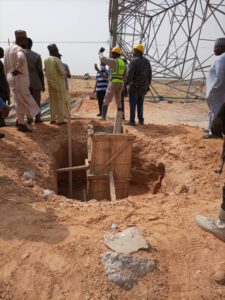
Engineers on Site standing beside one of the bombed transmission towers by Boko Haram terrorists at Jakarna for the construction of temporary diversion transmission lines for supply of power to Maiduguri, Borno state.
The TCN has embarked on series of reforms, repositioning and expanding it’s network operations in terms of reconductoring outdated network lines, constructing new transmission substations, expanding transmission transformers in various parts of the country in order to boast it’s capacity to off- take any available generated power and distribute same. Currently, it boasts of capacity to transmit any available generated power.
But the same cannot be said of all the DisCos. Instead, most of the DisCos are operating under outdated infrastructure, lack of investment, without any attempt at restructuring, reforming and expanding distribution capacities.
But the regulatory instrument released in February, 2021 by NERC titled: “Guidelines for Economic Merit Order Dispatch of Generation Capacity and Related Matters,” appears a saving instrument for TCN to compel DisCos to off- take assigned load allocations. While the Regulatory Instrument made it mandatory that where TCN was unable to deliver a Disco load allocation, the TCN shall be liable to pay for the associated capacity charge, it also provided that where a Disco fails to take its entire load allocation due to constraints in its network, the Disco shall be liable to pay the capacity charge as allocated in its vesting contract.
Further is that under the guidelines, TCN would be held accountable for failure to deliver to a Disco’s nominated trading points the contracted load allocation due to constraints in its (TCN’s) network and hold Discos accountable for failure to off-take its available contracted load allocation at its nomination points.
With the present state of investment and expansion programmes of the TCN, it is apparent that it will not be found wanting in compliance with the regulation.
Of recent, the Federal Executive Council approved about $26 million worth of power projects in Borno, Yobe and Adamawa States. According to the Minister of Power, Sale Mamman, FEC “approved the payment of the claims and the variation of onshore and offshore cost of the existing contract for the construction of 1×1 50 MBA three 31, 32, 33 KV sub-stations at Damaturu and 1×330 KV land by extension at Gombi in the sum of $1,621,423.88 cents plus N102,905,606.07.
“The other one is the approval of the contract for the design, manufacturing and supply of four fabricated sub-stations of 2×100 MBA 132 33 KV power transformers with complete accessories for deployment to Damaturu, Potiskum, Biu, and Maiduguri for the Transmission Company of Nigeria (TCN) in the sum of $24,387,850.22 cents plus N1,475,204,584.34. Altogether, it is N10,730,393,742.82.’’
Notwithstanding the degree of innovations and expansion programmes in the transmission network, TCN operations is further threatened and frustrated by the increasing spate of insecurity in Nigeria. For instance, early in January, 2021, Boko Haram terrorists bombed three high tension transmission towers along Maiduguri-Damaturu road thereby threw Maiduguri and it’s environs into total darkness. Even, after TCN had restored electricity supply to Maiduguri after two months of darkness with the construction of temporary diversion under tight security guards, the terrorists blew up the temporary diversion infrastructure and subsequently threw Maiduguri and it’s environs into darkness once again.
For now, work is still on going for the reconstruction of transmission towers T159,T160 and T161 blown by Boko Haram in Jakana area of Maiduguri along Maiduguri-Danaturu transmission line under tight security guards and measures. It would be recalled that while work was ongoing on the temporary transmission line in the month of February, 2021, five out of the TCN engineers working on the line were rushed to the hospital following injuries sustained as one of their vehicles drove on an explosive device buried underground by insurgents. This indicates that without adequate security arrangements, the staff are exposed to either being killed, maimed or kidnapped in course of their field work following heightened insecurity nationwide
The fact remains that though the TCN remains determined in achieving seamless transmission, it is faced with daunting challenges within the power sector value chain as well as security challenges even at the risk of personnel life.






Click to read full text









2027: Why Tinubu Will Defeat Kwankwaso In Kano — Abdulmumin Jibrin

214 UNICAL Students File N5 Billion Suit Challenging Removal From Law Faculty

Gov Sule Commends DSS, Other Security Agencies Over Rescue Of Kidnapped Victims In Nasarawa State

FG flags Off Smart Meters Installers Training programme, Targets Installing Seven Million Meters Nationwide

MPC Meeting: Nigeria’s Economy Remains Resilient To External Shocks, Cardoso Assures As Members Commit To Sustain Financial Stability

NHRC Tasks FG, State Govts, People Of Means To Make Practical Interventions Towards Combating Poverty, Inequity


-
 Business News1 week ago
TCN Boosts Power Transmission In Rivers State, Commissions 150MVA Power Transformer at Afam Substation
-
 Business News5 days ago
President Tinubu’s New Deep Offshore Investment Framework, Game Changer For Nigeria’s Oil Sector – TDF
-

 Business News5 days ago
FGN Power Company Supports Visiola Foundation’s 2026 STEM Summer Camp, Inspires Next Generation Of Energy Innovators