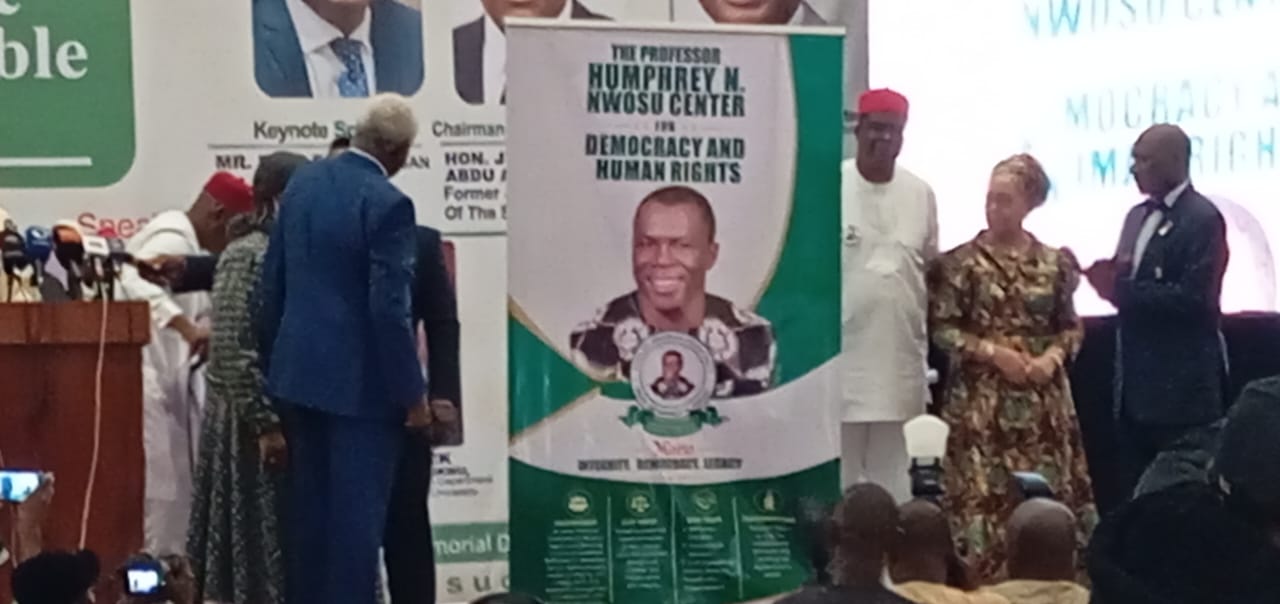
Communiqué issued at the Annual June 12 Commemoration Lecture and the Formal Unveiling of the Prof. Humphrey N. Nwosu Center for Democracy and Human Rights, held on 9 June 2026 at the Shehu Musa Yar’Adua Centre, Abuja, Nigeria, on the theme: “Electoral Integrity and the Future of Credible Elections in Nigeria.”
PREAMBLE
The Annual June 12 Commemoration Lecture and the Formal Unveiling of the Prof. Humphrey N. Nwosu Center for Democracy and Human Rights was held on 9 June 2026 at the Shehu Musa Yar’Adua Centre, Abuja. The event was organized by the National Human Rights Commission (NHRC) in collaboration with the Prof. Humphrey N. Nwosu Center for Democracy and Human Rights to honour the enduring legacy of the late Professor Humphrey N. Nwosu, whose leadership in conducting the June 12, 1993 Presidential Election remains a benchmark for electoral credibility, democratic governance, and public trust in Nigeria.
The unveiling of the Centre signifies a renewed national commitment to the core values of Integrity, Democracy, and Legacy. These guiding principles reflect Professor Nwosu’s steadfast dedication to electoral integrity, his invaluable contributions to the consolidation of democratic governance, and the enduring legacy he bequeathed to future generations of Nigerians in the pursuit of free, fair, and credible elections.
The Lecture brought together senior government officials, members of the judiciary, legislators, election administrators, representatives of political parties, civil society organizations, development partners, academics, the media, and other stakeholders. The gathering provided a platform for critical reflection on Nigeria’s democratic journey and the collective responsibility of all stakeholders to uphold the values of integrity, strengthen democratic institutions, and preserve the legacy of those who have advanced the cause of democracy and human rights in the country.
In his keynote address to the forum, the foremost Nigerian human rights lawyer, Mr. Femi Falana, speaking on the theme, “Electoral Integrity and the Future of Credible Elections in Nigeria,” emphasized the importance of electoral integrity as a foundation for democratic legitimacy. He also highlighted the following key issues:
Political parties that fail to conduct free, fair, and transparent primary elections cannot be said to be fully committed to the conduct of credible elections in Nigeria;
Professor Humphrey N. Nwosu successfully conducted the June 12, 1993 Presidential Election, which remains widely regarded as one of the freest and fairest elections in Nigeria’s history;
The prevailing security challenges in the country raise critical concerns regarding the conduct of peaceful, inclusive, and credible elections;
The persistent incidents of kidnapping, abduction and other forms of criminality must be effectively addressed to create an enabling environment for credible electoral processes.
The continued threat of terrorism and insecurity could undermine electoral activities and impede meaningful participation in the democratic process.
Nigerians must remain steadfast in defending the principles of justice, equity, and accountability, and be willing to stand for what is right irrespective of ethnic, tribal, or religious considerations.
Genuine democracy cannot thrive where any group of people is excluded or subjected to discrimination in governance processes; and that there is no democracy without liberation of women
Eminent Nigerians, human rights activists, scholars, and politicians who served as members of the panel engaged in robust deliberations on the following thematic areas:
Electoral Integrity and Public Trust;
The panel deliberated extensively on the critical relationship between electoral integrity and public confidence in democratic institutions, and observed as follows:
i. Electoral integrity remains the cornerstone of any credible electoral process and can only be guaranteed where electoral management bodies operate independently, free from political interference, and where the will of the people is not truncated.
ii. The erosion of public trust and confidence in the electoral process constitutes a significant threat to Nigeria’s democracy, underscoring the need for sustained efforts to restore citizens’ confidence in electoral institutions and processes; and
iii. The real threat is Independent National Electoral Commission (INEC), itself not being independent: The panel expressed concern over the perceived lack of independence of INEC, emphasizing the need to strengthen its institutional autonomy, transparency, and accountability in the administration of elections.
b) Electoral Reform and the Legal Framework
The panel underscored the importance of comprehensive electoral reforms as a prerequisite for strengthening Nigeria’s democratic institutions and observed as follows:
i. Meaningful and sustainable electoral reform should draw significantly from the recommendations of the Justice Mohammed Uwais Electoral Reform Committee.
ii. INEC should undertake internal structural and institutional reforms to address existing challenges and improve public confidence in the electoral process.
iii. Electoral officials must uphold the highest standards of professionalism, impartiality, and non-partisanship in the discharge of their duties in order to restore trust in the electoral system.
iv. Strengthening the institutional capacity and independence of INEC is essential to enabling the Commission to effectively discharge its constitutional mandate and advance democratic governance.
v. The recruitment, appointment, and promotion processes within INEC should be transparent, merit-based, and free from ethnic, political, or other primordial considerations; STOP
vi. INEC should take a proactive role in advocating for and implementing electoral reforms aimed at improving the credibility, transparency, and efficiency of elections in Nigeria;
vii. As much as laws and regulations are critical to electoral processes, the commitment to faithfully implement and uphold their underlying objectives is equally important in achieving meaningful electoral reform;
viii. INEC should exercise its statutory powers and responsibilities with courage, independence, and integrity, without undue influence or intimidation, in order to safeguard the sanctity of the electoral process and strengthen public confidence in democratic governance.
KEY OBSERVATIONS
Participants observed that:
a. The June 12, 1993 Presidential Election remains the most significant symbol of electoral integrity and democratic aspiration in Nigeria’s history.
b. Electoral integrity is fundamental to democratic legitimacy, political stability, national development, and the protection of human rights.
c. Despite notable democratic progress since 1999, challenges such as voter apathy, electoral violence, vote-buying, misinformation, political intolerance, and declining public trust continue to threaten the credibility of elections.
d. The independence, transparency, and effectiveness of electoral institutions remain critical to the conduct of free, fair, credible, and inclusive elections.
e. Youths, women, and persons with disabilities remain underrepresented in political leadership and decision-making processes.
f. Civic education, voter enlightenment, and citizen participation are indispensable for strengthening democratic culture and accountability.
g. The protection of civic space, freedom of expression, freedom of assembly, and access to justice are essential conditions for democratic consolidation.
h. The establishment of the Prof. Humphrey N. Nwosu Center for Democracy and Human Rights is a timely and strategic initiative for preserving democratic memory, advancing human rights, promoting electoral reforms, and developing future democratic leaders.
START 3. RESOLUTIONS AND RECOMMENDATIONS
The panel recommended as follows:
i. The establishment of an independent and robust electoral accountability, regulatory, and oversight framework with clearly defined procedures for monitoring, tracking, and auditing all stages of the electoral process in order to enhance transparency, credibility, integrity, and public confidence in elections;
ii. The strengthening of internal democracy within political parties to ensure transparent, inclusive, and credible candidate selection processes;
iii. The enhancement of the institutional independence, autonomy, and operational capacity of INEC to enable it to discharge its constitutional mandate effectively and without undue influence;
iv. The appointment of persons of proven integrity, competence, and professionalism to key electoral and governance institutions;
v. The implementation of reforms aimed at strengthening the electoral system and restoring the sovereignty of the people as the ultimate source of democratic authority;
vi. Consideration of constitutional and electoral reforms that promote political stability, accountability, and good governance, including proposals relating to tenure arrangements and electoral cycles;
vii. The full implementation of the recommendations of the Justice Mohammed Uwais Electoral Reform Committee and other relevant electoral reform initiatives;
viii. Increased civic and voter education to deepen public understanding of elections as a fundamental democratic process and a vehicle for popular participation in governance; STOP
ix. The strengthening of regulatory oversight and supervision of political parties to ensure compliance with constitutional provisions, electoral laws, and democratic principles, particularly with respect to internal democracy, candidate selection processes, and financial accountability;
x. The consideration of reforms aimed at fostering a more stable, cohesive, and effective party system, including measures to reduce excessive political fragmentation and promote ideological coherence among political parties; and
xi. The consideration of constitutional and electoral reforms introducing a single-term tenure for elected executive office holders as a means of promoting accountability, minimizing the influence of incumbency, and strengthening democratic governance.
4. COMMITMENTS
Participants reaffirmed their commitment to the ideals of June 12 and pledged to continue supporting initiatives that promote electoral integrity, constitutional democracy, human rights, accountability, transparency, civic participation, and ethical leadership in Nigeria.
START 5. CONCLUSION
The Lecture concluded with a renewed call on all stakeholders to work collectively towards building a democratic Nigeria founded on justice, inclusion, accountability, respect for human rights, and the rule of law. Participants further resolved that the values exemplified by Professor Humphrey N. Nwosu—integrity, courage, professionalism, and service to the nation—should continue to guide efforts aimed at strengthening democratic governance and credible elections in Nigeria.
Issued this 9th Day of June, 2026 for and on
behalf of the Participants.



















 Business News1 week ago
 News3 days ago