
News
How We Saved Federal Government Over $827.4 Million Using In-House Capacity, TCN


By CLEMENT NWOJI, Abuja
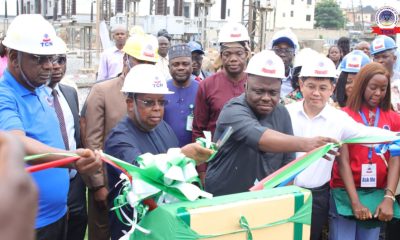
The Transmission Company of Nigeria (TCN) on Monday said it has saved the Federal Government over $827.4 million through what it called “use of in-house capacity” in takeover and construction of two substations initially awarded to contractors who abandoned the execution halfway.
The TCN managing Director, Usman Gur Mohammed disclosed this while briefing contractors tendering for the “design, supply and installation of OPGW optic fibre cable and universal Optical Transport Network (OTN) equipment” at some substations for monitoring, control and maintenance of system operation facilities.
While emphasizing efficiency in execution of contracts, he said contractors should be able to give competitive prices as TCN current management have no room for bogus bids short of competitive procurement process in line with the directive of ECOWAS heads of States.
He cited that TCN took over execution of two contracts involving construction of substations which were abandoned for many years by the contractors who refused to accept TCN renegotiated price.
Mohammed who said that TCN using in-house capacity to execute the contract, noted that it saved huge amount of money apart from successful completion of the work.
According to the TCN managing director, “We are working to achieve the frequency control required by international standards. The next thing we want to achieve is to modernize and stabilise the grid.
“We need to have steady reserve, we have secured steady reserve of 360 MW, but 360 MW is not adequate and that is what we have procured through competitive exercise. It is with NERC and they are working on how they can get the funding and once it is approved, we deploy it. This is the first time, it is being done in the power sector of Nigeria.
“Another thing is critical investment in lines and substation. From February 2017 when we took over to December, 2018, we expanded the grid by adding 3100 MW. This has never happened in the history the grid that in less than two years.
“We did that through the use of what we called in-house capacity mostly. We empowered our system engineers to install transformers and equipments across the country and they did it successfully at the rate of less than 10 percent of the cost and at less than 10 percent of the time.
“We took over some contracts which have not been performed, most of them have stayed over ten years for contracts which are not supposed to be more than two years.
“Two good examples that I can give you are the Damaturu substation and Idu substation in Kano. In Damaturu substation, when we asked the contractor what it will take to complete the work, the contractor insisted that we have to pay her $4.4 million in addition to $823 million in addition to what she had collected 100 percent of the contract sum plus the variation she had collected amounting to over $2 million.
“So, we took over the work and we sent only N140 million to Bauchi region. I learnt that only N120 million was used and the substation was completed. We have energised the place and it is one of the best substations in the country now.
“Now the same thing happened in Kano, the contractor said we have to pay him N590 million additional cost. But we told him that we won’t. Therefore, we cancelled it and took over. We completed it with N66 million including the road and everything. We have energised it and it is functioning very well.”
He spoke on the recovery of abandoned containers of TCN equipment and installations at the port, saying: “Out of 800 containers we met stranded at the port, we have recovered as at last week 768 containers and I also want to put it on record to you that no containers arrived while we are here that we have not cleared.”
He stressed that Nigeria has to face squarely the task of providing electricity no matter how difficult it may seem because of its multiple advantages.
“Electricity for anybody who want to know, the difference between poverty and development is electricity and you can access any county by their per capita power consumption. If their per capita power consumption is very poor, they will also be very poor”, he asserted.
On the efforts to launch SCADA, he said the nation’s experience had not been good towards this.
According to him, “The last one is the automation, SCADA/EMS/Telecom, including Tele-protection and all the associated elements. We are also tackling it headway. Our experience has not been palatable in that we had attempted to have a functional SCADA more than twice several years but it has not been successful. We don’t want a repeat of that experience.That’s why any thing that we are doing now, we are making sure that it has to be successful.
“We have the funding of the SCADA from the world bank but we have not launched it because we want to solve what caused the failures in the past.
“We in TCN, if there is anything we have achieved in the last two years, is that we have been able to achieve competitive procurement of our services. We ‘re proud to say that we have brought some level of transparency that everybody is proud of, to be honest.
“And that includes resisting the temptations to do things the way they used to do it before. We are going to jealously guard that achievement. We are not going to allow to go back to the previous way because that is reducing our cost and giving us value for our money.
“This is consistent with the directive given by ECOWAS council of heads of States meeting in December 22, 2018 which mandates every government agency to ensure competitive procurement of their services and equipment. We are not going to wait for government to force us to do that because we have already achieved that.
“That is why we continue to open up and ensure that anything we are buying, we are buying them in a way that is transparently done. We have also stabilised TCN to some extent despite the fact that we are not getting all our revenue from the market. TCN is not bankrupt company, I can tell you. Everything we are buying or advertised to buy, we have the money to pay. As an account, I don’t award contract that when we don’t have the money to pay.”







Click to read full text









Power Minister Decries Yearly Energy Loss Worth N120 Billion Along 132kV Ikorodu–Sagamu corridor, Threatens Stiff Measures Against Culprits

Arrest Kuje Council Chairman Now For Breaching Constitution, Inciting Disturbance Of Public Peace With “Leave Kuje If Not APC” Comment

MESSAGING AND 2027 ELECTION CAMPAIGNS

NERC Gives PHED 60-Days To Incorporate PHED SubCo To Oversee Interstate Power Supply As AKSERC Assumes Electricity Oversight

Electricity For Underserved Communities: REA, Alpha Morgan Bank Collaborate On ₦50 Billion Financing Facility To Accelerate Access

Asset Integrity, Life Extension, Fixing Obsolescence Key To Sustaining Value For Independents – Seplat CEO


-
 News1 week ago
Electricity For Underserved Communities: REA, Alpha Morgan Bank Collaborate On ₦50 Billion Financing Facility To Accelerate Access
-
 Business News3 days ago
AECAF Congratulates Abdulrazaq Isa, Bala Wunti, On Respective Emergence As Chairman, CEO World Energy Council Nigeria
-

 News3 days ago
Community Leaders Commend DSS Over Arrest of Arms Supply Kingpin, Dismantling of Terrorists’ Networks In Katsina, Nasarawa States