
News
2060: FG Targets Unlocking Investment Opportunities In Renewable Energy Worth $410 Billion

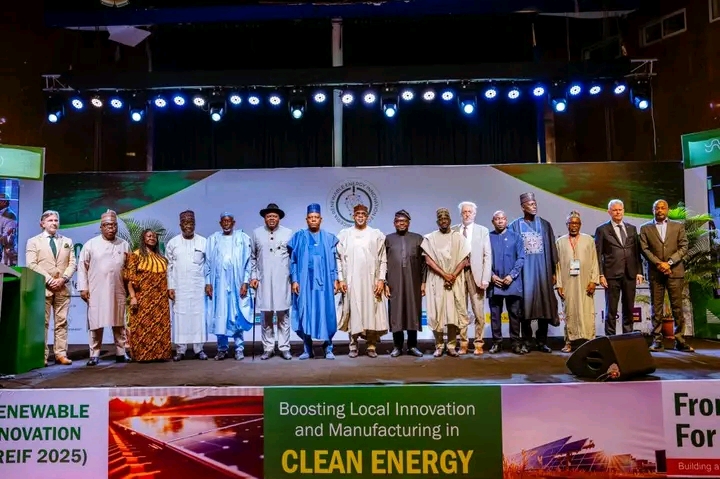
Group photograph with the Vice President, Sen. Kashim Shettima at the event.
…As REA Champions Domestication Of Renewal Energy Innovations
The federal government is targeting unlocking investments opportunities in renewable energy subsector worth over $410 billion between now and 2060.
It also indicated that over $23 billion is required to expand energy access and connect the millions of Nigerians who still live in energy poverty within the timeframe.
The Vice President, Kashim Shettima, disclosed this in Abuja Tuesday, while declaring open on behalf of President Bola Tinubu the two-day inaugural “Nigerian Renewable Energy Innovation Forum (NREIF) 2025.”
He further said the ambition is to deliver a power system capable of 277 GW total installed capacity by 2060, stressing however that apart from investments, its achievement requires innovation, local capacity and commitment.

The Managing Director of the Rural Electrification Agency, Mallam Abba Aliyu while delivering his opening remarks.
According to the Vice President, “Renewal energy is the escape root from the historical shortcomings that define our energy story. This is why the success of our energy transition will not be met by the elegance of our policies or by our admission of our convictions but by our abilities to transform our ideas into practical solutions that guarantee availability, affordability and sustainability for every Nigerian.
“Nigeria’s energy transition presents an investment opportunity of over $410 billion between now and 2060. Of this more than $23 billion is required to expand energy access and connect the millions of Nigerians who still live in energy poverty.
“We have too much at stake. We are blessed with the minerals that power clean technologies, and Nigeria brings to the table youth, ambition, and untapped renewable potential.
“Let us seize this moment. Let us affirm that Nigeria is ready, ready to harness her resources, unlock her capital, and become the vibrant heartbeat of Africa’s renewable energy revolution,” he declared.
“But beyond access lies our grander ambition, which is to deliver a power system capable of 277 gigawatts of total installed capacity by 2060. This ambition demands more than investment; it demands innovation, local capacity, and commitment,” he added
Sen. Shettima assured investors, development partners and other stakeholders at the forum of President Tinubu’s commitment to consolidating policy foundations that would lead to a renewable energy market that is self-sustaining.
“We are enhancing incentives for local manufacturing, streamlining regulatory frameworks, and deepening collaboration with State Governments, investors, and development partners to de-risk private capital and accelerate the emergence of a self-sustaining renewable energy market,” the VP explained.
The ‘Nigeria First’ industrial strategy, he pointed out, demands that the future of Africa’s renewable energy supply chains be anchored indigenously, just as he said, “From solar panel assembly lines in Lagos to battery recycling hubs along our industrial corridors, Nigeria must not only participate in this revolution but lead it.”
To this effect, VP Shettima hinted at the Federal Ministry of Power’s readiness to develop policies that would lay the foundation “for a more decentralised, competitive, and inclusive electricity market.”
He however noted that efforts to prioritise energy transition cannot succeed without the private sector, even as he called on development partners and Original Equipment Manufacturers “to localise technologies, strengthen value chains, and invest in skills and knowledge transfer.
“We count on our State Governments to champion renewable industrial clusters and serve as engines of green growth across the federation,” he added.
The Vice President urged participants at the maiden Nigerian Renewable Energy Innovation Forum 2025 to reach agreements, forge partnership and consolidate a national roadmap that would unfold the over $400 million investment in Nigeria’s renewable energy manufacturing value chain into a reality.
“I am pleased to announce that through the engagements facilitated under this Forum, more than 400 million dollars in new investment commitments are being mobilised into Nigeria’s renewable energy manufacturing value chain.
“These include solar panels, smart meters, battery storage, and recycling facilities. These investments are projected to create over 1,500 direct jobs across multiple States and reflect growing global confidence in Nigeria’s clean energy industrialisation drive,” he disclosed.
Earlier, Minister of Power, Chief Adebayo Adelabu, said the Nigerian Renewable Energy Innovation Forum (NREIF) marks a new chapter in Nigeria’s energy transformation pathway that highlights the role of innovative partnership in targeting a significant amount of local solar energy production capacity.
While giving background of the event, the Managing Director of the Rural Electrification Agency, Mallam Abba Aliyu, said the NREIF is a forum that connects policy and vision with research efforts as well as accelerates Nigeria’s aspirations to developing a sustainable green energy ecosystem.
He explained that the Forum was conceived from a simple but powerful idea — that the future of power in Nigeria will not be imported; it will be innovated, built, and sustained here at home.
According to him, “NREIF stands as a platform to connect policy ambition with market reality, research with investment, and innovation with implementation — a space where the ecosystem can co-create Nigeria’s renewable energy future.”
The REA Managing Director observed that across the world, the energy transition is accelerating, driven by advances in solar technology, battery storage, and digital energy systems, and stressed that Nigeria cannot be left behind.
“The Nigerian government has already set ambitious targets:
Achieving net-zero by 2060,
Delivering a 30GW of electricity by 2030, with at least 30% from renewables. And through our Energy Transition Plan (ETP) and Energy Compact, committing to mobilize over $10 billion in clean energy investment this decade.
“These commitments form the backdrop against which the NREIF becomes not just timely — but essential, as a platform to translate targets into investments, and investments into impact”, Mallam Abba Aliyu further explained.
In the same vein, the UN Deputy Secretary General, Ms. Amina Muhammed, who was represented by the United Nations Resident/ Humanitarian Coordinator in Nigeria, Mohammed M. Malick Fall, said the gathering of stakeholders embodied the global ambition in the renewable energy sector, and provides a direction for Nigeria to harness its abundant natural renewable energy capacity and lead the continent as the engine of renewable energy solution.
He pledged the UN’s commitment to collaborate with Nigeria on the journey to build a vibrant local energy sector and foster the aspiration of powering homes, schools and communities.
Also, the Dutch Ambassador to Nigeria, Bengt Van Loosdrecht, said his country remains Nigeria’s reliable partner in the renewable energy sector, noting that the event represents a “milestone” in the partnership between both countries.
In the presence of the Vice President, the Governors of Jigawa, Bayelsa and Ogun States, and the management of REA, signed several multi-million Memorandum of Understanding (MOUs) with various private sector development partners, including the Dutch government, among others.







Click to read full text









THE PROPOSED OPPOSITION CONSENSUS CANDIDACY

Vandals On Rampage, Destroy Five Transmission Towers Along Ikot Abasi – Eket 132kV Line

Deep Offshore Incentive Order Will Accelerate Investment, Production Growth, Says Ojulari

FG flags Off Smart Meters Installers Training programme, Targets Installing Seven Million Meters Nationwide

MPC Meeting: Nigeria’s Economy Remains Resilient To External Shocks, Cardoso Assures As Members Commit To Sustain Financial Stability

NHRC Tasks FG, State Govts, People Of Means To Make Practical Interventions Towards Combating Poverty, Inequity


-

 News4 days ago
Police Arrest Clergyman, Air Force, Navy Personnel Over Alleged Plot To Kidnap Bishops’ Wives In Plateau
-
 Business News1 week ago
Asset Integrity, Life Extension, Fixing Obsolescence Key To Sustaining Value For Independents – Seplat CEO
-
 News7 days ago
Gov Abiodun Commends Army, Police, DSS, Others For Intelligence-led Rescue Of Five Kidnapped Poly Students, Two Others