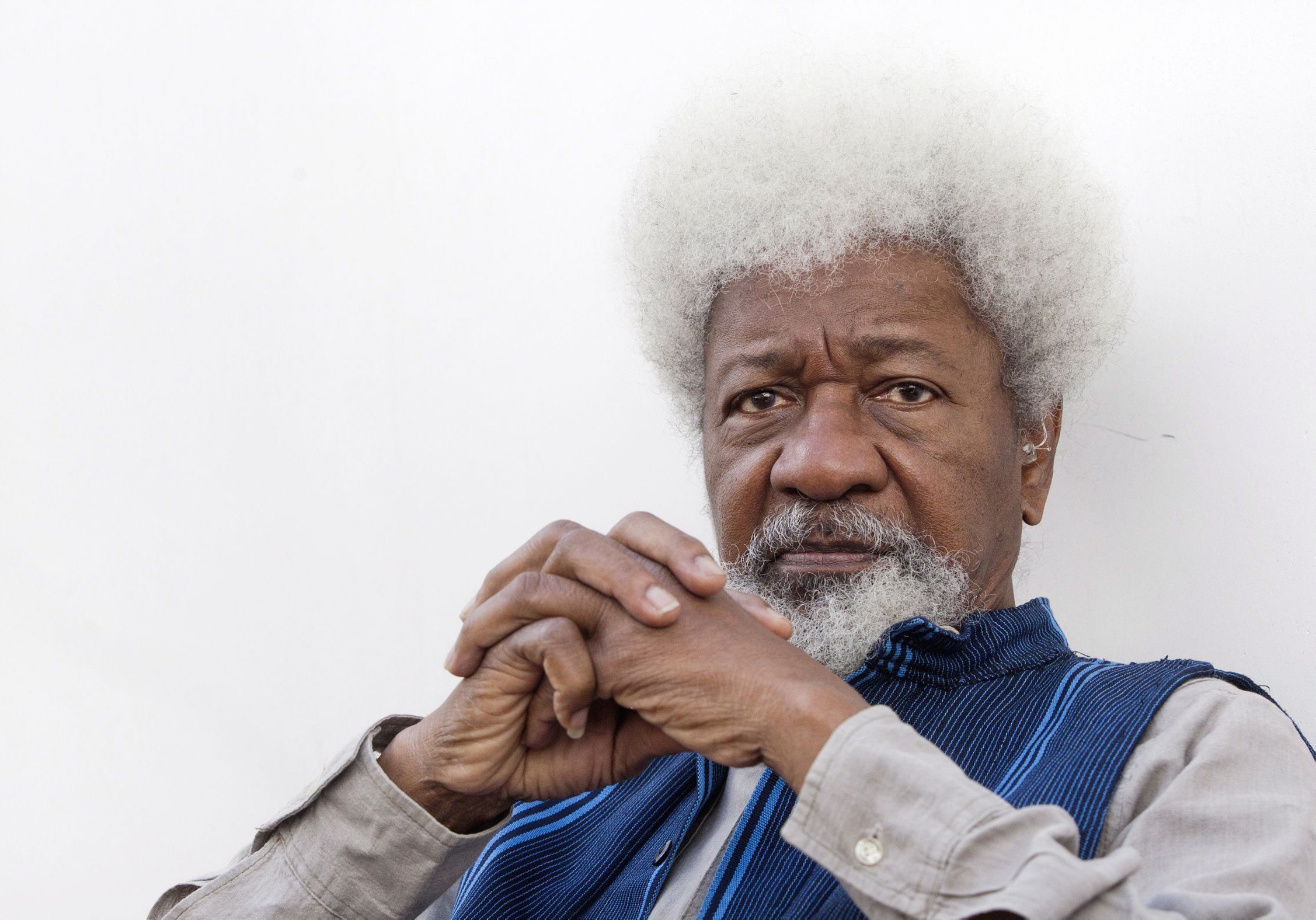
(By Femi Dada, a Geologist, Science Editor and student of political thoughts, attempts in this reminiscence to capture the environment in which Wole Soyinka worked and flourished)
A clip of the film, Kongi’s Harvest circulated on social media in the period about the time of Wole Soyinka’s 90th birthday celebration, on 13th July, 2024. Before the film about this ‘African Maximum Ruler’ was premiered, it was shown to us the ‘cast’, in a private viewing, I think. It’s the film about ‘military rulers’ swarming over all of Africa at the time, from Gamel Naser (’52), to Black Africa’s post-independence 1st coup against Sylvanus Olympio in nearby Togo here (’60 or ’61); to the murder of Patrice Lumumba in Congo (’62 or ’63), to dethronement of Nkrumah in Ghana (’63); to Nzeogwu’s Nigerian Coup (’66), to dethronement of Sekou Toure in Guinea, to final dethronement of our ‘deified’ Emperor Selasie in Ethiopia, by Col Mengitsu Haile Mariam, in the early 70s. This was how ‘mutinous soldiers swam all over Africa at the time. Pardon the accuracies of my dates, I’m just trying to give the ‘back-ground and context’ to a Film like the ‘Kongi’s Harvest’, which i had the privilege to be ‘cast’ in, in 1969, alongside Nigeria’s finest actors then, the likes of Femi Johnson.
About that time, I was on ‘part-time employment’ on ‘lights-control’ too, in the Arts Theatre of the School of Drama (now Wole Soyinka Theatre), of the University of Ibadan, all the way from the Faculty of Science, as a Geology student. I was on ‘stipend’ from Dexter Lyndesy, the then Caribbean technical director of the UI pioneer Theatre, that had productions rivalling Broadway. I particularly remembered ‘The Royal Hunt of the Sun’ on the exploits of the Spanish Conquistadors in the ‘so-called’ New World of the 15th century. Just let’s say I was a relatively ‘rich student’ in my university years of the mid-60s, with my stipend also as a Western Region-Nigeria scholarship recipient. In short, I had the means to engage in ‘revolutionary pursuits’ of sorts then, as per my young ‘naive activist mind’ for boys of my age.
Back to the ‘coup scenarios’ in Africa at the time. And lest I forget, Sellasie became defied across the Atlantic by the nascent ‘Rastafarian Movement’ of the time. It was also the awakening movements of Marcus Garvey in the Caribbean at the time, and that of W.E. B. du Bois, leader of the NAACP (National Association for Advancement of Coloured People) in the US, of that period. I recall at the beginning of the Nigerian Crisis in ’64/’65, i had my ‘first baptism of fire’, when I stayed in the fore-front ‘naively’ of our ‘march’ from the University Campus to Government House, to demand removal of Premier of the Western Region – Nigeria Government. We were of course intercepted close to the run-way of the then Ibadan Airport, and several of us landed with broken bones in the wards of the University Teaching Hospital (UCH), Ibadan. I escaped, and became more experienced in subsequent ambushes, even by the Military in Ibadan at the time. I recall like yesterday, when the attempt at reconciling Colonels Gowon and Ojukwu took place in Ghana, in order to try and ‘avert’ the Nigerian Civil War. It was considered that Gen Ankrah, then Head of Ghana’s Military Government would be listened to by the two younger belligerent Officers as Gowon and Ojukwu were at the time. General Ankrah was their Senior in UK’s Staff College of Sandhurst (Britain being colonial rulers of both Countries); and this attempt at reconciliation failed. And from there, it was ‘down-hill’ into Civil War in Nigeria.
Wole Soyinka’s apparently ‘naive’ mediatory visit to Ojukwu was in this ‘context’. He, Wole too, was relatively young at the time; but ‘naive’ in the sense that Nigerian young military officers then ‘erroneously’ saw coup-planning as a ‘patriotic duty’ to Country, just as their compatriots through-out Africa. It is the same mistake being made by young officers in Niger, Mali, Burkina Faso, in the Sahel, now; a mistake we predict will ‘worsen’ the situations of these countries, with spill over into the rest of West and Central Africa.
One lesson we took away then was Gen Ankrah’s ‘eternal admonition’ to the duo of young Gowon-Ojukwu at the time (Ankrah was older) that, ‘applying martial-military laws to ruling a civilian polity, will always lead to failure’. This is the lesson Africa is yet to learn. The ‘converse’ of this is that the civilian political-elite in Africa is also yet to learn that politics based on ‘rule of law, equity, and transparency’ is the antidote to ‘disruptive rule’ in Africa. Ask the Kenyans now?
Wole Soyinka went into incarceration for his ‘mediating attempts’ on the Nigerian crisis of the mid ’60s for about three years. His saving grace from solitary confinement was probably his ‘ingenuity’ in prison to keep his mind occupied, an ingenuity that produced his ‘prison notes’ in the book, ‘The Man Died’. He was released in 1969 unrepentant, his head unbowed. It was our privilege as members of ‘Kongi’s Brigade’ to receive him into his ‘official residence’ on University of Ibadan campus, that joyous day!!!
‘This is the context of ‘Kongi’s Harvest Film,’ shot in 1969. A lot of us have passed to the great beyond, but some of that generation still remain, including ‘Kongi’ – Wole Soyinka himself, by God’s special grace. It is unfortunate therefore that some upstart Nigerian baby-politicians, of ‘questionable means’ themselves, would have the effrontery to attempt to insult such a ‘national icon’, who at the risk of his life made ‘attempts at reconciliation’ in his country. It shows how far Nigeria has sunk; and whether its situation is a redeemable one is now issue of ‘debate’.
Fast forward to the ’70s-’80s, Nigerians continued to try to redeem the country also, and as a Geologist on Nigeria’s Steel Project, based in Kaduna at the time, one continued privileged interaction with ‘activists’ who honestly thought they could continue the ‘fight’ to rescue Nigeria. Again our small circle of intellectual interactions, mostly in writings, include Bala Usman (academic, historian, political scientist); Patrick Wilmot (political scientist of Carribean extraction, expelled by the Nigerian Military Government then); Edwin Madunagu (mathematician, political scientist ); Biodun Jeyifos (academic, political scientist, semanticist); Femi Bamgboye ( Vet Doctor, political scientist, semanticist); and spartan Balarabe Musa (accountant and my wife’s boss in the banking sector) – politician, and Governor of Nigeria’s Kaduna State. He was later impeached as the first one to be so removed from office in Nigeria’s turbulent politics. Balarabe was the one who appointed Bala Usman his ‘Secretary to Government’. It was probably the ‘finest days and hours’ of the Nigerian ‘left’.
Back at his homebase in the University of Ibadan at the time was a very active Faculty, part of which Wole was a prominent member. This was the era of the likes of Grillo (Anatomy), Tokunbo Durotoye (Physiology), Olumbe Basir (Biochemistry), Oyawoye and Burke (Geology), Ade Ajayi and Ikime (History). Others were, Etteh (Physics), Irvin in chemistry with his world class haemoglobin research centre; and Mrs Ebun Oni in physics. Mrs HIll held Zoology, after Onabamiro’s era; Alasoadura in botany; Sackla (Egyptian) in pre-medicine. In social sciences and economics were the likes of Mabogunje (Geography), Aboyade (Economics); Bade Onimode and Omafume Onoge (Political Science); and Essien-Udom, with Ukpabi Asika also in Social Sciences. Lambo, was in Psychiatry, and later became Vice Chancellor after the departure of Kenneth Dike to the East, before the civil war. Ogunlesi was in medicine. Bolaji Idowu was in Religion, and was Vicar, Chapel of the Resurrection. It was the era of Ademolekun as Registrar, and Akpata as Deputy Registrar. In Wole’s real ‘forte’(in the Art Theatre), were the likes of Dapo Adelugba, Jimi Solanke, and Dexter Lindesy. And lastly, the ‘town’ was in close collaboration with the ‘gown’ in the perpetual presence of the likes of Bola Ige, and Tunji Otegbeye, in the lecture and debate circuits of the University of Ibadan campus of the time. There were several others; but this is the fertile intellectual soil on which Wole Soyinka interacted and blossomed with others, at that time, in the mid-60s.
Fast-forward again to the ’80s and ’90s, and Soyinka, back from self-imposed exile came back to confront the Nigerian Military, and had to be forced out again through the ‘popular NADECO (National Democratic Coalition) trail’, alongside other ‘resistance fighters’. That Wole is 91 now in his ‘chequered life’ is symptomatic of the ‘political malaise’ confronting nearly all African politics, and the ‘struggle still continues’. And whether Africa would eventually fulfil its destined role in the ‘community of nations’ is still debatable. Witness the rousing welcome the civilian populations gave their perceived ‘liberators’ in the recent Sahelian coups, as civilian populations are wont to do; a welcome that soon ‘turns to ashes’ in their mouths!! We have seen it all before. If Africa would not pull itself up ‘by its boot-straps’, the consequences would be dire for Africa, with fall-outs on ‘international stability’. Maybe it’s the ‘doggedness’ of the Wole Soyinka-types that might save Africa; and ‘who knows’?
We should also recall that layered on the incessant coups in Africa at the time were ‘legitimate liberation movements. In Angola, was Augustino Neto; in Guinea-Bissau, was Amilcar Cabra; in Mozambique, was Samora Machel; in Namibia, was Jonas Savimbi; in Southern Rhodesia (now Zimbabwe), was Robert Mugage; and of course, in South Africa, was the indefatigable African National Congress, whose ‘guiding spirit’ was Nelson Mandela, even from prison.
Nigeria was so active in liberation movements of Southern Africa at the time, she was granted the status of ‘frontline State’. Indeed, many students of Southern Africa origin were granted scholarships by the ‘activist’ Nigeria government then to study at the University of Ibadan of Wole Soyinka’s time!!. Even several leaders of the Southern Africa liberation movements, were ‘sheltered’ in Nigeria.
Each time we see the Clip of the Kongi’s Harvest film, we try to locate ourselves in it, as ‘Kongi’s Brigade’, without success. The film itself is a ‘pioneer effort’ at ‘film-making’ in Nigeria; a fore-runner of current Nigerian fledgeling ‘Nollywood film industry’. We understand ‘Kongi’s Harvest’ was not a spectacular success at the ‘box office’, probably because of its ‘intellectual bent’, and because it lacked the razz-matazz of the then action movies; but it was undeniably a success as a ‘pioneer’. It was Directed by Ossie Davis, a leading Afro-American Director of the time; and it was produced by our own Oladele of ‘Calpeny Films’ here; a ‘pioneer film production company’ in this part of the world.
And I remember that ‘iconic salute’ of Kongi, in that film, like yesterday. It’s a salute where Kongi suddenly ‘jerks’ his hand to his ‘chest’, very firmly. It was not pre-planned. It was impromptu, and this became one of the most ‘iconic symbols’ of that film. It testifies to the ‘depth of mind’ of Kongi. We took off from the University of Ibadan campus that morning of 1969, in a convoy towards Abeokuta. Outside Ibadan, like half-way to Abeokuta, our convoy stopped so that people could ease themselves. As is our practice in this part of the world, without any apologies, we all faced the road-side bushes to ease ourselves – nearly all boys and relatively ‘young men’ like Wole himself. Oh, it was a pleasant break in the journey to stretch ourselves. As is usual among boys of that age, banters were thrown about whose ‘urine ejection’ was more ‘forceful’, and stuff like that. The atmosphere became like a picnic. And out of no-where, the question arose about how ‘the Brigade’ would ‘take salutes’ when we start shooting on ‘location’. There was a small crowd around Kongi, debating this, as others returned to their cars. I happen to still be around. And suddenly Wole asked us: what about this, and he suddenly ‘jerked his hands to the chest’, as in that ‘iconic salute’ in the film. And that was unanimously adopted, and it became ‘our salute’, among several other ‘gestures’. It’s a salute to innovation; it’s a salute to ‘ingenuity’, greater than Hitler’s Nazi salute of the early 20th Century, as this is a salute to ‘hope and confidence’.
‘Kongi, you have paid your dues, you have given abundant hope internationally as a fitting ‘Laureate’ that you are. You have represented us well. Take your deserved rest. I’ve not seen you physically since 1969/70, but your presence is ubiquitous everywhere.
‘O kare’ (‘you did us proud’). !!!
-Femi Dada, Lagos.
July, 2025.+234 803 690 0818 (sms & whatsapp) mrfemidada@gmail.com

















 Business News1 week ago