
Business News
Why Metering Electricity Consumers, Achieving Liquidity In Nigeria’s Power Sector Remain Illusive

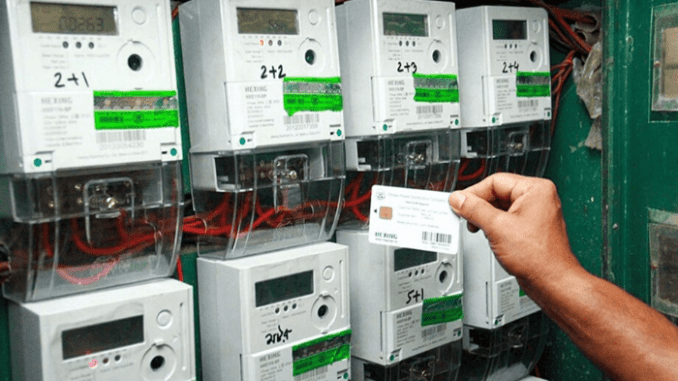
Efforts at metering Nigeria’s households with estimated population of over 200 million and diverse business premises have proved herculean task being fraught with numerous challenges. The power sector regulator, NERC however, remains unrelenting and consistently introduces one metering initiative after the other or concurrently. CLEMENT NWOJI gives account of over a decade of metering initiatives, why it remains illusive, others.

Chairman of NERC, Mr. Sanusi Garba
Pre-paid metering of electricity consumers in Nigeria could not have arisen but for transparency, accountability and need to ensure equity and fair play as well as financial liquidity in the Nigeria Electricity Supply Industry (NESI) value chain. The corruption practices and gross manipulations associated with the old analogue post-paid metering system further fueled agitations for more acceptable metering system that would provide succour to consumers even in the midst of chronic epileptic power supply nationwide.
However, innovations by the apex regulatory body, the Nigerian Electricity Regulatory Commission (NERC) at finding sustainable and reliable funding metering system, one after the other, have not succeeded. This is mainly due to increasing trust deficit on the part of the citizens and oftentimes, suddenly withdrawal of funding either shortly after each pilot phase or at the middle of implementation of one metering initiative and the other. Thus, even when series of efforts had been made in the past to provide every electricity consumers with pre-paid meters either at their residential or business premises (industries and manufacturing companies), it has received high degrees of sabotage and abuse. To this extent, it may not be over statement to infer that pre-paid metering of electricity consumers nationwide and achieving financial liquidity in NESI will ever remain elusive in Nigeria.
Investigations have revealed that most electricity consumers using heavy duty appliances and industrial machines prefer use of postpaid meters fraught with fraudulent practices perpetuated by electricity consumers in concert with dubious officials of power Distribution Companies (DisCos). In this case, the consumers more often in connivance with corrupt DisCos officials bribe their ways into receiving discounted monthly electricity bills. At other times and in absence of both pre-paid and postpaid meters, DisCos resort to exaggerated estimated (crazy) bills imposed on electricity consumers. This obtains until recently, in response to the yearnings of consumers, NERC came up with control measure and introduced estimated bill caping thereby restricting the DisCos from arbitrary exploitation of consumers.
Even at that, meter bypassing has become a common practice among the rich and the poor in Nigeria despite the existing penalties culprits are faced with depending on the meter phase, whether first offender or subsequent offender and maximum demand or non-maximum demand consumer. For non-Maximum Demand (MD) meters, the fine for a first offence is set at N100,000 for single-phase meters and N200,000 for three-phase meters. Subsequent violations attract higher penalties of N150,000 and N300,000, respectively. Contained in the Amended Order on Unauthorised Access, Meter Tampering, and By-pass which replaces Order No: NERC/REG/41/2017, took effect from 22 January 2025. This amendment aligns with the Electricity Act 2023 and the Customer Protection Regulations (CPR) 2023, which allow DisCos to disconnect unauthorised connections without notice and prescribe reconnection conditions.
Attempts in the past to ensure inclusive pre-paid metering of electricity consumers have not succeeded in acheiving the target result and consequently hinder improved financial liquidity of the sector. The metering gap in electricity sector value chain was part of the reasons for the introduction of reforms in the electricity sector which led to the creation of the regulator, the unbundling and privatisation of the government owned vertically integrated utility company (NEPA).
In fact, the metering gap has resulted in very low revenues and thus a high level of losses for the DisCos, entrenched estimated billing of customers, customers’ dissatisfaction, payment apathy, electricity theft, among other anomalies. Of course, apart from the earlier inhibiting factors mentioned, some other major causes of the metering gap include high cost of metering infrastructure – funding and affordability, absence of cost reflective tariffs, DisCos inability to raise financing, institutionalization of estimated billing which is often referred to as crazy bills, energy theft, bypass and tampering of meters, customers apathy and distrust or even outright refusal to pay bills or pay for meters. These increases financial losses in the sector.

Statistics obtained from the regulatory authority shows that in 2012, prior to privatisation, NESI had 56% metering with over 2.28 million unmetered customers. However, effective metering initiatives began in 2013-2018 with the introduction of Credit Advance Payment for Metering Implementation (CAPMI) with the achievement of only 410, 796 meters installed within three years of its operation.
In 2018, it was replaced with another policy known as the Meter Asset Provider (MAP) and it led to the contracting of over 6,588,971 meters while mere 122,737 meters were installed as at December, 2019. The policy was later reviewed in 2020 leading to installation of a total of 2,184,254 meters as at December, 2024. The 2020 witnessed another metering policy known as the National Mass Metering Programme (NMMP) funded through the Central Bank of Nigeria and World Bank loans. Though, it was meant to be in three phases, but only the pilot phase was funded by CBN with the procurement of one million meters and the installation of 943,111 meters.
Still in search of more acceptable and sustainable means of closing the metering gap, Meter Acquisition Fund (MAF) was introduced. It targets the harvesting and transferring of N1.185/kWh of energy sold to centrally collecting fund manger for all DisCos to be used to procure meters. Its impact include the provision of N21 billion for metering Band A customers under tranche A. It also led to the procurement of 143,929 meters which installations are said to be ongoing. Yet, the latest metering initiative for the time being, is the Presidential Metering Initiative (PMI) introduced in 2024 with the objective of obtaining N700 billion loan from Federation Accounts Allocation Committee (FAAC) to procure 2.6 million meters and consolidate all previous metering initiatives.
NERC’s fourth quarter 2024 report indicates that some of the metering initiatives run side by side while others had elapsed due to challenges earlier enumerated. For instance, the report shows that during the quarter under review, 179,064 meters (96.56% of the total installations) were installed under the MAP framework, 4,076 meters were installed under the Meter Acquisition Fund (MAF), 1,924 meters were installed under the Vendor Financed framework, and 374 meters were installed under the DisCo Financed framework.
NERC expressly states: “The Commission expects DisCos to utilise a combination of all available frameworks contained in the 2021 Meter Asset Provider and National Mass Metering Regulations (NERC – R – 113 – 2021) as well as the MAF to close their respective metering gaps. As a safeguard for customers against exploitation due to the lack
of meters, the Commission has continued to issue monthly energy
caps for all feeders in each DisCo. This sets the maximum amount of energy that may be billed to an unmetered customer for the respective month based on gross energy received by the DisCo and consumption by metered customers on their respective feeders.”
In all these metering initiatives, as at end of 2024, only 6,156, 726 electricity consumers had been metered while 7,182,909 are unmetered. The various metering initiatives have common problem of being inconclusive mainly due to lack of funding, distrust between consumers and DisCos, slow and inefficient procurement processes by DisCos, consumers resistance to prepaid meters due to lack of awareness and distrust of the system, funding and affordability constraints on the part of consumers, delays in installation and lack of refunds, among other constraints.
When these challenges will abate for attainment of inclusive and comprehensive metering nationwide, remains a mirage.






Click to read full text








AECAF Congratulates Abdulrazaq Isa, Bala Wunti, On Respective Emergence As Chairman, CEO World Energy Council Nigeria

President Tinubu Charges NLNG Board To Convert Gas Flaring Into Nation’s Economic Benefit

FG Unveils RAMCO, Vows To End Cycle Of Neglected Power Infrastructure

MPC Meeting: Nigeria’s Economy Remains Resilient To External Shocks, Cardoso Assures As Members Commit To Sustain Financial Stability

NERC Gives PHED 60-Days To Incorporate PHED SubCo To Oversee Interstate Power Supply As AKSERC Assumes Electricity Oversight

Electricity For Underserved Communities: REA, Alpha Morgan Bank Collaborate On ₦50 Billion Financing Facility To Accelerate Access


-
 News1 week ago
NERC Gives PHED 60-Days To Incorporate PHED SubCo To Oversee Interstate Power Supply As AKSERC Assumes Electricity Oversight
-
 News5 days ago
Electricity For Underserved Communities: REA, Alpha Morgan Bank Collaborate On ₦50 Billion Financing Facility To Accelerate Access
-

 News1 week ago
FG Commends TCN Over Transmission Infrastructure Upgrade, Says It Reflects Administration’s Policy Targets