
News
UN, NHRC, Development Partners, CSOs, Others Brainstorm On Action Plan For Human Rights Priority Areas


The United Nations (UN) and the National Human Rights Commission (NHRC) on Tuesday kick-started practical steps towards addressing human rights aberrations in Nigeria, with a national dialogue to identify priority areas for action.
The UN country team in collaboration with the National Human Rights Commission, Office of the United Nations High Commissioner for human rights and UN Women, which organized the two day forum, expressed concerns on the need to address prevailing human rights challenges in Nigeria.
Speaking, the United Nations Resident/Humanitarian Coordinator, Edward Kallon, noted that Nigeria is faced with myraids of human rights challenges as it strives towards a nation that acknowledge the rights of all human beings.
Kallon, who was represented by Peter Hopkins, said however, that the dialogue provided opportunity to talk to international corporation for collective action in the realisation of human rights in Nigeria.
According to him, “Like other countries, Nigeria faces a myriads of human rights challenges as Nigeria strives towards a nation that acknowledges the rights of all human beings, a strong and effective national protection systems, UN systems and mechanisms may have been established as well as the constitution of the Federal republic of Nigeria 1999 which sets the agenda for much of our work.
“Your presence here today underlies the importance to talk to international corporation in the realisation of human rights in Nigeria. This initiative today is a step towards realising the dreams captured in the call to action for human rights here in Nigeria.
“In the next two days, we will be looking at four issues: to take stock of UN support to government and national partners in the area of human rights; to develop understanding of the current trends and appreciation of how this evolved; to identify instant priorities for the UN Supports to human rights taking into account emerging trends for human rights in the country; to identify ways and means of strengthening collaboration with UN, Nigeria and partners to address agreed priorities and taking into consideration best approaches”

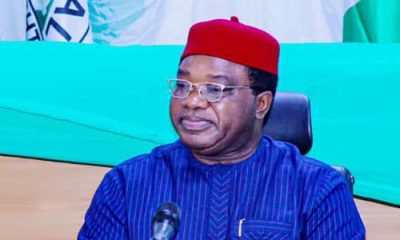
The Executive Secretary of National Human Rights Commission, Tony Ojukwu while delivering a speech at the dialogue session
On his part, the Executive Secretary of the NHRC, Tony Ojukwu, noted that the nation is faced with human rights challenges due to activities of state and non-state actors which necessitates thinking out of the box for viable solutions out of the conundrum.
He said: “It is important for all of us stakeholders to reflect deeply on the human rights situation in Nigeria with a view to drawing up a priority plan that could effectively engage the human rights challenges of the country. As a necessary stakeholders, the UN, MDAs and CSOs should be very interested in a priority plan that could result from a dialogue like this.”
The Executive Secretary further indicated the National Action Plan (NAP) 2021-2025 document on improving the protection and promotion of human rights in Nigeria will soon be approved by the Federal Executive Council.
He assured that when approved, it will become the current Nigeria’s policy document on Human Rights.
On his expectations, Ojukwu said: “The idea of developing a national action plan for the promotion and protection of human rights is to have an integrated national strategy for engagements and interventions on the promotion and protection of human rights.
“Having followed a laborious consultative process aimed at establishing ownership by national actors, it is expected that all human rights actors will galvanise and gravitate their activities towards the realisation of the plan. In this regard, development partners supporting human rights activities in the country should insist that such activities are geared towards clearly addressing an identifiable challenge in the NAP for the country.
“On the part of MDAs and CSOs, having been necessary stakeholders in the development of the plan, they should program their intervention activities for which they seek support from development partners towards addressing a clearly identifiable challenge on human rights as clearly indicated in the plan for the country.
“In other words, the Justification for any application for funding should be that the intervention sought to be made is addressing a challenge identifiable in the NAP for human rights Document.
“I must emphasize that since the development partners hold the funds for human rights activities, the equally have a binding obligation to use their resources for the realisation of the Vienna Declaration and program of Action by ensuring that national action plans developed are adhered to by key actors in the country.
“Without doing this, the NAP for promotion and protection of human rights will remain a piece of document on the shelf of the Office of the High Commissioner for Human Rights in Geneva.”






Click to read full text









FORCEPA And The Battle For 2027: How Federal Agency Chiefs Are Reshaping Tinubu’s Re-election Strategy

Peter Obi Declares Hunger in Nigeria A National Emergency On World Food Day

Opposition Under Pressure As Tinubu Nominates New INEC Commissioners Ahead of 2027 Election

Swift Telephone Network Recieves NCC’s Unified Access Service License, Ventures Into Full Telcom Services

PTDF Inaugurates Experts Committee To Overhaul CSDT Operational Policy, Curriculum Development, Others.

Post-Recapitalisation: Omosehin Tasks Underwriters on Capacity, Warns Capital Without Delivery is Meaningless


-

 Business News1 week ago
The Media Battle Over Insurance Recapitalisation: Separating Facts, Perceptions and Strategic Outcomes
-
 News6 days ago
Tinubu’s ₦729bn Power Debt Paydown Barely Scratches Surface as GenCos Await Trillions in Unsettled Arrears
-
 Business News6 days ago
WAPP Board Renews Chairman’s Tenure For Second Term As Engr Abdulaziz Advocates Cooperation