
Education
Train Medical Workers In Local Languages, Others – Ehanire Proffers Solutions To Curb Nigeria’s $2b Yearly Loss To Poor Health Sector

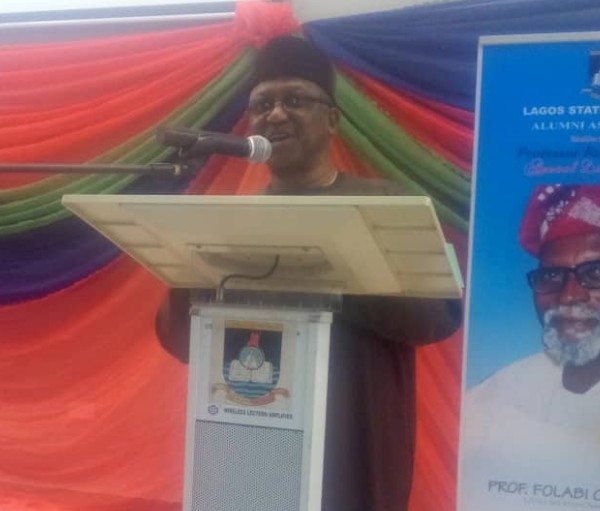
…LASU Has Graduated 200,000 Graduates, Others – Fagbohun Gives Pioneering VC Reasons To Be Proud
By LOVETH AZODO, Lagos
Sequel to Nigeria loss of over $2billion to poor health sector, the Nigeria Minister of State for Health, Dr. Osagie Ehanire has highlighted some solutions that will curb the rise of Nigeria citizens seeking healthcare in other countries.
The Minister Urged Institutional sectors to train medical workers in local languages, design curriculum that addresses local questions that are begging for answers and to address the relationship between the traditional practitioners and the orthodox practitioners.
In the mood of celebration of the Lagos State pioneering Vice Chancellor, Prof. Folabi Olumide, the Lagos State University sitting Vice Chancellor, Prof. Olanrewaju Fagbohun, SAN stated that the institution has since its inception graduated 200,000 graduates.
Ehanire said this at the maiden edition of the Professor Folabi Olumide annual lecture organized by the Alumni with the theme “Rethinking Medical Education: An Imperative for Improving Health Care in Nigeria” held on Thursday at the university’s Aderemi Makanjuola lecture theatre.
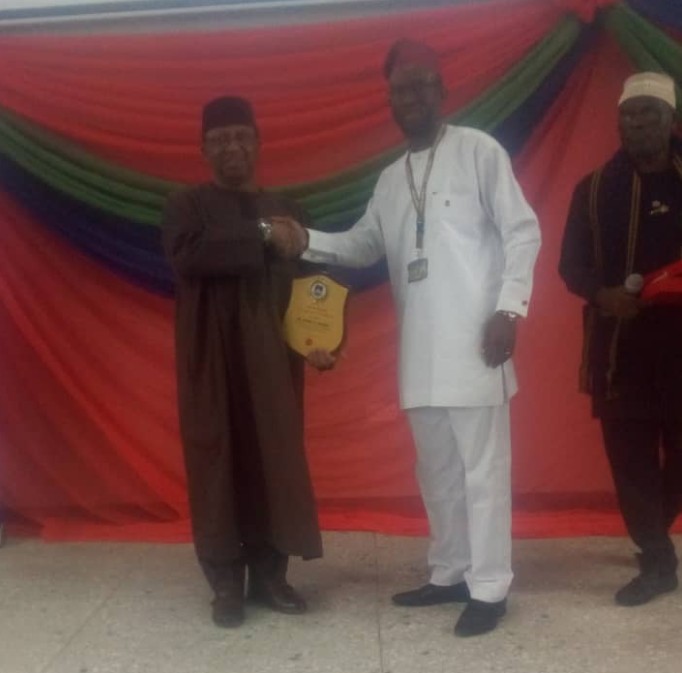
The Lagos State University VC presenting a plaque to the Minister of state for Health, Dr. Osagie Ehanire
In his welcome address, Fagbohun said “sir you have every reason to be proud from one campus the university has now contains three campuses, seven faculties, three schools, one college, seven academic centers, a post graduate school, over 23000 students and close to 2700 academic and non-academic staff.
The Minister commended the management of the university and the alumni for organizing the event and for choosing the theme, he said “The theme of this programme is apt and relevant to the direction of the President Muhammad Buhari’s administration on health.”
He highlighted some of the concerns of the federal ministry of health, the need for universal health cooperation which he said is contained in the change and next level agenda of the president, the situation of Nigerian citizens chooses to seek health care abroad which rips the country of global confidence in the health system and interpersonal rivalries and frequent strives amongst workers and service distortion.
On tackling the problems in the Nigerian health sector, he stated “ we must tackle our challenges which is to provide basic health care for 198million citizens and also provide improved patient centre health care at all levels where it is needed, we also need to develop a country culture and circumstance tailored strategy and healthcare workers to achieve this objective, specific for us.”
“Prioritization may need placing less emphasis on some areas that are not relevant to our environment, however best practices from all parts of the world may be use to create a fit for purpose system, workforce and strategy.”
“It will be useless to copy hook line and sinker what work in another country with the erroneous belief that and mindset, beliefs and strategy are unique and different, we can solve these 3 problems by giving thesis and instruction in the native local languages of our community rather than pursuing the so-called international standards and designing a curriculum that addresses as local questions which are begging for answers. I talked with the Ethiopian minister for health who told me once that they train workers in English language and gave them an exam which 20 percent of them failed, they were later given same exam in their local language and 80percent of them passed, this shows that language was an obstruction but what he was interested in is service delivery.”
However, he stated that the door of learning from other countries must never be hut out but should always remain open. “the relationship between traditional practitioners that are reality in our country and orthodox practitioners also needs to be address.” He added
“It is necessary for us to go back to the drawing board. Medical education is in a state of constant flux. As new knowledge emerges, we must strive in Nigeria to remain up to speed with training and curriculum development.”
“Beyond the impact of global knowledge and technology, countries have always tailored Medical Knowledge to their specific needs. Nigeria’s medical education must be tailored to meet our needs.”
“We therefore must look at tailored specific solutions to our environment. However, best practices from around the world may be used to tailor our education. For example, we can train out medical practitioners in our local languages. We must also look at workable relationships in the interest of our country.”
The guest lecturer, Professor Foluso Afolabi Lesi, cited in his paper, the determinants of health as
Income and social status, education, physical environment, employment and working conditions.
“There has been an improvement in Nigeria’s health indices especially in areas of infant mortality rate. The improvement in health indices is directly influenced by growth of Medical Schools in Nigeria.” He said
On building a good health care system he stated “A good health care system requires among other, a robust financing mechanism; well trained and adequately paid workforce; reliable information on which the indices are based.
Prof Lesi identified some problems with Nigeria medical education which includes; Quality of our products, Drop in the quality of graduates of our education sector, Discord among members of the health care team, Shortage of postgraduate training position, Brain Drain, Over 40k of the Doctors Nigeria has produced are operating abroad.
On tackling the problems he added that Everyone within their spheres of influence must decide to do things right, We must build better capacity among our faculty for teaching, research and leadership, We must encourage innovation and entrepreneurship among students and faculty, We must properly motivate and reward excellence.
”Health indices in Nigeria, though improving are still unacceptably high, we in tertiary institutions, need to rethink his we train our health workforce to achieved desired results, we need to have selfless result-oriented and purposeful leadership at all levels of government, we all must join Prof Olumide in believing that “Africa will surely rise.” He said



Click to read full text









Electricity For Underserved Communities: REA, Alpha Morgan Bank Collaborate On ₦50 Billion Financing Facility To Accelerate Access

2027: Why Tinubu Will Defeat Kwankwaso In Kano — Abdulmumin Jibrin

214 UNICAL Students File N5 Billion Suit Challenging Removal From Law Faculty

FG flags Off Smart Meters Installers Training programme, Targets Installing Seven Million Meters Nationwide

MPC Meeting: Nigeria’s Economy Remains Resilient To External Shocks, Cardoso Assures As Members Commit To Sustain Financial Stability

Oriire Abduction: Suspects Arrested By DSS Bag Life Sentence For Membership Of Ansaru Terrorist Organization


-

 Business News1 week ago
TCN Boosts Power Transmission In Rivers State, Commissions 150MVA Power Transformer at Afam Substation
-

 News3 days ago
NERC Gives PHED 60-Days To Incorporate PHED SubCo To Oversee Interstate Power Supply As AKSERC Assumes Electricity Oversight
-
 Business News6 days ago
President Tinubu’s New Deep Offshore Investment Framework, Game Changer For Nigeria’s Oil Sector – TDF