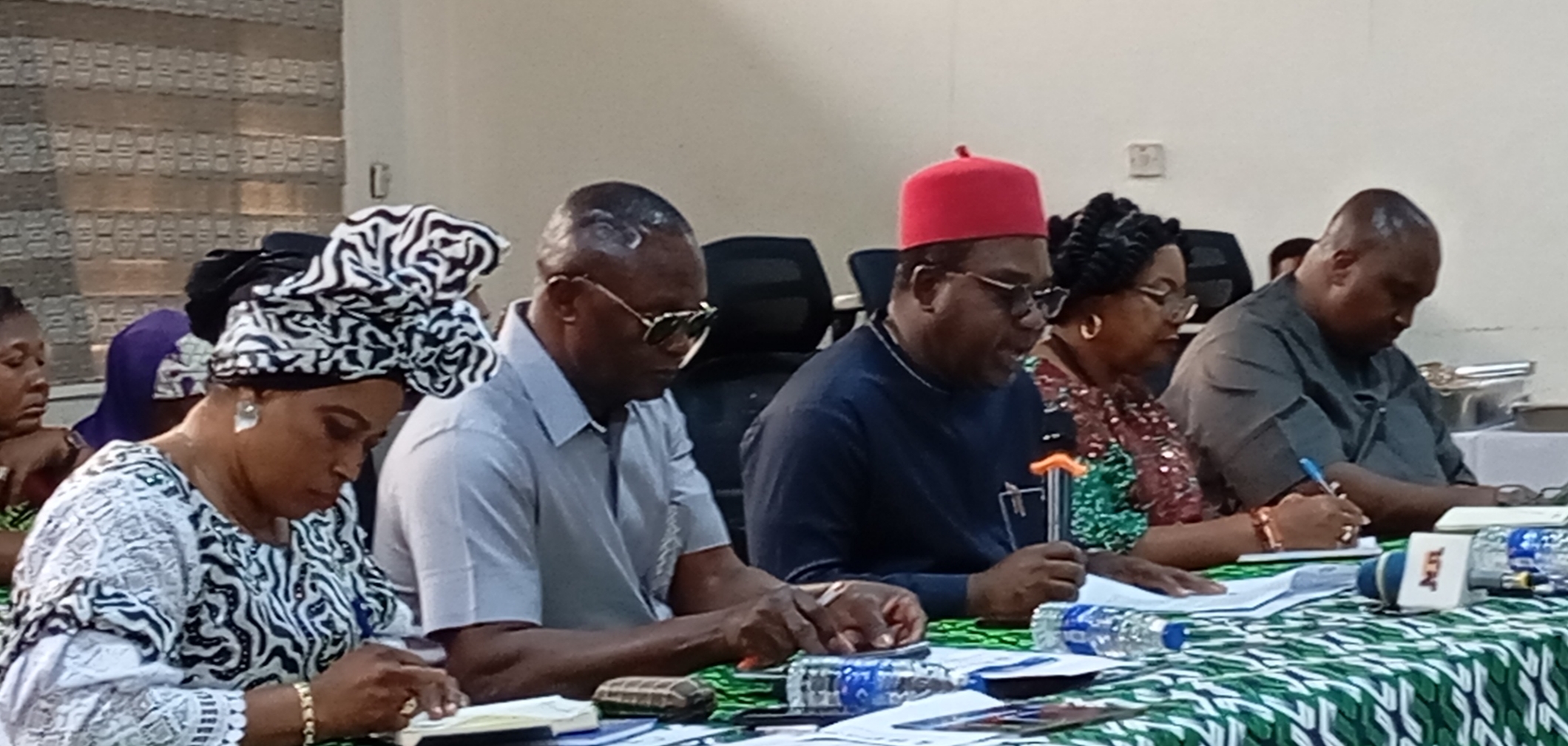
From Left-Right: The Representative of Minister of Women affiars, Director, Legal Services, Sweet Adesuwa Okundaye; National Coordinator, LEDAP, Chino Obiagwu SAN; NHRC Executive Secretary, Dr. Tony Ojukwu; Executive Director, Women Aid Collective (WACOL), Prof. Joy Ezeilo SAN; and Mr. Hillary Ogbonna. Photo credit: Optimum Times, 11/12/2025.
Given growing inhibiting cultural practices against women in Nigeria, the minister of women affairs and social development, Hon. Imaan Sulaiman-Ibrahim, has tasked traditional leaders and women to boldly safeguard cultural values that uplift the womenfolk while also resisting and discarding harmful practices that contradict the nation’s Constitution, violate dignity, or undermine justice.
The Minister made the charge while speaking at the National Human Rights Commission (NHRC) and the Legal Defence and Advocacy Project (LEDAP) consultative forum on eliminating harmful traditional and religious practices impacting the rights of women and gender equality in Nigeria, on Thursday in Abuja.
He observed that beyond laws and policies, most of the cultural practices that undermine women are woven into community survival mechanisms and maintained that for that reason the traditional leaders in various communities have key roles to play in eradicating those harmful and degrading practices against women.
The Minister who was represented by the Ministry’s Director, Legal Services, Sweet Adesuwa Okundaye, said: “Harmful traditional and religious practices—including early and forced marriage, denial of inheritance rights, female genital mutilation, dehumanising widowhood rites, and child socialisation practices that compromise the rights and wellbeing of children—continue to impede social progress.
” These practices not only violate fundamental human rights, they limit productivity, weaken family structures, and undermine Nigeria’s socio-economic potential.
“Many of these traditions are woven into community survival mechanisms, and changing them requires addressing the underlying economic realities.
“This is why traditional rulers must remain at the centre of national reform efforts. They shape values, influence norms, and guide the moral compass of communities. We must also recognise that women themselves, often out of economic necessity or social pressure, contribute to sustaining certain harmful practices.”
He canvassed that expanding alternative and sustainable sources of livelihood for women is essential for breaking cycles of dependence, broadening choices, and empowering women to challenge unhealthy norms.
On his part, the Executive Secretary of the NHRC, Dr. Tony Ojukwu, lamented that recent national and international data showed that Nigeria accounts for millions of survivors of gender-based violence.
According to him, Nigeria “remains among the countries with the highest absolute numbers of women affected by Female Genital Mutilation (FGM), and continues to report alarmingly high numbers of SGBV incidents each year.
“These practices are not merely personal tragedies — they are violations of fundamental human rights protected under our Constitution, domestic legislation and international obligations.
“They deny girls the right to education and health, they rob women of economic opportunities and autonomy, and they fuel cycles of poverty and marginalisation. They also undermine community wellbeing and impede national development.”
Ojukwu further revealed that evidence and data from the Commission’s monthly Human Rights Situation Dashboard indicates that human rights complaints arising from gender-based violence, including harmful socio-cultural norms have reached epidemic levels, accounting for over 50,000 complaints from January to November 2025.
” NHRC is over-stretched financially and institutionally; hence, the need for our pushing the campaign for the ending of all forms of violence against women.
“But the NHRC cannot — and must not — act alone. Laws and policies are necessary but not sufficient. Harmful practices are sustained by social norms, myths, economic pressures and local power structures.
“That is why we have convened this consultative forum: to bring together traditional rulers, religious leaders, community elders, women’s groups, youth, law enforcement, health professionals, the justice sector and development partners — to listen, to map the root causes, to share evidence, and to agree practical, locally-led strategies for prevention, protection and accountability”, he stated.
The National Coordinator, LEDAP, Chino Obiagwu SAN, who gave the project overview, spoke on “Empowering traditional rulers in Nigeria to adopt and implement community guidelines for gender equity and non-discrimination against women”.





















 News4 days ago