
News
Presidential Committee On Correctional Service And Reform Frees 3, 768 Prisoners, Says Malami


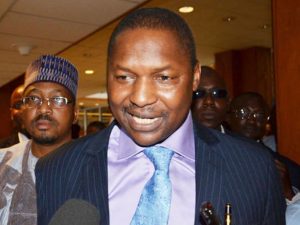
The Attorney General of the Federation and Minister of Justice, Abubakar Malami has disclosed that a total number of 3,768 prisoners have been released.
The release was made during visits by the Presidential Committee on Correctional Service and Reform to over 34 prisons in 16 states across the country.
He revealed these on Monday at the first National Workshop on the Effective Implementation of the Nigerian Correctional Service Act, 2019 organised by the Federal Ministry of Justice in collaboration with the Presidential Committee on Correctional Service and Reform and the Nigerian Correctional Service.
He noted that the release was a product of the Nigerian Correctional Service Act, 2019 which was the much-awaited legislative wand for bringing an end the hydra headed problems associated with overcrowding and prison congestion in the country.
Those released were made possible through “payment of fines for convicts for minor offences with the option of fine but were unable to pay the fines, general review of peculiar cases and advocacy overtures to relevant authorities.
“The Committee has written letters of appeal to several State Government Executives to act on some special cases encountered during the visits to various prisons in some states as well as to exercise their powers of clemency in deserving cases or commute to life sentence those condemned to death.
“The Committee carried out prison’s inspection exercises wherein a number of facilities were discovered to be in dire need of urgent rehabilitation or remodeling and has made recommendations as a matter of urgency to the relevant authorities for the renovation/construction
of affected prison facilities.
“The Committee during its visits, also conducts the review of cases of inmates awaiting trial for upwards of five (5) years, and of inmates eligible for Prerogative of Mercy with relevant authorities and looks into cases of condemned convicts on death row for over ten (10) years with the view to getting relevant authorities to commute the sentences to life imprisonment.”
It would be recalled that in October 2017, the Minister constituted the Presidential Committee on Correctional Service and Reform with the Honourable Chief Judge of the High Court of the Federal Capital Territory, Justice I.U Bello as the chairman, to fast-track the decongestion of Correctional centres.
Malami further highlighted the innovations brought in by the Correctional Service and Reform Act saying : “A Superintendent shall refuse to admit any person brought in with severe bodily injury, mentally unstable or underage provided that the Superintendent shall ensure due documentation of the name, date and
other particulars relating to the person that was refused admission.
“Under the new dispensation, the Correctional Service is obliged to take adequate steps to ensure the prevention of torture, prevention of inhuman and degrading treatment against inmates and the prevention of sexual and non – sexual violence and bulling of inmates. This provided for under section 14 (8) and section 15(1) of the Act.
“On female inmates, section 34 (1) of the Act provides that there shall be a provision of separate facilities for female inmates in all States of the Federation and that the Correctional Service shall provide all necessary facilities to address special needs of women such as medical and nutritional needs of female inmates including pregnant women, nursing mothers and babies in custody. In addition, by virtue of section 35 (1) of the Act, young offenders shall no longer be kept in adult custodial facilities.
” The Correctional Service shall rather
provide separate male and female borstal training institutions for Juvenile offenders.”
The Minister’s full text of speech is as below:
KEYNOTE ADDRESS BY ABUBAKAR MALAMI, SAN, HONOURABLE ATTORNEY – GENERAL
OF THE FEDERATION AND MINISTER OF JUSTICE, AT THE FIRST NATIONAL
WORKSHOP ON THE EFFECTIVE IMPLEMENTATION OF THE NIGERIAN CORRECTIONAL
SERVICE ACT, 2019 ORGANISED BY THE FEDERAL MINISTRY OF JUSTICE IN
COLLABORATION WITH THE PRESIDENTIAL COMMITTEE ON CORRECTIONAL SERVICE
AND REFORM AND THE NIGERIAN CORRECTIONAL SERVICE
[PROTOCOL]
It is my great pleasure to welcome all participating Justice Sector Institutions to this first and very important national workshop on the Nigerian Correctional Service Act, 2019.
The purpose of this Workshop is to sensitize and conscientise participating Justice Sector Institutions and other stakeholders on their roles towards the proper implementation of the Nigerian
Correctional Service Act, 2019.
The Workshop is expected to prepare grounds for the implementation of the Act. To this end, and in line with the theme of this Workshop “Towards Effective Implementation of the Correctional Service Act, 2019” participants are expected to come up with a Road Map for the effective implementation of the provisions of the Act especially with
regards to Non – Custodial Measures. We believe that it is only when duly implemented that we can get the best out of this critical piece of legislation.
We consider the Nigerian Correctional Service Act, 2019 very critical to the administration of Criminal Justice in Nigeria for quite a number of reasons.
In the first place, it is our much-awaited legislative wand for bringing to an end the hydra headed problems associated with
overcrowding and prisons congestions in the Country. With this Act in place, we now have the much needed legislative backbone for the comprehensive implementation of the national policies and strategies for prisons decongestion in Nigeria and I cannot but give credit to
Mr. President for his demonstrable commitment towards the speedy
decongestion of Nigerian prisons, now Correctional Centres.
Distinguished Participants, Ladies and Gentlemen, on assumption of office, President Muhammadu Buhari raised alarm over the deplorable state of prisons nationwide, noting that it is a national disaster and that many of the prisons are about 90% over crowded. He stressed the
need to put in place urgent measures to speedily decongest the Correctional / Custodial Centres.
One of the recommended measures is the enactment of a new legislative framework in line with international best practices. President Muhammadu Buhari saw this as a step in the right direction and demonstrated his commitment to the decongestion of correctional centres in Nigeria when on 31st July, 2019, he signed the Correctional Service Bill, 2019 into Law. With this Act in place, it is hoped that
in no distant time, Correctional Centres will be fully and systematically decongested.
THE CORRECTIONAL SERVICE ACT, 2019
The guiding principles that ran across the Act took clue from the objectives of the Act as stated under section 2 (1) of the Act which
are to –
(a) ensure compliance with international human rights standards and
good correctional practices;
(b) provide enabling platform for the implementation of non-custodial measures;
(c) enhance the focus on corrections and promotion of reformation,
rehabilitation and reintegration of offenders; and
(d) establish institutional, systemic and sustainable mechanisms to
address the high number of awaiting trial persons.
The Act repealed the Prisons Act, CAP P29, Laws of the Federation of Nigeria, 2004. It established for the Federation, the Nigerian Correctional Service to provide both custodial and non – custodial
services under its section 1 (1) and (2). The Nigerian Prisons Service (NPS) is now known as the Nigerian Correctional Service (NCS).
By virtue of section 9 of the Act, the hitherto existing prisons are now to be known as Custodial Centres or Correctional Centres. Under section 46 of the Act, a “Correctional Centre” means a prison or any centre that serves as a place for detention, imprisonment or incarceration aimed at promoting a reformation, rehabilitation and
reintegration of inmates. Section 46, defined a “Custodial Centre” as
a place where individuals sentenced by the court requiring imprisonment are kept or those remanded in custody by order of the
court are kept, and may be used interchangeably with the word, “custodial facility”. The hitherto Prison Officers or Warders are now known as “Correctional Officers”.
Secondly, there are quite a number of innovations in the new Act, which I consider worthy of mention. In compliance with international human rights and good correctional practice, the Act provided for both custodial and non – custodial services. Under section 1(2) of the Act, the Correctional Service shall consist of custodial service and non –
custodial service. While Part I of the Act provides for Custodial Service, Part II provides for non – Custodial Service.
By virtue of section 4 (1) (c) and (2) (c) of the Act, the Controller– General shall, in accordance with the provisions of the
Administration of Criminal Justice Act and other relevant legislationand policies administer non – custodial measures and superintend on non – custodial institutions and centres.
Section 8 (1) (d) and (2)
(h) established for the Correctional Services, both Custodial and Non
– Custodial Centres and a Directorate on Non – Custodial Service.
Also in compliance with International Human Rights, section 12 (2) (c)
empowers the Chief Judge with discretion to commute death sentence to
life imprisonment, where an inmate sentenced to death has exhausted
all legal procedure for appeal and a period of 10 years has elapsed
without the execution of the sentence. In addition, section 12 (4) and
(7) empowered relevant authorities to take necessary steps to rectify
overcrowding within a period of three months while under section 12
(8), State Controller of Correctional Service shall in conjunction
with the Superintendent have power to reject more intakes of inmates
where it is apparent that the Correctional Centre in question is
filled to capacity.
Under section 18 (1) (d) of the Act, the Correctional Centre shall issue early notification in respect of the custodial centre exceeding its capacity to the heads of judiciary, law enforcement and prosecuting agencies, ACJA Monitoring Committee, Prerogative of Mercy
Committee and relevant bodies and institutions. By virtue of section
18 (2) of the Act, upon the delivery of the notification under section
18 (1) (d), the State Controller shall cause to be activated, the
procedure for refusal to admit awaiting trial persons to his custodial
centre, where the heads of the relevant agencies notified fails to
take necessary steps to address the situation within a reasonable time
not exceeding three months.
A Superintendent shall refuse to admit any person brought in with severe bodily injury, mentally unstable or underage provided that the Superintendent shall ensure due documentation of the name, date and
other particulars relating to the person that was refused admission.
Under the new dispensation, the Correctional Service is obliged to take adequate steps to ensure the prevention of torture, prevention of inhuman and degrading treatment against inmates and the prevention of sexual and non – sexual violence and bulling of inmates. This provided for under section 14 (8) and section 15(1) of the Act.
On female inmates, section 34 (1) of the Act provides that there shall be a provision of separate facilities for female inmates in all States of the Federation and that the Correctional Service shall provide all
necessary facilities to address special needs of women such as medical
and nutritional needs of female inmates including pregnant women, nursing mothers and babies in custody. In addition, by virtue of section 35 (1) of the Act, young offenders shall no longer be kept in adult custodial facilities. The Correctional Service shall rather
provide separate male and female borstal training institutions for Juvenile offenders
The enactment of the Act indeed marks another milestone in our national Strategies deployed towards urgently decongesting our correctional/Custodial Centres.
SOME ACHIEVEMENTS OF THE FEDERAL MINISTRY OF JUSTICE AND PRESIDENTIAL COMMITTEE ON CORRECTIONAL SERVICE AND REFORM
In October 2017, The HAGF constituted the Presidential Committee on Correctional Service and Reform with the Honourable Chief Judge, of the High Court of the Federal Capital Territory, Honourable Justice I.U Bello as the chairman, to fast-track the Decongestion of
Correctional centres. I can assure you that the Committee has continued to deliver on its mandate. The committee has visited and appraised over thirty-four (34) prisons in sixteen (16) states. A total number of Three Thousand, Seven Hundred and Sixty-Eight (3,768), (prisoners)have been released during these visits via payment of fines for convicts for minor offences with the option of fine who are unable to pay the fines, general review of peculiar cases and advocacy overtures to relevant authorities. The Committee has written letters of appeal to several State Government Executives to act on some special cases encountered during the visits to various prisons in some states as well as to exercise their powers of clemency in deserving cases or commute to life sentence those condemned to death.
The Committee carried out prison’s inspection exercises wherein a number of facilities were discovered to be in dire need of urgent rehabilitation or remodeling and has made recommendations as a matter of urgency to the relevant authorities for the renovation/construction
of affected prison facilities.
The Committee during its visits, also conducts the review of cases of inmates awaiting trial for upwards of five (5) years, and of inmates eligible for Prerogative of Mercy with relevant authorities and looks
into cases of condemned convicts on death row for over ten (10) years with the view to getting relevant authorities to commute the sentences to life imprisonment.
His Excellency, granted the request of the Honourable Attorney-General
of the Federation and Minister of Justice to reconstitute the Presidential Advisory Committee on Prerogative of Mercy which was inaugurated on the 28th of August, 2018. Both Committees are currently
working tirelessly on their respective mandates.
VIRTUAL AUTOMATED CASE MANAGEMENT SYSTEM
Not quite long ago, the Federal Executive Council granted approval to the Federal Ministry of Justice for the award of a contract for the installation of the Virtual Automated Case Management System to fast track the decongestion of Correctional Centres in Nigeria. This system will integrate with the existing Prisons Information Management System
(PIMS) with the ultimate aim of being a holistic improvement on the efficiency of the entire Justice Sector. This project will take off in December, 2019.
STANDARD SKILL ACQUISITION CENTRE AT KEFFI CORRECTIONAL CENTRE
The Federal Ministry of Justice is currently working on a standard Skill Acquisition Centre at Keffi Correctional Centre as a pilot scheme. Training of inmates is ongoing and the upgraded cente will be
launched in December 2019. This will be replicated in more Correctional Centres across the Federation. This will enhance the focus on corrections and promotion of reformation, rehabilitation and
reintegration of offenders as provided by the Act.
PLANS FOR 2020
Conclusion of the nationwide on the spot assessment of prisons.
The Presidential Committee on Correctional Services and Reform plans
on holding a National Summit on ways to sustain the decongestion of correctional centres in Nigeria in the second quarter of the year.
Hosting of the Meeting of the Attorneys-General of the thirty-six
states of the Federation to develop appropriate policy to fast track
decongestion of correctional centres
Capacity Building for Judges, Magistrates and Correctional Officers
on Non-Custodial sentencing/measures.
In view of S.18 of the Act, the CS&R Unit intends to set up a National Task Force in collaboration with the 36 State Government towards decongesting awaiting Trail Persons in custody. A similar instance, like the Task Force set up in the Federal Ministry of Justice to deal with Boko Haram Awaiting Trial Persons in Kainji, Niger State and in Borno State yielded humongous result.
The various mentioned measures put in place by the FMOJ to support
the reformation of the Correctional centers across the Nation has indeed brought to the fore of national discourse the issue of ’Prisons Reform’ therefore making it a matter requiring urgent attention.
As a leading stakeholder in the Justice Sector Reform Program, be
assured the FMOJ will continue to provide its high wattage support to the reform of the Criminal Justice Sector in Nigeria.
MAJOR ACHIEVEMENTS AND INNOVATIONS IMBEDDED IN THE ACT
1. Joint exercise of discretions between the Executives and Judiciary.
Where the Executive fails to order for execution of death sentence,
the Chief Judge is empowered to commute death sentence to life
imprisonment.
2. Discretion is vested in Correctional Services (state controller) to
rectify overcrowding without 3rd party recourse by way of rejecting
more intakes.
3. Multi-stakeholder constant engagement by way of early notification
on custodial centre exceeding its capacity to heads of judiciary and
law enforcement and prosecuting agencies.
4. Checks on prevention of torture and prevention of inhuman and
degrading treatment. Thereby making those responsible for torture to
bear responsibility.
5. Gender sensitivity in the correctional service administration by
way of taking into consideration peculiarities relating to pregnant
women, nursing mothers and babies in custody.
6. Imbibing international human right standard in the correctional
service administration.
CONCLUSION
We look forward to the collaboration and support of all Justice Sector
Stakeholders. It is on this note that I declare this Workshop open.
I wish you all a fruitful deliberation and thank you all for your attention.
Abubakar Malami, SAN
Honourable Attorney – General of the Federation
and Minister of Justice,
Attorney – General’s Chambers,
Federal Ministry of Justice,
Shehu Shagari Way,
Maitama, Abuja





Click to read full text









Beyond Building Mini-Grids: Why RAMCO Could Change Economics Of Renewable Energy In Nigeria

GOCOP Mourns Former President And Publisher Of The Eagle Online, Dotun Oladipo

Dolly Parton, Lady Who Asked God Intimate Questions Goes Home To Her Maker

MPC Meeting: Nigeria’s Economy Remains Resilient To External Shocks, Cardoso Assures As Members Commit To Sustain Financial Stability

NERC Gives PHED 60-Days To Incorporate PHED SubCo To Oversee Interstate Power Supply As AKSERC Assumes Electricity Oversight

Asset Integrity, Life Extension, Fixing Obsolescence Key To Sustaining Value For Independents – Seplat CEO


-
 News7 days ago
NERC Gives PHED 60-Days To Incorporate PHED SubCo To Oversee Interstate Power Supply As AKSERC Assumes Electricity Oversight
-

 News4 days ago
Electricity For Underserved Communities: REA, Alpha Morgan Bank Collaborate On ₦50 Billion Financing Facility To Accelerate Access
-
 Business News1 week ago
President Tinubu’s New Deep Offshore Investment Framework, Game Changer For Nigeria’s Oil Sector – TDF