
News
Over 232 Cases Of Violence Against Women, Girls Treated Within Four Months As NHRC Raises Concerns

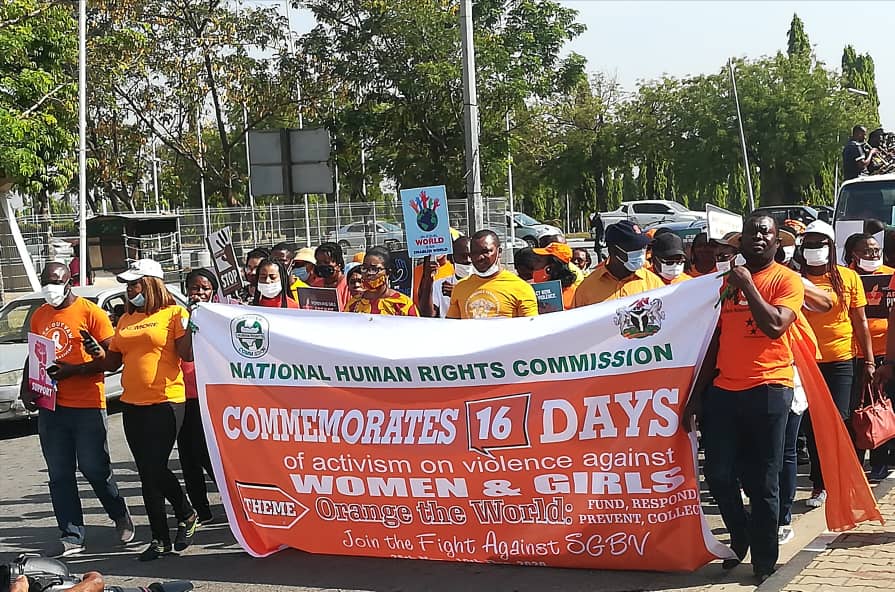
The National Human Rights Commission (NHRC) has decried the increasing waves of violence against women and girls, advocating that more concerted efforts must be consistently done to avert the trend globally.
Executive Secretary of NHRC, Tony Ojukwu, who raised the alarm, cited that within four months of Covid-19 pandemic lockdown, the commission received and treated over 232 cases of various forms of violence against women and girls in Nigeria.
He spoke on Wednesday, November 25 after procession marking the commemoration of the international day on elimination of violence against women and girls and the launch of the take off of the 16 Days of Activism on violence against women. This year’s theme is “Orange the world: Fund, Respond, Prevent, Collect”.

From Left: The Executive Secretary NHRC, Tony Ojukwu (3rd Left) flanked by other officials during post procession press briefing marking the International Day on Elimination of violence against women and girls and the launch of the take off of the 16 days of Activism on violence against women. Photo: By Optimum Times.
He lamented that in the past decades, despite the adoption of the Declaration of the Elimination of Violence Against Women by the UN General Assembly, it has been reported that violence against women and girls, whether physical, sexual, emotional or economics have spiked, notwithstanding concerted efforts at ensuring that laws and policies are put in place for their protection.
According to him, “In recent times, due to the COVID-19 pandemic and the lock-down that followed, the violence against women and girls was exacerbated. This was seen in the number of reports received from the public by the Commission.
“Between March and June 2020, the Commission received and treated about 232 cases of various forms of violence against women and girls, including rape, sexual assaults, domestic violence, and other forms of inhuman treatments from the 36 States including FCT. These reports indicate that there is no one state that is immune from the global violence against women, and girls.
“Women and girls experience various forms of violence notwithstanding the provision of the 1999 Constitution of the Federal Republic of Nigeria,
pledging to protect, promote and enforce the rights of all, including women and girls, the passage of the Violence Against Persons (Prohibition) Act, and the fact that Nigeria is party to the International Human Rights Treaties, including but not limited to CEDAW, the Maputo Protocol for the Protection of the Rights of Women in Africa.”
The Executive Secretary of NHRC cited that some forms of the violence experienced by women and girls include rape, domestic violence, forced/early marriage, denial of marriage inheritance, physical and sexual assault and female genital mutilation, denial of family inheritance, harmful widowhood practices, etc., among other human rights violations/abuses.
He said: “These violations are perpetrated with impunity as few violators, if any, are held accountable for the violations or abuse. Survivors of SGBV fear to report to their families or law enforcement agencies because in most cases the alleged perpetrators are either families, neighbours, or persons who may engage in reprisals. Other concerns include social stigmatization from the community members and pressures from the family to drop the charges.
“Where the cases are reported to the law enforcement they are reluctant to conduct the investigations or blame the survivors for the acts perpetrated against them, thus forcing survivors to “settle the matter out of court’, or ‘within families’. The perpetrator is not adequately punished for the crime.
“Violence against women and girls is a human rights violation that impacts on, and impedes progress in many areas of their lives, and the Country’s realisation of its obligations under the Sustainable Development Goals (SDG) and other international human rights treaties.
“Violence against women and girls aggravates poverty (SDG 1), hunger (SDG 2); health related issues (SDG 3); education (SDG 4); gender equality (SDG 5) and peace & security (SDG 16). One of the main contributing factors to gender based violence is the deliberate misunderstanding of women and girls’ human rights, and the generalized society’s approval of cultural practices and attitudes that violate women and girls’ rights.”
During the 16 days of activism, the Commission has programmed to engage a constructive advocacy with States to pass laws to outlaw harmful practices against women and girls, make policies that seek to protect women and girls and take a stand against SGBV.









Click to read full text









President Tinubu’s New Deep Offshore Investment Framework, Game Changer For Nigeria’s Oil Sector – TDF

FGN Power Company Supports Visiola Foundation’s 2026 STEM Summer Camp, Inspires Next Generation Of Energy Innovators

NEPZA Frowns At Zone’s Unlawful Trespassing, Applauds Zeberced’s Acceleration Of $300 Million FTZ Projects In Abuja

FG flags Off Smart Meters Installers Training programme, Targets Installing Seven Million Meters Nationwide

MPC Meeting: Nigeria’s Economy Remains Resilient To External Shocks, Cardoso Assures As Members Commit To Sustain Financial Stability

NHRC Tasks FG, State Govts, People Of Means To Make Practical Interventions Towards Combating Poverty, Inequity


-

 News7 days ago
Police Arrest Clergyman, Air Force, Navy Personnel Over Alleged Plot To Kidnap Bishops’ Wives In Plateau
-

 News1 week ago
Gov Abiodun Commends Army, Police, DSS, Others For Intelligence-led Rescue Of Five Kidnapped Poly Students, Two Others
-

 News6 days ago
NISO Pledges Collaboration With State Regulators To Deepen Electricity Supply As GOSERC Reveals Upcoming 30 Mini-grids