The National Human Rights Commission (NHRC) has explained that the National Action Plan (NAP) for the promotion and protection of human rights in Nigeria (2024-2028) is very encompassing exceeding provisions contained in Chapter two and four of the nation’s constitution, necessitating the need for collective efforts by all, Ministries, Departments and Agencies (MDAs) for its implementation and realisation of the objectives.
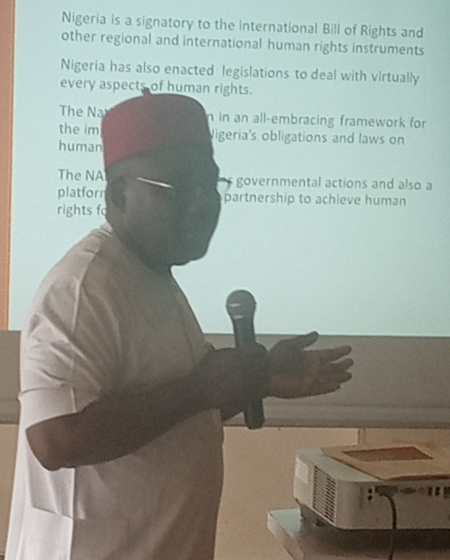
Executive Secretary of the Commission, Dr. Tony Ojukwu, gave the insights at the opening session of the inter-agency consultative workshop on the implementation of the National Action Plan (NAP) for the promotion and protection of human rights in Nigeria (2024-2028) as well as while making presentations on the “Step by step approach on implementing NAP”.
The workshop was organised by the NHRC in partnership with the Committee on human rights of House of Representatives with support of FCDO, Policy and Legal Advocacy Centre (PLAC) and UK International Development, in Abuja Wednesday.
He described NAP as “a twin document that incorporates the National Action Plan for Business and Human rights, marking a significant milestone in Nigeria’s commitment to human rights protection. The NAP is not just a document; it is a strategic roadmap for integrating human rights into governance, policy-making, and institutional frameworks.”
According to Dr. Ojukwu, The NAP serves as a strategic framework to audit, improve, and monitor human rights through collaboration among government, civil society, and other national and international stakeholders.
“The development of the NAP involved extensive consultations with MDAs and the civil society, led by the National Human Rights Commission. Its focus is to address gaps, promote, protect and enforce human rights in compliance with national and global human rights standards.
“The NAP stands out as a comprehensive policy document with transformative goals for advancing human rights in Nigeria, balancing past challenges with future aspirations.”
The NHRC Executive Secretary said the workshop was meant to activate the implementation framework of the NAP by bringing together key stakeholders across government agencies, civil society, and development partners.
“We recognize that effective implementation requires a coordinated, multi-sectoral, and inter-agency approach to ensure that the principles enshrined in the NAP translate into concrete actions that impact the lives of all Nigerians”, he stated.
In a presentation, Dr. Ojukwu maintained that NAP is not just policy document, but a national obligation for Nigeria to its people and to the outside world, adding that it provides an opportunity for the implementation of a focused government agenda towards the various human development and governance challenges in Nigeria.
According to him, “The NAP is very broad and covers almost every political, civil, economic, social and environment aspects of human rights and development. The need for strategic development partners’ support to Governments at federal and state level can never be over-emphasised.
“Effective implementation of the NAP will be key to achieving other broader national development plans.”
On his part, the Chairman of House committee on human rights, Hon. Abiola Peter Makinde, said that the need for promotion and protection of human rights of every Nigerian cannot be over emphasised.
The Chairman who was represented by the Deputy Chairman, Hon. Mudashiru Luqman, observed that there had been constant struggles for the protection of human rights of individuals, groups and communities in Nigeria.
“There are several Nigerians that still face inequality, injustice and discrimination in Nigeria. There is need for us to speak up for those who are denied their fundamental human rights”, he said.
Also speaking, the Chairman of Police Service Commission, DIG Hashima Argungu, advocated for abolition of bail conditions of detained suspects requiring them to provide sureties, directors with landed properties in choice areas of the Federal Capital Territory Abuja.
He argued that there is no way a civil servant who had lived on his legitimate monthly salary could afford such landed property.
The Executive Director of the Policy and Legal Advocacy Centre (PLAC), Clement Nwankwo, commended the National Assembly for their current efforts towards enacting Human Rights Defenders Bill and the reviewed National Human Rights Commission Act.
He noted that with what the NHRC is doing, the scope of observance and implementation of human rights can be expanded.
On the state of emergency declared Tuesday night in Rivers state by President Bola Tinubu, Nwankwo maintained that it must be condemned for what it is. “It is authoritarian usurpation of democratic principles. It must not be left to stand”, he declared.
In her goodwill message, the British High Commission, Deputy High Commissioner, Gul Lever, pledged that the Commission would stand with Nigeria to ensure implementation of the National Action Plan for the promotion and protection of human rights.


















 Business News1 week ago
 Politics1 week ago
 Business News1 week ago