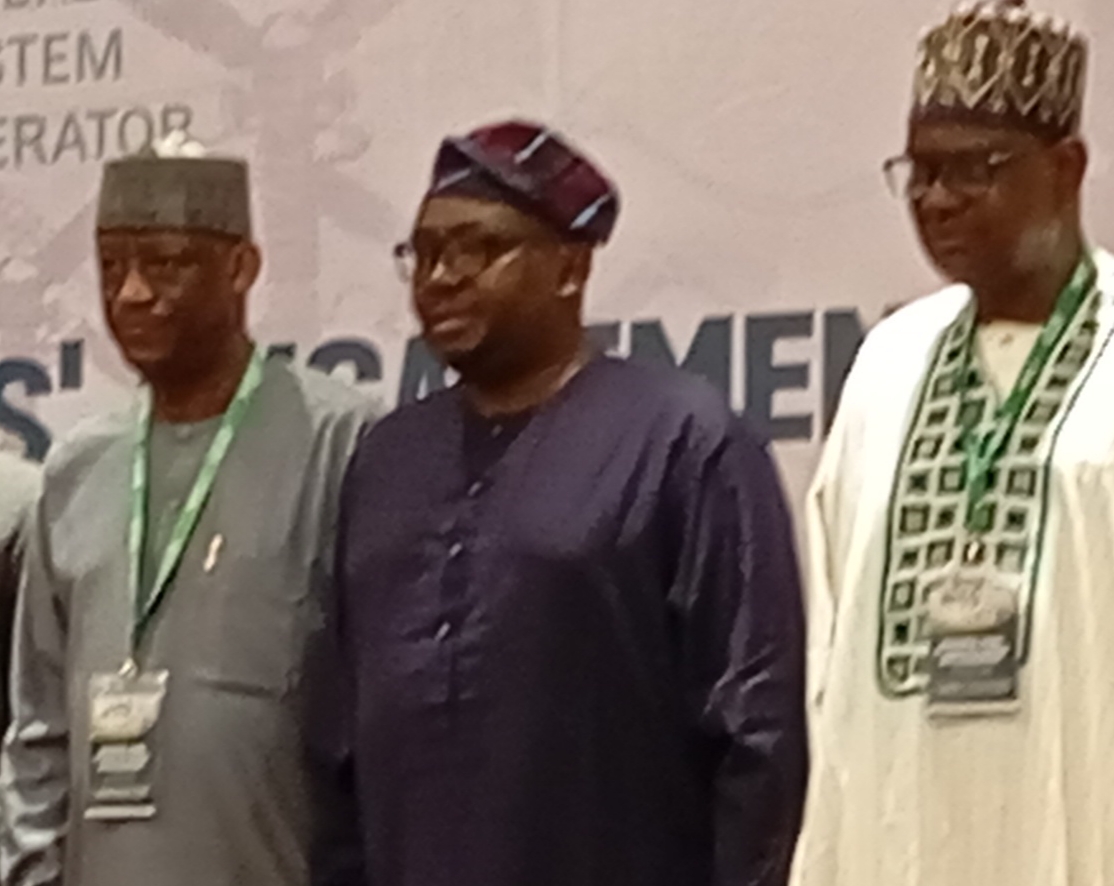
The Minister of power, Adebayo Adelabu (center) flanked by the Managing Director/CEO NISO, Engr. A.B.Mohammed (right) and the Managing Director/CEO TCN, Engr. Abdullaziz Sule (left) at the NISO maiden stakeholders engagement in Abuja.
The Federal government has mobilized a whooping sum of N700 billion from Federation Accounts Allocation Committee (FAAC) for procurement of electricity meters under the Presidential Metering Initiative (PMI) targeted at reducing the protracted metering gap nationwide.
This is even as the government has also through commercialisation of the sector, boosted its revenue by 70 percent thereby reducing its liability to the sector by N700 billion.
The Minister of Power, Adebayo Adelabu made these disclosures while speaking at the opening session of a two-day (19-20 Nov, 2025) maiden NISO stakeholders’ engagement in Abuja with the theme “Building a resilient and competitive electricity market – The role of the Nigerian Independent System Operator (NISO)”.
He said the FAAC fund for metering is further complemented by the World Bank DISREP fund of $500m which adds 3.45million meters to the sector.
While giving update on the nation’s installed capacity for energy generation, Adelabu indicated “Increase in the country’s installed capacity for energy generation from 13GW to 14GW and the attainment of an all-time generation peak of 5,801.44 MW and a maximum daily energy record of 128,370.75 MWh on March 4, 2025.”
The Minister commended NISO for starting on a great note, stressing however that NISO as an organization has started on a great note, stressing however that the “effectiveness of NISO will depend significantly on the cooperation it receives from market participants and institutions across the sector.
“All stakeholders must support the organisation by complying with established procedures, providing timely information, and participating actively in engagements such as this one.
“As we look ahead, the priorities of government remain consistent – to build a reliable and secure power system capable of meeting national demand, to promote a competitive electricity market that encourages investment and efficiency, to ensure stable operations across the grid, and to improve the quality of supply available to Nigerian homes and industries”, he added.
Earlier in an opening remarks, Chairman, Board of Directors’ NISO, Dr. Adesegun Akin-Olugbde, who was represented by the Managing Director/CEO of NISO, Engr. A. B. Mohammed enumerated that the engagement was meant to clarify NISO’s mandate and technical functions; Identify vulnerabilities in grid and market operations; Discuss mechanisms for ensuring resilience and operational stability; Strengthen institutional and commercial collaboration; Reinforce compliance as a non-negotiable requirement; and Build consensus on reforms needed to enhance market confidence and performance.
He extended appreciation to all industry stakeholders : the Minister of power, NERC, Gencos, TCN and the DisCos for their cooperation, professionalism, and collaboration during the recent successful synchronization trial of the Nigerian grid with the West African Power Pool (WAPP) interconnected regional grid.
According to him, “This achievement was not the effort of one institution; it was the result of collective dedication across the entire value chain – from system operations, TCN teams, and generation and distribution coordination, to support from gas suppliers, regulators, and market participants.
“Your contributions affirmed what we can accomplish when the industry works together with a shared purpose. NISO deeply values this spirit of partnership, and we look forward to building on it as we advance grid stability and regional market integration.”
Engr. Mohammed maintained that Nigeria has made history with the successful synchronization of the national grid with the West African Power Pool interconnected system.
According to him, “For four unbroken hours, electricity flowed from Nigeria and Niger into the entire West African sub-region covering Benin, Togo, Ghana, Côte d’Ivoire, Liberia, Sierra Leone, Guinea, Senegal, Mali, The Gambia and Guinea Bissau operating at a single, stabilized frequency.
“That achievement was not accidental. It was the result of strengthened coordination, harmonized operating procedures, and transparent system management. It was a demonstration of what is possible when technical competence, operational discipline, and institutional collaboration work in harmony.
“The milestone recorded is more than a technical success, it positions Nigeria as a regional power hub; opens new avenues for electricity trading; unlocks foreign exchange potential; and reinforces investor confidence in the emerging Nigerian electricity market.
A resilient electricity market requires more than engineering; it requires relationships. It requires trust among service providers, trust between the market and regulators, trust between government and operators, and, above all, trust from the Nigerian people.”