…As Prof. Dakas Proposes Institutionalized Dialogue
The National Human Rights Commission (NHRC) has expressed concern over the potential of application of disproportionate force in dealing with the nation’s protracted insecurity, advising that caution must be applied in order not to amount to torture, cruel, inhuman or degrading treatment which is not permitted under any circumstances.
The Commission cited that the 1999 Constitution of Nigeria (as amended), section 33 guarantees the right to life, while section 34 guarantees the dignity of the human person.
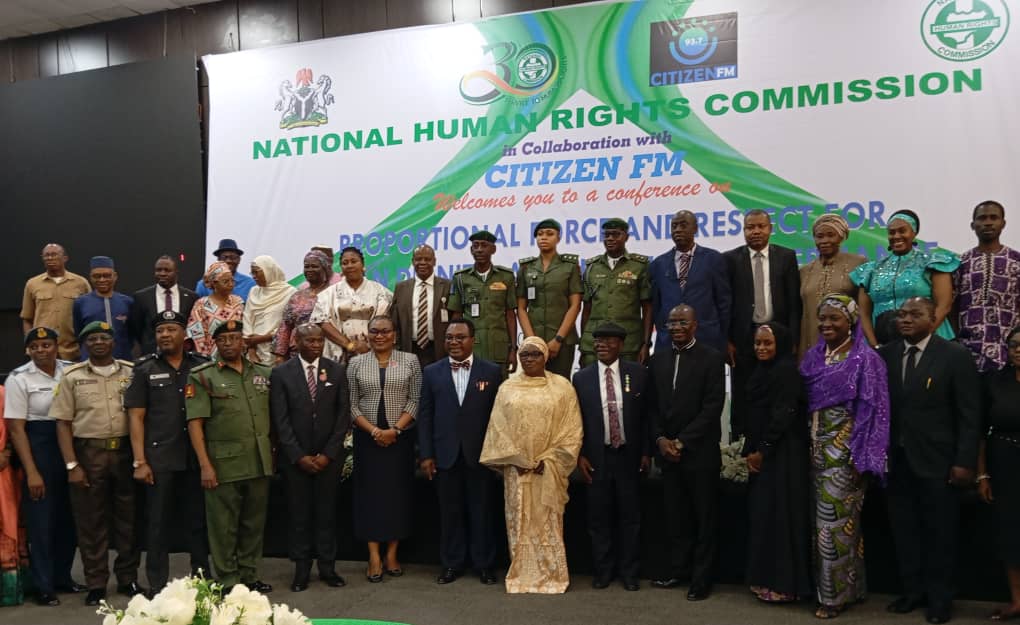
The Executive Secretary of the NHRC, Dr. Tony Ojukwu SAN, canvassed this at the opening session of a dialogue on “Proportional force and respect for human dignity: A dialogue in governance”, organized by the Commission in collaboration with Citizen FM as part of activities marking the 30th anniversary of the Commission. Those in attendance include representatives of Kaduna and Katsina states government, the Chief Justice of Nigeria, Chairman of NDLEA, Gen. Buba Marwa, Department of State Services, Inspector General of Police, representatives of the Nigerian Air Force, Navy, Army among others.
According to Ojukwu, “These provisions state that every individual possesses an inherent worth that must be respected at all times including situations of insecurity and armed conflicts. It places an obligation on security institutions to uphold and protect human dignity as a matter of law and governance.
“The principles of international humanitarian law recognize that even in situations of armed conflict, humanity must not be abandoned.”
Citing other legal provisions to backup his view, such as Article 51(5)(b) of Additional Protocol I to the Geneva Conventions, the Armed Forces Act, Laws of the Federation of Nigeria, 2004, the Nigeria Police Act 2020, as well as the Revised Force Order 237 (2019), Ojukwu said these provisions ensure that both military and police operations are guided by the principles of necessity, proportionality, and respect for human dignity, consistent with Nigeria’s constitutional and treaty obligations.
However, Ojukwu said: “While proportional force and respect for human dignity are substantive principles guiding our security operations, Dialogue is the instrument through which governance becomes participatory and institutions earn trust of the citizens in the systems meant to protect them.
” For the National Human Rights Commission, dialogue in governance means creating platforms where the military, law enforcement agencies, MDAs, civil society, legal practitioners, academics, and citizens can sit together to examine the challenges of security and human rights.
“Of similar principle and relevance to proportional force are the principles for the Prohibition of Torture, Cruel, Inhuman or Degrading Treatment and Punishment. Prohibition of Torture and CID is protected under the Convention against Torture, Section 34 of the 1999 Constitution as amended as well as, under the Anti-Torture Act of 2017.
“Since disproportionate force is sometimes targeted to result in the infliction of harm, pain, either physical or mental or psychological, there is need to be circumspect on force applied with response to a security situation at hand as disproportionate force can become torture, cruel, inhuman or degrading treatment which is not permitted under any circumstances.
“It is proposed that where disproportionate force is applied, it should be considered as torture, cruel, inhuman or degrading treatment or punishment unless, good faith on the part of the officer is established beyond reasonable doubts.”
While presenting the keynote speech on “Proportional Use of Force By Law Enforcement Officials and Respect for Human Dignity: A Dialogue in Governance”, the Chairman, Nigerian Law Reform Commission , Professor Dakas C.J. Dakas, SAN, advocated for institutionalized dialogue to eliminate suspicion between citizens and the law enforcement agencies.
According to Prof. Dakas, “A peaceful society is built not only on laws but on relationships. Dialogue allows citizens and law enforcement to understand one another, resolve conflicts early, and uphold justice in a way that is mutually reinforcing.
“Dialogue is not a sign of weakness. It is a tool of strength, a path to reconciliation, and a foundation for better law enforcement and better citizenship.
“We cannot build peaceful societies through silence or suspicion. We build them through speaking, listening, understanding, and working together in an atmosphere of mutual respect.”
Prof. Dakas further observed that
Nigeria faces complex security realities of banditry, terrorism, communal conflict, cybercrime, among others, adding that these pressures test the capacity and professionalism of Nigeria’s security agencies daily.
He said that in the midst of these challenges and efforts to solve them there are recurring concerns such as Unclear engagement rules, Excessive or poorly regulated force, Delayed accountability mechanisms, Trust deficit – Public mistrust due to past abuses and Insufficient training and equipment.
“The consequence is a widening gap between citizens and the institutions meant to protect them. This gap must be closed, not with force, but with reforms, transparency, and renewed commitment to service”, he maintained.





















 Business News1 week ago
 News3 days ago
 News6 days ago