The Nigeria Deposit Insurance Corporation (NDIC) has effected payments of insured deposits to 84.98% of depositors of the defunct Heritage Bank with Bank Verification Number (BVN) linked their accounts to date.
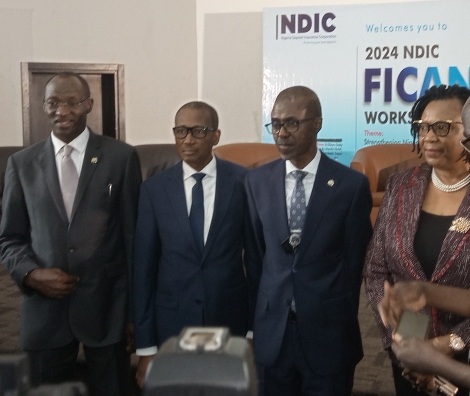
The Managing Director and Chief Executive Officer of NDIC, Mr. Bello Hassan, made this disclosure while delivering a key note address at the ongoing 2024 NDIC Business Editors and Finance Correspondents Association of Nigeria (FICAN) workshop holding in Lagos. The theme of the workshop is “Strengthening Nigeria’s Financial Safety-Net: The Role of NDIC”.
OPTIMUM TIMES reports that the license of Heritage Bank was revoked by the CBN on June 3, 2024. Acting in accordance with the relevant provisions of the Banks and Other Financial Institutions Act (BOFIA) 2020 and the NDIC Act 2023, the NDIC was appointed liquidator to manage the orderly resolution of the bank and oversee the payment of its depositors and other claimants.
Also, NDIC promptly commenced payments to the depositors four days after Heritage bank’s license revocation and closure.
According to the NDIC Managing Director, “In the discharge of this critical role of depositor reimbursement, the Corporation began the payment of the insured deposits of N5 million maximum per depositor within a record time of four days of the bank’s closure. This was achieved using Bank Verification Numbers (BVN) as a unique identifier to locate depositors’ alternate accounts in other banks without the need to fill forms or visits the NDIC offices.
“This innovative approach has indeed, enabled the payment of 84.98% of depositors with BVN linked accounts to date. The prompt payment of depositors, coming at a time when the Corporation had also recently increased the deposit insurance coverage from N500,000 to N5 million in Deposit Money Banks, significantly cushioned the negative impact of bank failure, especially during the current challenging economic climate.
“This achievement is consistent with the provisions of the International Association of Deposit Insurers (IADI) Core Principle 15, which emphasises timely payouts to depositors of failed bank.”
Mr. Hassan further assured that having largely reimbursed depositors their insured deposits, the Corporation is committed to ensuring that depositors with balances
exceeding N5 million are also paid the balance of their deposits.
On those with uninsured deposits, he indicated that these uninsured deposits represented a significant portion of the total deposits in Heritage Bank and gave further assurances that the Corporation is working to ensure that depositors with amounts in excess of the maximum insured amount of N5 million are paid.
“In this regard, the Corporation is already working assiduously to ensure that, all depositors with amounts in excess of the maximum insured amount of N5 million are paid through liquidation dividends from the realisation of the defunct
bank’s assets and recovery of debts.
“The Corporation has already initiated the process of debt recovery and realisation of investments and physical assets of the defunct bank to ensure timely payment of the uninsured deposits of the defunct bank”, he assured.
The NDIC Managing Director also explained that the Corporation’s responsibilities extend to the creditors of the defunct bank, who would receive payments after all depositors have been fully reimbursed.
In his view, “This orderly process, based on asset realisation and priority of claims, is essential in maintaining public trust in the banking system and promoting financial stability. The handling of the Heritage Bank liquidation illustrates the broader role of the NDIC in ensuring that even in times of financial disruption, depositors can be rest assured that their funds are protected.”
The NDIC was established over three decades ago to protect depositors, especially the most vulnerable, and to contribute to the stability of the financial system. Its core mandate includes providing deposit insurance cover to depositors of licensed banks, supervising insured financial institutions, resolving distressed banks, and ensuring orderly resolution in the event of bank failure.






















 Business News1 week ago
 News3 days ago