From Chidi Nkwopara, Owerri
Against the backdrop of torrents of election petitions by aggrieved persons and interested parties flooding the Election Petition Tribunals to challenge the outcome of the just concluded 2023 election, the trial Judges have been urged to take courage in dispensation of justice and pull back Nigeria from the precipice.
The Anglican Archbishop of Owerri Ecclesiastical Province, Most Rev. Dr. David O. C. Onuoha, gave the charge weekend, while flagging off the Provincial Council Meeting at St. Mary’s Cathedral, Oguta.
His words: “Now that the election battle has shifted to the courts, we should continue to pray that the judiciary will rise to the occasion and find courage to redeem this nation.
“Our judges must do everything possible to pull Nigeria back from the precipice and reposition it for greatness, through rulings and orders that will discourage impunity, make corruption unattractive and declare broad day rubbery a criminal offence, while ensuring that justice equity and fairness are upheld.”
While wondering how someone will manage the storm that comes after a very vigorous campaign and success in the polling units and another person is declared winner of the election, the Anglican cleric was of the view that the electoral umpire disappointed the citizens.
He said: “The entire exercise was a mixed bag of excitement and frustration. The introduction of cutting age technology like the Bimodal Voter Accreditation System (BVAS) INEC Result Viewing Portal (IRev) as well as the promise to upload results real time, from the pooling boots, elicited confidence and excitement, especially on those like us, who had vowed not to have anything to do with elections in Nigeria, as a result of the failure and/or refusal to make people’s vote count.
“Nigerians were persuaded by the rhetorics of the electoral umpire to troop out to exercise their franchise, thinking that a new Nigeria was about to berth. Alas, the 2023 general elections have gone down as the worst in the history of Nigeria!
“It is very sad and regrettable that those in the Ivory tower, who discipline students for examination malpractice, with the exception of a few of them, can attain such an inglorious height in electoral malpractice.
“We wonder how they can still, in good conscience, certify graduating students as being worthy in character and learning. Unless the Nigerian state has deemed itself irredeemable, the INEC Chairman and his co-workers should be made to explain why they not only deceived Nigerians, but also wasted over N300 billion tax payers money in the charade called election, which they superintended.”
Onuoha suggested that since professors have repeatedly failed Nigerians in INEC duties, assistant lecturers and graduate assistants, should be tried, stressing that: “As up starters, they may still have the fear to do the right thing and refrain from doing anything that could put their future in jeopardy.”
On the planned national census exercise, Archbishop Onuoha pleaded that “it should be put on hold, until the sense of accountability is sufficiently inculcated in our public officers, otherwise Nigeria is at the verge of losing hundreds of billions of tax payers’ money in another futile venture”.
Continuing, Onuoha recalled that the citizenry cannot forget the present reality of living in constant fear, as a result of insecurity, both in the house, office, market, places of worship and on the road.
His words: “Perhaps, the most disturbing among the regular constants of stress and hopelessness buffeting Nigerians, is the dearth or acute scarcity of our national currency.
“A situation where one has money in the bank but cannot have access to it, to solve his pressing needs, is more frustrating than having no money at all.
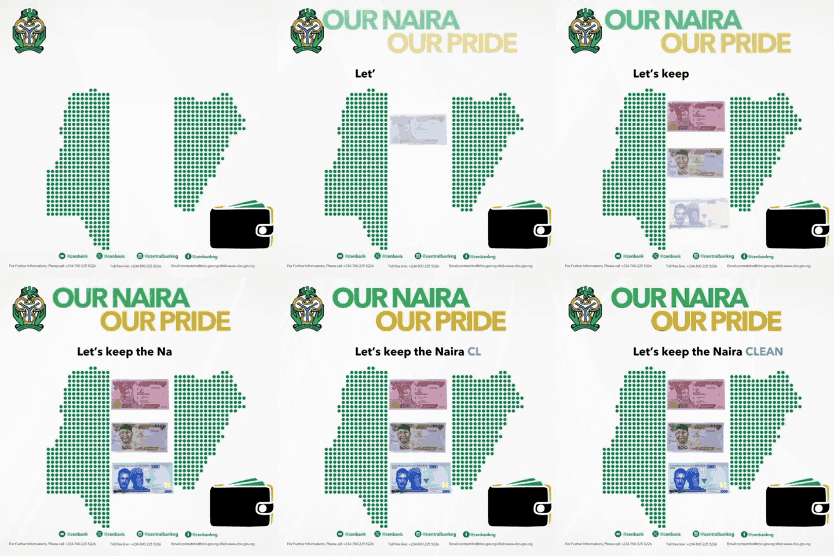
“We regret the untold hardship Nigerians are going through, on account of the infamous and ill planned, ill-timed and ill executed project of redesigning our national currency, the Naira.
“The Central Bank of Nigeria had earlier adduced the following as the objectives for the exercise/policy: to reduce the money in circulation outside the banking system, to increase the supply of clean notes, to make the monetary policy more efficacious, to limit the counterfeiting of the Naira, to deepen the cashless policy and support the security forces in fighting terrorism and ransom taking.
“While acknowledging the positive impact of the policy with regard to the last point above, it is doubtful whether the untold hardship Nigerians are going through as a result, can in any way, be justified.
“What the apex bank did not tell us is how so much money came to circulate outside the banking system.”



















 News1 week ago