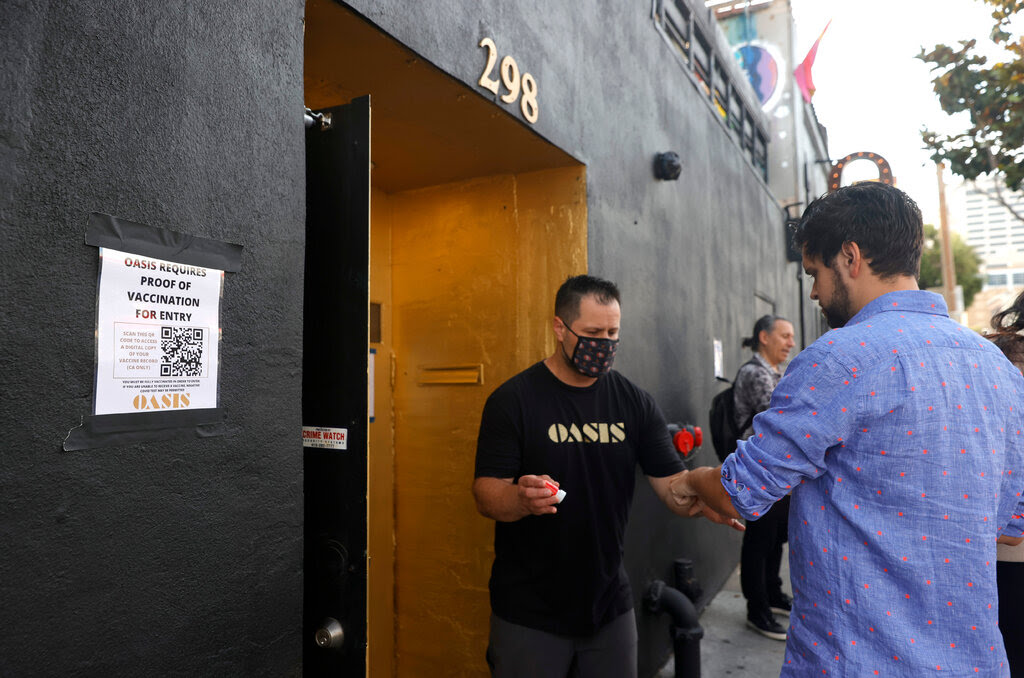
San Francisco leaders on Thursday unveiled some of the nation’s toughest restrictions on unvaccinated people, barring them from indoor dining, bars, nightclubs, gyms, large concerts, theaters and other events held inside. The new rules, which take effect on Aug. 20, would apply even to people who can show they have tested negative for the coronavirus.
“This is an important step towards our recovery,” Mayor London Breed said during a briefing announcing the new requirements. “We all have to do our part. We need to get vaccinated.”
The rules are similar to those announced by Mayor Bill de Blasio of New York earlier this month, except that San Francisco will require patrons to be fully vaccinated while New York requires only a minimum of one dose.
The new requirements come amid a flurry of increasingly strict vaccine rules for public workers, private companies and colleges and as virus cases and hospitalizations have risen sharply across the country that are only expected to accelerate once the Food and Drug Administration grants full approval to the vaccine in the coming weeks.
San Francisco’s order does not apply to people dining outdoors, entering a restaurant to order take-out or to children under 12, who are not yet eligible for vaccines.
City officials indicated that they will give more leeway to employees of affected businesses than to patrons. Restaurant and bar workers have until Oct. 13 to prove that they are fully vaccinated, a move that the mayor said was designed to prevent people from losing their jobs.
The city is also giving a grace period to the city’s 35,000 municipal employees, who are required to be vaccinated 10 weeks after the final F.D.A. approval. Health care workers and those who work in homeless shelters, jails and other congregate settings considered high risk have until Sept. 15 to be vaccinated.
California, which has fully vaccinated 65 percent of its adults, has fared better than states like Florida, Texas and Arkansas in terms of the new surge of virus cases, but cases in California are still about 10 times higher than they were in mid-June, according to a New York Times database.
Countries like France and Italy have announced vaccine or testing requirements for their populations to participate in certain activities, like indoor dining.
Many such vaccine requirements, such as the one in France and one announced by the city of Palm Springs last week, allow patrons and employees to provide a recent negative coronavirus test instead of proof of vaccination.
But coronavirus tests only reflect the moment in which they were taken, and it is possible for someone to get infected, and potentially spread the virus, in the time between testing negative and, say, eating in a restaurant.
Dr. Denis Nash, an epidemiologist at the City University of New York Graduate School of Public Health and Health Policy, said that relying on tests could allow the Delta variant to spread.
San Francisco has been relatively successful in convincing its residents to become vaccinated. With 78 percent of its eligible population fully vaccinated, the city’s vaccine rates are well above the national rate of 50 percent and California’s 65 percent rate, according to The Times’s database. Among San Francisco residents 12 to 17 years old 96 percent are vaccinated according to city data.
The mayor, who since the beginning of the pandemic has put in place some of the strictest measures to counter the virus, unveiled the new restrictions on Thursday with bar and restaurant owners in attendance.
City officials are making the case that residents have few excuses not to get vaccinated. Last week the city launched a free service that sends a mobile vaccination team to anyone’s home or business provided there are a minimum of five people ready to be vaccinated. The team offers a choice of the Johnson & Johnson, Moderna, and Pfizer vaccines.
-New York Times

















 Business News1 week ago
 News7 days ago
 News1 week ago