News
Winnie Mandela, Ex-wife of Former South African President, Late Nelson Mandela Dies at 81 years.

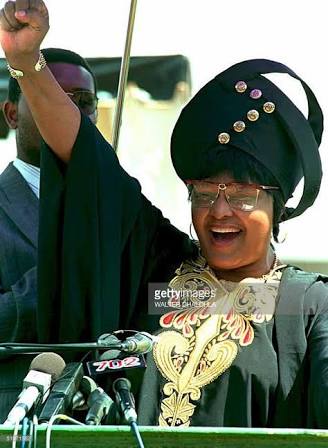
Winnie Mandela
*Life And Time Punctuated With Ups, Downs
Winnie Mandela, Ex-wife of Former South African President, Late Nelson Mandela Dies at 81 years.
Her personal assistant, Zodwa Zwane‚ confirmed it on Monday, April 2, 2018.
He said in a statement, “It is with profound sadness that we inform the public that Mrs Winnie Madikizela-Mandela passed away at the Netcare Milpark Hospital‚ Johannesburg‚ South Africa on Monday, April 2‚ 2018.
“She succumbed peacefully in the early hours of Monday afternoon surrounded by her family and loved ones,” her family said in a statement.
According to Wikipedia, Winnie Madikizela Mandela OLS
(born Nomzamo Winifred Zanyiwe Madikizela; 26 September 1936 [1] – 2 April 2018 [2]), commonly known as Winnie Mandela, was a South hi of Arts, Culture, Science and Technology.
A member of the African National Congress (ANC) party, she served on the ANC’s National Executive Committee and headed its Women’s League.
Born to a Xhosa family in Bizana, in the then Union of South Africa, she studied social work at the Jan Hofmeyr School.
In 1958, she married anti-apartheid activist Nelson Mandela in Johannesburg; they remained married for 38 years and had two children together.
In 1963, Mandela was imprisoned following the Rivonia Trial; where she became his public face during the 27 years he spent in jail. During that period, she rose to prominence within the domestic anti-apartheid movement. She was arrested and detained by state security services on various occasions and spent several months in solitary confinement.
In the 1980s, when she was based in Soweto, Madikizela-Mandela endorsed violent behaviour; including necklacing against alleged police informers and collaborators with the National Party government.
Her security detail, known as the Mandela United Football Club, carried out a number of these actions, including the kidnapping, torture, and murder of such individuals, most notoriously the teenager Stompie Moeketsi.
Nelson Mandela was released from prison on 11 February 1990, and the couple separated in 1992 but remained officially married until their divorce was finalised in March 1996.
The couple remained in contact, and she visited him when he was ill in later life. As a senior ANC figure, she took part in the post-apartheid ANC government, although was dismissed from her post amid allegations of corruption.
The Truth and Reconciliation Commission established by Mandela’s government to investigate past human rights abuses revealed many of her violent activities during the 1980s; which damaged her reputation. In 2003, she was convicted of theft and fraud. She temporarily retreated from active political involvement although returned several years later.
A controversial figure, Madikizela-Mandela retained a level of popular support within the ANC and was known to her supporters as the “Mother of the Nation”.
During the apartheid era, she was offered academic honours abroad. Conversely, she was reviled by others for having personally been responsible for the murder, torture, abduction, and assault of numerous men, women, and children, as well as indirectly responsible for an even larger number of such crimes.
Although branded by followers as “a revolutionary and heroic figure…it doesn’t take that much digging to remember the truly awful things she has been responsible for.”
Early Life: Her Xhosa name is Nomzamo (“She who tries”). She was born in the village of Mbongweni, Bizana, Pondoland, in what is now the Eastern Cape Province. She was the fourth of eight children, which consisted of seven sisters and a brother. Her parents, Columbus and Gertrude, were both teachers. Columbus was a history teacher and a headmaster, and Gertrude was a domestic science teacher. Gertrude died when Winnie was nine years old, resulting in the break-up of her family as all the siblings were sent to live with different relatives.
Madikizela-Mandela went on to become the head girl at her high school in Bizana. After she matriculated, she went to Johannesburg to study social work at the Jan Hofmeyr School, despite restrictions on the education of blacks during the apartheid era.
She earned her degree in social work in 1956, and several years later earned a bachelor’s degree in international relations from the University of Witwatersrand.
She held a number of jobs in various parts of what was then the Bantustan of Transkei; including with the Transkei government, living at various points of time at Bizana, Shawbury and Johannesburg. Her first job was as a social worker at Baragwanath Hospital in Soweto.
Marriage/Children: She met lawyer and anti-apartheid activist Nelson Mandela in 1957. She was twenty-two years old and standing at a bus stop in Soweto when Mandela first saw her and charmed her, securing a lunch date the following week.
They got married in 1958 and had two daughters, Zenani (born 1958) and Zindziwa (born 1960). Her husband was arrested and jailed in 1963, but would not be released until 1990.
The couple separated in 1992 and was seperated from Mandela whilst she was First Lady. They finalised the divorce in March 1996 with an unspecified out-of-court settlement. Her attempt to obtain a settlement up to US$5,000,000 (R70,000,000)- half of what she claimed her ex-husband was worth, was dismissed when she failed to appear in court for a settlement hearing.
When asked about the possibility of reconciliation in a 1994 interview, Winnie said: “I am not fighting to be the country’s First Lady. In fact, I am not the sort of person to carry beautiful flowers and be an ornament to everyone.”
Apartheid: Due to her political activities, Winnie was regularly detained by the National Party government. She was tortured, subjected to house arrest, kept under surveillance, held in solitary confinement for over a year and even banished to a remote town.
She emerged as a leading opponent of apartheid during the later years of her husband’s imprisonment (August 1963 – February 1990). For many of those years, she was exiled to the town of Brandfort in the Orange Free State and confined to the area, except for when she was allowed to visit her husband at Robben Island.
Beginning in 1969, she spent eighteen months in solitary confinement at Pretoria Central Prison. It was at this time that Winnie Mandela became well known in the Western world. She organised local clinics, campaigned actively for equal rights and was promoted by the ANC as a symbol of their struggle against apartheid.
Corruption and criminal allegations: Her reputation was damaged by such rhetoric as that displayed in a speech she gave in Munsieville on 13 April 1986, where she endorsed the practice of necklacing (burning people alive using tyres and petrol) by saying: “With our boxes of matches and our necklaces we shall liberate this country.”
Further tarnishing her reputation were accusations by her bodyguard, Jerry Musivuzi Richardson, that she had ordered kidnapping and murder. On 29 December 1988, Richardson, who was coach of the Mandela United Football Club, which acted as Mrs. Mandela’s personal security detail, abducted 14-year-old James Seipei (also known as Stompie Moeketsi) and three other youths from the home of a Methodist minister, Rev. Paul Verryn, claiming she had the youths taken to her home because she suspected the reverend was sexually abusing them.
The four were beaten to get them to admit to having had sex with the minister. Seipei was accused of being an informer, and his body later found in a field with stab wounds to the throat on 6 January 1989.
In 1991, she was acquitted of all but the kidnapping. Her six-year jail sentence was reduced to a fine on appeal. The final report of the South African Truth and Reconciliation commission, issued in 1998, found “Ms Winnie Madikizela Mandela politically and morally accountable for the gross violations of human rights committed by the MUFC” and that she “was responsible, by omission, for the commission of gross violations of human rights.”
In 1992, she was accused of ordering the murder of Dr. Abu-Baker Asvat, a family friend who had examined Seipei at Mandela’s house, after Seipei had been abducted but before he had been killed. Mandela’s role was later probed as part of the Truth and Reconciliation Commission
hearings, in 1997.
She was said to have paid the equivalent of $8,000 and supplied the firearm used in the killing, which took place on 27 January 1989. The hearings were later adjourned amid claims that witnesses were being intimidated on Winnie Mandela’s orders.




Click to read full text









Leadway Expands Literacy Drive To Six States, Deepens Investment In Basic Education

Dangote Refinery Ramps Up To 700,000 Barrels Per Day, Strengthening Africa’s Energy Landscape

Five Soldiers, Three CJTF Members Killed As Troops Repel Terrorists’ Attack In Borno

Reno Omokri Says He Investigated Allegation Against Peter Obi in Peru, Found No Evidence, Warns Asari Dokubo
Beyond Text Generation: Thesis-Speedwrite Reframes Al-Assisted Research Around Structure, Integrity And Scholarly Method

Breaking news: Court Dismisses Eligibility Suit Against Jonathan, Awards N21Million Fine Against Lawyer