By Mohammed Abubakar Dutse
As part of the efforts to curb the rising incidences of domestic violence and divorce among youths, the Chairman/Chief Executive of the National Drug Law Enforcement Agency, (NDLEA), Brig. Gen. Mohammed Buba Marwa (rtd) has advocated on compulsory drug test for prospective couples before the solemnization of their marriages.
He believed that the suggestion, if accepted and implemented, incidences early divorces among young couples would drastically reduced while caes of violence could be reduced to the barest minimum while the marriage institution would be sustained.
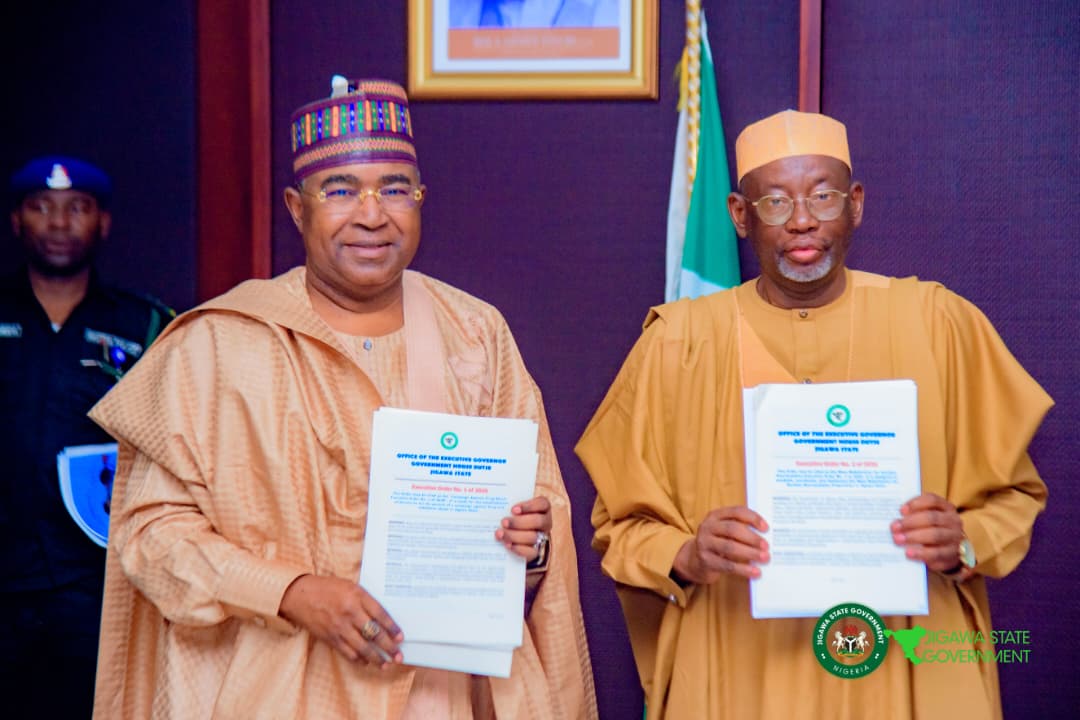
The former Lagos State Military Administrator made the suggestion, just as the Jigawa state governor Umar Namadi on Tuesday at the Council Chambers Government House Dutse signed into law two Executive Orders establishing a coordinated framework to combat drug abuse and institutionalize mass mobilisation for societal reorientation, describing the initiative as a strategic investment in the future of the state’s youth population and the moral renewal of its communities.
The Executive Orders seek establish the Jigawa State Task Force on Drug Abuse and Control and the Mass Mobilisation for Social Reorientation initiative. The 39-member Task Force has Dr. Ibrahim Bwaji, retired Narcotics Commander of the NDLEA as Coordinator while the 13-member mass mobilisation committee has the state Information Commissioner Sagir Musa Ahmed as the chairman.
Marwa maintained his suggestion, if bought it by the governors would be in addition to the newly introduced federal government policy of testing students of tertiary institutions of learning, especially those returning for drugs before being allowed into their campuses as well as HIV and blood genotype tests being conducted before marriages are solemnised.
His words, “When children are going for wedding fatiha, they go through HIV test, they bring genotype certificate, why not also bring drug-free certificate so that both the boy and the girl are declared drug negative? This campaign we’ve been pushing it and it’s been adopted gradually elsewhere. So we’re placing it before the governor of Jigawa state for consideration.
“We’re adopting this method because at the NDLEA, we face on daily basis issues between couples who get married and within weeks you’ll that they’d call that their husbands are pursuing them with knives and other dangerous weapons at home. All these are as results of drugs and three are important issues before the government,”
Marwa described Namadi’s support for the agency as unparalleled among Nigeria’s state governments, saying that by signing the orders intro law, the governor had clearly sent a message that the state had no room for drug barons and addicts, and commended the Jigawa state model for other state governors to emulate.
“There is no governor in Nigeria today who is doing more for the NDLEA State Command than the Governor of Jigawa State,” he said.
He disclosed that the governor had provided land for a permanent NDLEA barracks, office accommodation, official residential support for the state commander and additional assistance to strengthen the agency’s operations in Jigawa.
“As a student of governance and public administration myself, I am pleased to express my deepest commendation to the executive governor of this great state, His Excellency, Malam Umar A. Namadi, FCA, for the tremendous efforts he is making to transform Jigawa State for the better. The governor is proving that proactive governance is the best antidote to social malaise.”
Highlighting the agency’s national achievements, the NDLEA chairman disclosed that between January 2021 and December 2025, the agency recorded 77,859 arrests, secured the conviction of 14,122 offenders, seized 14.8 million kilogrammes of illicit substances and rehabilitated more than 50,000 individuals across its treatment centres nationwide.
He stated that Jigawa’s estimated drug prevalence rate of about seven per cent remained among the lowest in the country and expressed confidence that the newly inaugurated Task Force would help reduce the figure further through prevention, community mobilisation and sustained collaboration.
Governor Namadi said the Executive Orders were deliberate instruments of governance designed to fulfil commitments contained in his administration’s 12-Point Agenda and inaugural address, particularly the pledge to collaborate with relevant federal agencies to tackle drug abuse, strengthen local governance and drive positive societal transformation.
“The two Executive Orders directly address these commitments: one establishes a structured campaign against drug abuse by bringing prevention, treatment, rehabilitation, community mobilisation, and enforcement support under a coordinated framework. The other lends institutional strength to societal reorientation by promoting patriotism, honesty, discipline, respect for the law, civic responsibility, and service to the common good.”
The governor said recent social developments had reinforced the urgency of the initiative, stating that the aftermath of the August 2024 protests demonstrated how frustration, misinformation, idleness and weak social guidance could expose young people to destructive influences.
“Sustainable development requires more than projects and programmes; it also requires a positive civic culture, rooted in our traditions and the teachings of Islam, to guide citizens towards discipline, responsibility and the common good,” he said.
Describing Jigawa’s youthful population as one of its greatest assets, Governor Namadi warned that drug and substance abuse remained a serious threat capable of undermining the state’s future if not addressed proactively.
“Youth empowerment without values can become misdirected energy; values without opportunity can become frustration. Our duty, therefore, is to provide both opportunities that open legitimate paths to progress and guidance that anchors ambition in discipline, service, productivity and peaceful coexistence.”
Governor Namadi said the executive orders complement other reforms already introduced by his administration, including the Ward Level Development Advisory Committees and the Participatory Community Development Project Fund, both aimed at deepening grassroots participation, improving accountability and giving communities greater ownership of development initiatives.
He noted that drug abuse could only be defeated through a comprehensive approach combining enforcement with prevention, counselling, rehabilitation, family support and community vigilance, while societal reorientation required leadership by example, responsible citizenship and respect for the law.
Calling for collective action, the governor urged parents, teachers, religious and traditional leaders, ministries, local governments, development partners, community organisations, the private sector and youth groups to support programmes that expand opportunities in skills acquisition, entrepreneurship, agriculture, digital innovation, sports, creative industries and civic engagement.
The governor commended the NDLEA for its partnership with the Jigawa State government and praised the agency’s State Command for its operational achievements, including the seizure of nearly 2,000 kilogrammes of illicit drugs valued at over ₦2.8 billion and the conviction of 136 offenders.




















 News4 days ago
 Business News5 days ago
 News1 week ago