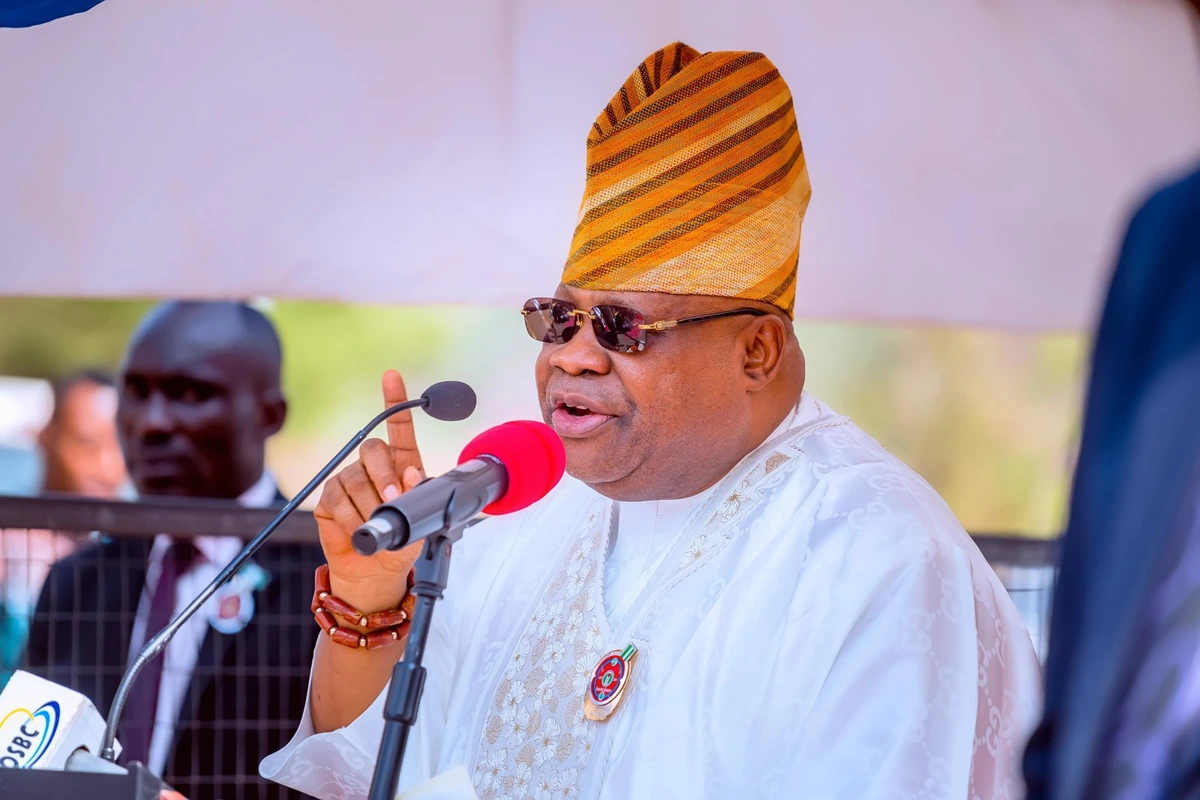
Osun State Governor, Senator Ademola Adeleke, has dragged the Economic and Financial Crimes Commission (EFCC) before the Federal High Court in Abuja, seeking ₦2 billion in damages over the freezing of the state’s Federal Statutory Allocation Account.
The suit, filed by the Osun State Government alongside the state’s Attorney General and Accountant General, names the EFCC, its Chairman and First Bank of Nigeria Limited as defendants.
The legal action comes shortly after President Bola Tinubu directed the anti-graft agency to vacate the freezing order, expressing concern that the timing of the action could create the impression of federal interference in the forthcoming governorship election in the state.
In the suit, the plaintiffs are asking the court to determine whether the EFCC has the legal authority to freeze or place a Post-No-Debit restriction on a state government’s account without first obtaining and serving a valid order of a court of competent jurisdiction.
They argued that the commission’s action violated constitutional safeguards, due process and the financial autonomy guaranteed to states under Nigeria’s federal system.
The plaintiffs described the freezing of the account as “an egregious act of executive lawlessness” and “a flagrant abuse of statutory powers,” insisting that the action was unconstitutional and of no legal effect.
They are therefore asking the court to nullify the restriction placed on the account, direct First Bank to immediately restore unrestricted access to the funds, and restrain both the bank and the EFCC from imposing similar restrictions in future except in accordance with the law.
The Osun State Government is also seeking ₦2 billion in exemplary and aggravated damages for what it described as the unlawful interference with public funds, in addition to the cost of the litigation.
No hearing date has been fixed for the matter.
The lawsuit follows the EFCC’s ongoing investigation into the alleged diversion of about ₦11 billion belonging to the Osun State Government, involving Ecology Funds, Intervention Funds and allocations from the Federation Account Allocation Committee (FAAC).
The commission had disclosed that investigations commenced in March 2026 and that several state officials, including the Accountant General, had been questioned.
According to the EFCC, it imposed the restriction after detecting what it described as suspicious transfers from the state’s accounts to several corporate entities, maintaining that the action was necessary to prevent the alleged movement of public funds while investigations continue.
The controversy, however, deepened after President Tinubu publicly distanced himself from the timing of the account freeze.
In a personally signed statement, the President said he was embarrassed by the development, stressing that although the EFCC was exercising powers backed by a court order, the timing of the action could be misinterpreted in the context of the state’s approaching governorship election.
He subsequently directed the commission to approach the court to vacate the freezing order and discontinue the action against the Osun State Government.
The dispute has also drawn legal scrutiny, with the Nigerian Bar Association (NBA) questioning the legality of freezing an entire state government’s account.
NBA President, Afam Osigwe (SAN), argued that while anti-corruption agencies may obtain court orders to freeze specific accounts linked to suspected criminal activity, imposing a blanket restriction on a state’s accounts raises serious constitutional concerns and could cripple government operations.
Legal observers say the suit is likely to test the extent of the EFCC’s investigative powers, the scope of judicial oversight in financial crime investigations, and the constitutional protections available to state governments over their public finances.














 Business News7 days ago
 News1 week ago
 Business News7 days ago