
For Records
THE RAIN BOMB HAS DROPPED!

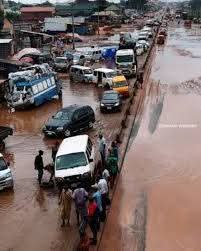
Disaster on Airport Road: This isn’t a river, it’s one of Abuja’s busiest highways completely drowned by a 10-minute “rain bomb.” The master plan has been defaced, and the concrete trap is snapping shut. Are we ready for September? Chudi Okologbu Uwandu narrates, saying BEHOLD EL-NIÑO, THE RAIN BOMB: Are We Ready To Take Cover…?”?
Two weeks ago, we warned about El-Niño under this headline.Shortly after, it descended on Abuja with massive flooding in some districts.
Residents marched out in protests, urging the Federal Capital Territory Administration to avert further disasters.
Reports of similar flooding have since poured in from parts of the country. Yet, the state and federal governments seem not to have done anything beyond the usual promises.Last week, the news wires were abuzz with stories of newly built roads being washed away by rain.
Road users were trapped for days on the Benin-Auchi section.Yet, the extraordinary heavy rain called El-Niño hasn’t even fully arrived in Nigeria as predicted by global weather experts.
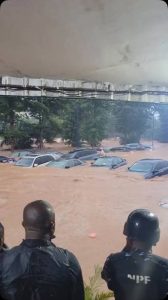
Today, we warn again as we enter September—the beginning of the very months predicted to bring even more rain and devastation. This year’s rain has arrived in exactly the pattern ascribed to El-Niño. Experts predict it will continue with more devastation in the coming months if we remain unprepared.
This is not the first time Abuja will be flooded dangerously. We all remember the tragic incidents at Trademore Estate, where a single overnight disaster claimed four lives, submerged 166 houses, and swept away 26 vehicles, causing damage worth billions of naira.
Government authorities blamed those losses on the distortion of the Abuja Master Plan, pointing out that houses were built on natural waterways. But my deep concern now is that those past disasters happened under normal rains.
If a full-blown El-Niño descends on us with its predicted power, this year, the level of destruction will be unimaginable.
But, what is this El-Niño?
Simply put, El-Niño is what happens when a massive part of the ocean becomes unusually hot, like a giant kettle boiling over. This distant ocean heat completely messes up the world’s wind and weather patterns. For us in Nigeria, it acts like a giant, overhead engine that breaks our normal rainy season.
Instead of giving us gentle, steady showers spread across several months, this engine traps weeks of heavy water and dumps it all at once in violent, short bursts.
It is a literal rain bomb, not just about getting wet. It is a direct threat to our livelihoods and our pockets. That is why the African Development Bank has warned that this super El-Niño will drain up to $20 billion from African economies, shrinking growth and making daily survival tougher for the average citizen.
Locally, the Nigerian Meteorological Agency (NiMet) has placed Abuja and 26 states on red alert for flash floods and destructive winds. Because our soils are already heavily soaked, these sudden downpours turn our streets into raging rivers in minutes.
Nowhere is this danger more self-inflicted than in our nation’s capital. While the FCTA builds massive new flyovers and completes long-abandoned highways, older inner-city roads are left to rot.
In established hubs like Gwarinpa and Garki, the internal asphalt is already washing away.The core issue is that our original Master Plan has been ruined. FCT Senator Ireti Kingibe recently spoke out on this exact crisis, directly linking Abuja’s worsening floods to the unchecked distortions of the city’s blueprint.
She openly criticized the administration for approving construction on critical natural green spaces, natural flood plains, and designated drainage channels.
Besides, greed and poor oversight has allowed developers to clear these vital green areas, paving them over with raw concrete. New estates are springing up daily without proper drainage. Where drains exist, they are choked solid with plastic waste and silt.
By replacing porous earth with concrete and ignoring internal infrastructure, we have built our own trap. Yet, public safety cannot be left to luck. Every household must take action immediately.
Clear your compound’s gutters today. Never attempt to drive or walk through floodwaters. Six inches of moving water can sweep a person off their feet, and two feet of water will carry a car away.
Unplug electronics during heavy rains to avoid severe lightning surges, and stay clear of trees or uncompleted buildings when the winds pick up.Our emergency and development control agencies are sleeping on a ticking clock.
The Federal Capital Development Authority (FCDA) must look beyond glamorous highway projects and urgently rehabilitate the drainage systems of our older districts. State governors must heed warnings and halt illegal constructions on designated green spaces.
Developers who fail to build standard drainage systems must face immediate, severe penalties. The National Emergency Management Agency (NEMA) cannot afford to be reactive. We need emergency shelters mapped out in low-lying communities right now.
This is no longer a routine rainy season. It is a verified emergency. Let us fix our structural failures ,today, before the skies open up completely.
*Chudi Okologbu Uwandu is a Retired Federal Civil Service Director, Policy Analyst, and Social Affairs Commentator.






Click to read full text








Kwara Building Collapse Death Toll Rises To Five As Occupants Consent To Entire Demolition

Alleged Illegal Property Possession: Court Asked To Award N50 Million Damages Against Company Linked To Police Service Secretary

Osibanjo Advocates Effective Regulation As African Lawyers, Advance Continental Standard For Children’s Digital Rights

AECAF Congratulates Abdulrazaq Isa, Bala Wunti, On Respective Emergence As Chairman, CEO World Energy Council Nigeria

Electricity For Underserved Communities: REA, Alpha Morgan Bank Collaborate On ₦50 Billion Financing Facility To Accelerate Access

NERC Gives PHED 60-Days To Incorporate PHED SubCo To Oversee Interstate Power Supply As AKSERC Assumes Electricity Oversight


-
 Business News6 days ago
AECAF Congratulates Abdulrazaq Isa, Bala Wunti, On Respective Emergence As Chairman, CEO World Energy Council Nigeria
-

 News1 week ago
Community Leaders Commend DSS Over Arrest of Arms Supply Kingpin, Dismantling of Terrorists’ Networks In Katsina, Nasarawa States
-
 News4 days ago
Power Minister Decries Yearly Energy Loss Worth N120 Billion Along 132kV Ikorodu–Sagamu corridor, Threatens Stiff Measures Against Culprits